
Mind map
Logistical problems subject to the Research
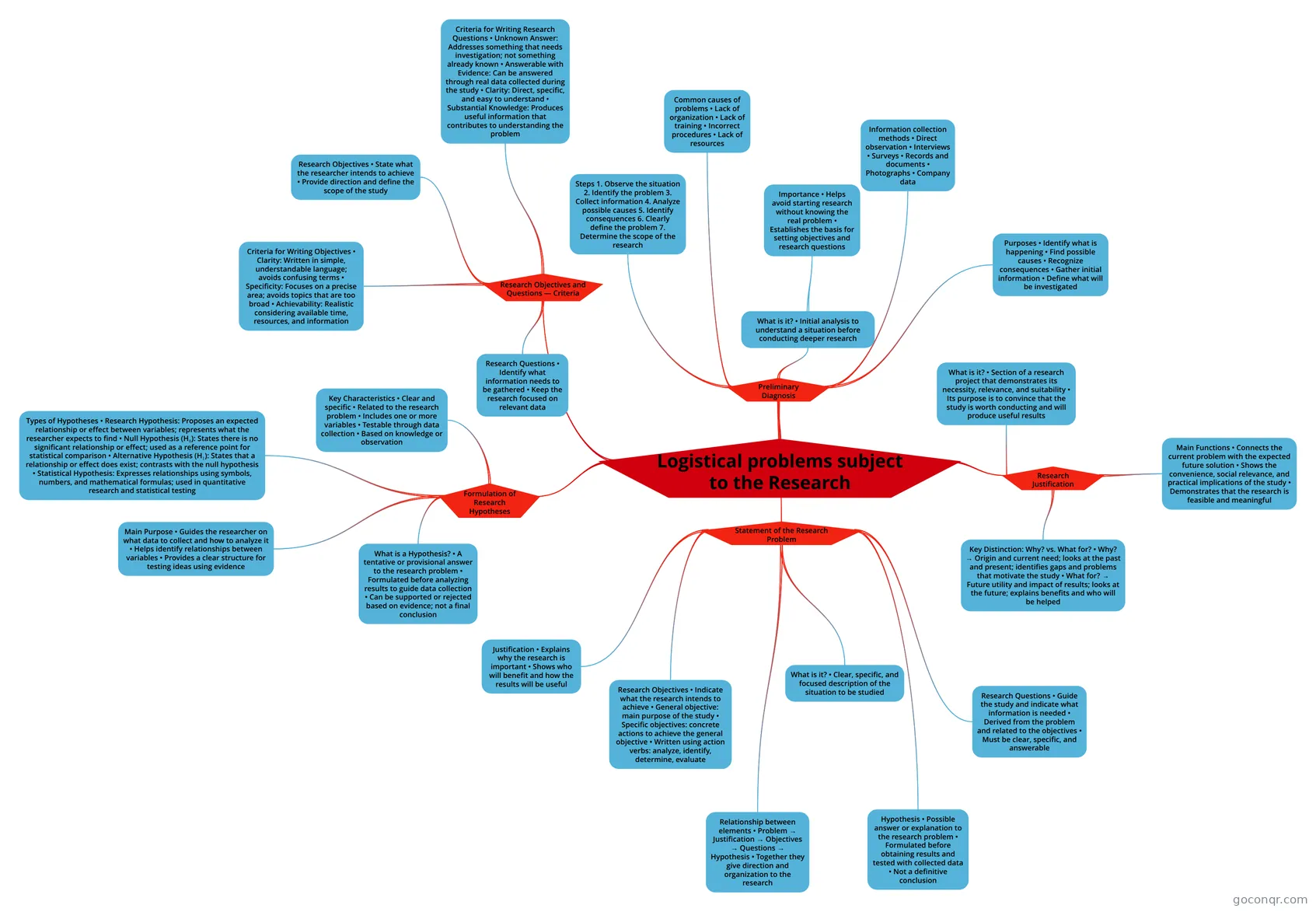
Mind map: Logistical problems subject to the research
Map content
Logistical problems subject to the Research
Preliminary Diagnosis
- Statement of the Research Problem
- What is it? • Clear, specific, and focused description of the situation to be studied
- Justification • Explains why the research is important • Shows who will benefit and how the results will be useful
- Research Objectives • Indicate what the research intends to achieve • General objective: main purpose of the study • Specific objectives: concrete actions to achieve the general objective • Written using action verbs: analyze, identify, determine, evaluate
- Research Questions • Guide the study and indicate what information is needed • Derived from the problem and related to the objectives • Must be clear, specific, and answerable
- Hypothesis • Possible answer or explanation to the research problem • Formulated before obtaining results and tested with collected data • Not a definitive conclusion
- Relationship between elements • Problem → Justification → Objectives → Questions → Hypothesis • Together they give direction and organization to the research
- What is it? • Initial analysis to understand a situation before conducting deeper research
- Importance • Helps avoid starting research without knowing the real problem • Establishes the basis for setting objectives and research questions
- Purposes • Identify what is happening • Find possible causes • Recognize consequences • Gather initial information • Define what will be investigated
- Steps 1. Observe the situation 2. Identify the problem 3. Collect information 4. Analyze possible causes 5. Identify consequences 6. Clearly define the problem 7. Determine the scope of the research
- Information collection methods • Direct observation • Interviews • Surveys • Records and documents • Photographs • Company data
- Common causes of problems • Lack of organization • Lack of training • Incorrect procedures • Lack of resources
- Statement of the Research Problem
Research Justification
- What is it? • Section of a research project that demonstrates its necessity, relevance, and suitability • Its purpose is to convince that the study is worth conducting and will produce useful results
- Key Distinction: Why? vs. What for? • Why? → Origin and current need; looks at the past and present; identifies gaps and problems that motivate the study • What for? → Future utility and impact of results; looks at the future; explains benefits and who will be helped
- Main Functions • Connects the current problem with the expected future solution • Shows the convenience, social relevance, and practical implications of the study • Demonstrates that the research is feasible and meaningful
Formulation of Research Hypotheses
- What is a Hypothesis? • A tentative or provisional answer to the research problem • Formulated before analyzing results to guide data collection • Can be supported or rejected based on evidence; not a final conclusion
- Key Characteristics • Clear and specific • Related to the research problem • Includes one or more variables • Testable through data collection • Based on knowledge or observation
- Types of Hypotheses • Research Hypothesis: Proposes an expected relationship or effect between variables; represents what the researcher expects to find • Null Hypothesis (H₀): States there is no significant relationship or effect; used as a reference point for statistical comparison • Alternative Hypothesis (H₁): States that a relationship or effect does exist; contrasts with the null hypothesis • Statistical Hypothesis: Expresses relationships using symbols, numbers, and mathematical formulas; used in quantitative research and statistical testing
- Main Purpose • Guides the researcher on what data to collect and how to analyze it • Helps identify relationships between variables • Provides a clear structure for testing ideas using evidence
Research Objectives and Questions — Criteria
- Research Objectives • State what the researcher intends to achieve • Provide direction and define the scope of the study
- Criteria for Writing Objectives • Clarity: Written in simple, understandable language; avoids confusing terms • Specificity: Focuses on a precise area; avoids topics that are too broad • Achievability: Realistic considering available time, resources, and information
- Research Questions • Identify what information needs to be gathered • Keep the research focused on relevant data
- Criteria for Writing Research Questions • Unknown Answer: Addresses something that needs investigation; not something already known • Answerable with Evidence: Can be answered through real data collected during the study • Clarity: Direct, specific, and easy to understand • Substantial Knowledge: Produces useful information that contributes to understanding the problem
Information
- Description
- Mind Map on Logistical problems subject to the Research, created by Enrique Ibarra on 21/10/2026.
- Created by
- Enrique Ibarra
- Views
- 8
- History
-
- Created by Enrique Ibarra · Jul 2, 2024
- Copied by Enrique Ibarra · Oct 21, 2026
- Rating