
Mind map
Topic 2 - The Electromagnetic Spectrum
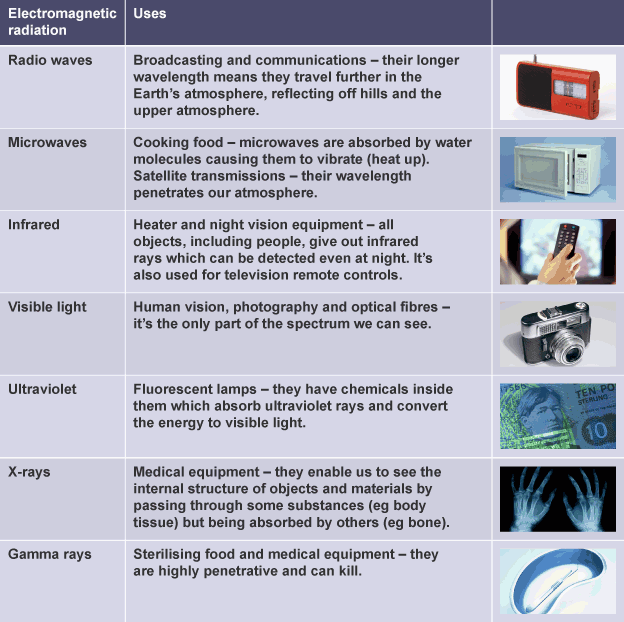
Map content
Topic 2 - The Electromagnetic Spectrum
Visible Light
- Using a prism, you can split up white light to form a spectrum. (A prism is a block of glass with a triangular cross-section.) The light waves are refracted as they enter and leave the prism. The shorter the wavelength of the light, the more it is refracted. As a result, red light is refracted the least and violet light is refracted the most, causing the coloured light to spread out to form a spectrum.
- Visible light is just one type of electromagnetic radiation: there are various types of electromagnetic radiation with longer wavelengths of light than red light and with shorter wavelengths than violet light. All the different types of electromagnetic waves travel at the same speed through space.
Infrared Radiation
- Discovery: William Herschel put coloured filters over his telescope in order to make his observations safer. Noticed different coloured filters heated up his telescope by different amounts. Using a prism to break up visible light he put a thermometer in the different colours. Found temperature rose as he moved the thermometer from violet to red. Measured the temperature where there was no visible light, at the red end of the spectrum. The temperature was the highest: he had discovered infrared.
- Danger - skin burns
Ultraviolet Radiation
- Discovery: Following Herschel’s work, Johann Ritter tried to find invisible rays at the violet end of the spectrum. Used silver chloride, which turns black when exposed to light. Happened fastest when exposed to the invisible rays at the violet end of the spectrum.
- Dangers - damage to surface cells and eyes, leading to skin cancer and eye conditions, ionising
Radio Waves
- Microwaves
- Infrared
- Visible Light
- Ultraviolet
- X-Rays
- Gamma rays
- All types of electromagnetic radiation are transverse waves and they all travel at the same speed in a vacuum.
- 299,792,458 m/s
- 3x10^8m/s
- Nearly nine hundred thousand times faster than sound, which is why you see a flash of lightning before you hear the thunder.
- 3x10^8m/s
- 299,792,458 m/s
- All types of electromagnetic radiation are transverse waves and they all travel at the same speed in a vacuum.
- Gamma rays
- X-Rays
- Wavelength decreases from radio waves to gamma rays.
- Ultraviolet
- Frequency Increases from radio waves to gamma rays.
- As frequency increases, danger of wave increases, radio least dangerous, gamma most dangerous
- Visible Light
- Infrared
- Microwaves
Microwaves
- Dangers - Internal heating of body cells, microwaves target water, can heat water in our body.
X-rays
- Dangers - Ionising, mutation or damage to cells in the body
Gamma Radiation
- Dangers - Ionising, mutation or damage to cells in the body, more dangerous than x-rays.
·
- Ionising radiation includes alpha and beta particles and gamma rays and they transfer energy.
Images and files in the map
Information
- Description
- GCSE Physics (P1) Mind Map on Topic 2 - The Electromagnetic Spectrum, created by Matt Cooper on 15/12/2015.
- Created by
- Matt Cooper
- Views
- 0
- Rating