
Mind map
Education Policy and Inequality
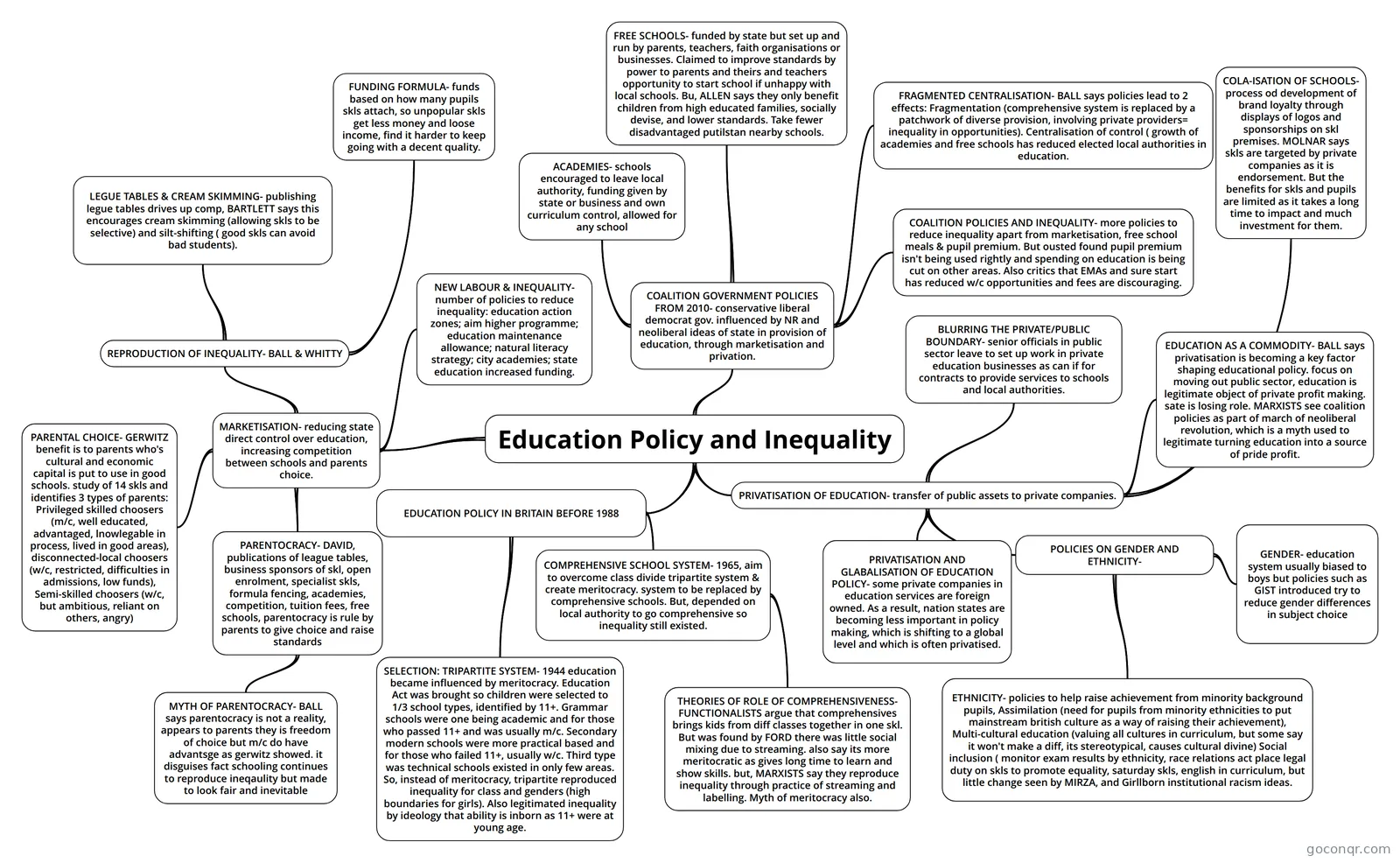
Mind map: education policy and inequality
Map content
Education Policy and Inequality
EDUCATION POLICY IN BRITAIN BEFORE 1988
- SELECTION: TRIPARTITE SYSTEM- 1944 education became influenced by meritocracy. Education Act was brought so children were selected to 1/3 school types, identified by 11+. Grammar schools were one being academic and for those who passed 11+ and was usually m/c. Secondary modern schools were more practical based and for those who failed 11+, usually w/c. Third type was technical schools existed in only few areas. So, instead of meritocracy, tripartite reproduced inequality for class and genders (high boundaries for girls). Also legitimated inequality by ideology that ability is inborn as 11+ were at young age.
- COMPREHENSIVE SCHOOL SYSTEM- 1965, aim to overcome class divide tripartite system & create meritocracy. system to be replaced by comprehensive schools. But, depended on local authority to go comprehensive so inequality still existed.
- THEORIES OF ROLE OF COMPREHENSIVENESS- FUNCTIONALISTS argue that comprehensives brings kids from diff classes together in one skl. But was found by FORD there was little social mixing due to streaming. also say its more meritocratic as gives long time to learn and show skills. but, MARXISTS say they reproduce inequality through practice of streaming and labelling. Myth of meritocracy also.
MARKETISATION- reducing state direct control over education, increasing competition between schools and parents choice.
- PARENTOCRACY- DAVID, publications of league tables, business sponsors of skl, open enrolment, specialist skls, formula fencing, academies, competition, tuition fees, free schools, parentocracy is rule by parents to give choice and raise standards
- MYTH OF PARENTOCRACY- BALL says parentocracy is not a reality, appears to parents they is freedom of choice but m/c do have advantsge as gerwitz showed. it disguises fact schooling continues to reproduce ineqaulity but made to look fair and inevitable
- REPRODUCTION OF INEQUALITY- BALL & WHITTY
- LEGUE TABLES & CREAM SKIMMING- publishing legue tables drives up comp, BARTLETT says this encourages cream skimming (allowing skls to be selective) and silt-shifting ( good skls can avoid bad students).
- FUNDING FORMULA- funds based on how many pupils skls attach, so unpopular skls get less money and loose income, find it harder to keep going with a decent quality.
- PARENTAL CHOICE- GERWITZ benefit is to parents who's cultural and economic capital is put to use in good schools. study of 14 skls and identifies 3 types of parents: Privileged skilled choosers (m/c, well educated, advantaged, lnowlegable in process, lived in good areas), disconnected-local choosers (w/c, restricted, difficulties in admissions, low funds), Semi-skilled choosers (w/c, but ambitious, reliant on others, angry)
- NEW LABOUR & INEQUALITY- number of policies to reduce inequality: education action zones; aim higher programme; education maintenance allowance; natural literacy strategy; city academies; state education increased funding.
- PARENTOCRACY- DAVID, publications of league tables, business sponsors of skl, open enrolment, specialist skls, formula fencing, academies, competition, tuition fees, free schools, parentocracy is rule by parents to give choice and raise standards
COALITION GOVERNMENT POLICIES FROM 2010- conservative liberal democrat gov. influenced by NR and neoliberal ideas of state in provision of education, through marketisation and privation.
- ACADEMIES- schools encouraged to leave local authority, funding given by state or business and own curriculum control, allowed for any school
- FREE SCHOOLS- funded by state but set up and run by parents, teachers, faith organisations or businesses. Claimed to improve standards by power to parents and theirs and teachers opportunity to start school if unhappy with local schools. Bu, ALLEN says they only benefit children from high educated families, socially devise, and lower standards. Take fewer disadvantaged putilstan nearby schools.
- FRAGMENTED CENTRALISATION- BALL says policies lead to 2 effects: Fragmentation (comprehensive system is replaced by a patchwork of diverse provision, involving private providers= inequality in opportunities). Centralisation of control ( growth of academies and free schools has reduced elected local authorities in education.
- COALITION POLICIES AND INEQUALITY- more policies to reduce inequality apart from marketisation, free school meals & pupil premium. But ousted found pupil premium isn't being used rightly and spending on education is being cut on other areas. Also critics that EMAs and sure start has reduced w/c opportunities and fees are discouraging.
PRIVATISATION OF EDUCATION- transfer of public assets to private companies.
- BLURRING THE PRIVATE/PUBLIC BOUNDARY- senior officials in public sector leave to set up work in private education businesses as can if for contracts to provide services to schools and local authorities.
- PRIVATISATION AND GLABALISATION OF EDUCATION POLICY- some private companies in education services are foreign owned. As a result, nation states are becoming less important in policy making, which is shifting to a global level and which is often privatised.
- COLA-ISATION OF SCHOOLS- process od development of brand loyalty through displays of logos and sponsorships on skl premises. MOLNAR says skls are targeted by private companies as it is endorsement. But the benefits for skls and pupils are limited as it takes a long time to impact and much investment for them.
- EDUCATION AS A COMMODITY- BALL says privatisation is becoming a key factor shaping educational policy. focus on moving out public sector, education is legitimate object of private profit making. sate is losing role. MARXISTS see coalition policies as part of march of neoliberal revolution, which is a myth used to legitimate turning education into a source of pride profit.
- POLICIES ON GENDER AND ETHNICITY-
- GENDER- education system usually biased to boys but policies such as GIST introduced try to reduce gender differences in subject choice
- ETHNICITY- policies to help raise achievement from minority background pupils, Assimilation (need for pupils from minority ethnicities to put mainstream british culture as a way of raising their achievement), Multi-cultural education (valuing all cultures in curriculum, but some say it won't make a diff, its stereotypical, causes cultural divine) Social inclusion ( monitor exam results by ethnicity, race relations act place legal duty on skls to promote equality, saturday skls, english in curriculum, but little change seen by MIRZA, and Girllborn institutional racism ideas.
Information
- Description
- A-Level Mujeres Mind Map on Education Policy and Inequality, created by pri9494 on 01/04/2016.
- Created by
- pri9494
- Views
- 16
- Rating
More on Education policy and inequality