
Sociology of Education and Education Policy
297 resources created by 186 users
This Sociology of Education and Education Policy page on GoConqr gathers community-made mind maps, flashcards, quizzes and notes, from the roles of education and functionalism to class, gender and ethnic differences in achievement and marketisation policies. It's built for school students revising for A-level or GCSE Sociology, and for teachers after ready-made material. There are over 2,400 resources here, including more than 70 quizzes and over 1,500 mind maps. Pick a topic, try a quiz to spot your gaps, then make your own revision sets.
Top Sociology of Education and Education Policy resources
-
106 cardsFlashcards on Ethnic Differences in Achievement (2.3) How do Tony Lawson and Joan Garrod define ethnic groups?
-
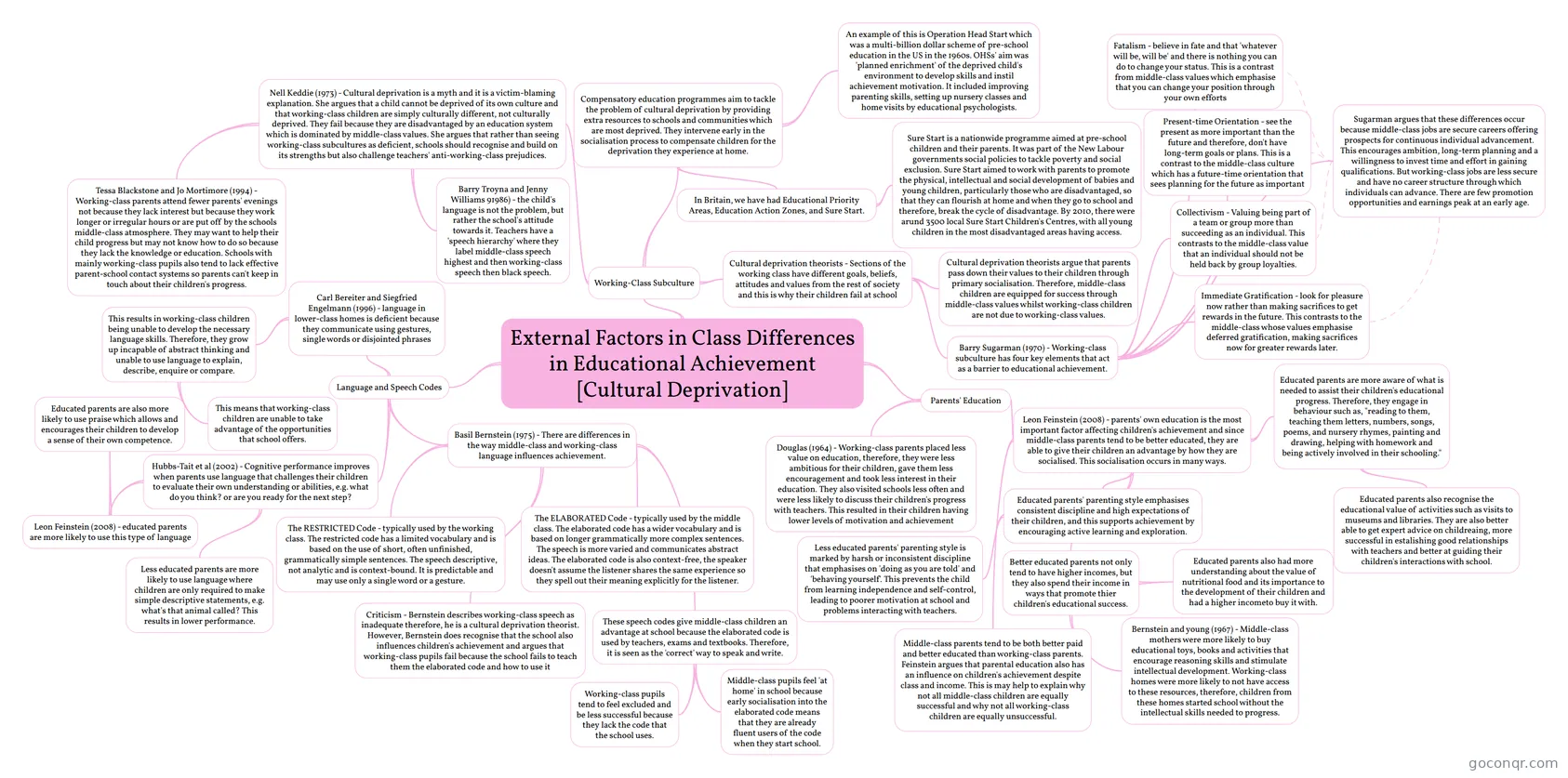 Mind map External Factors in Class Differences in Educational Achievement [Cultural Deprivation]
-
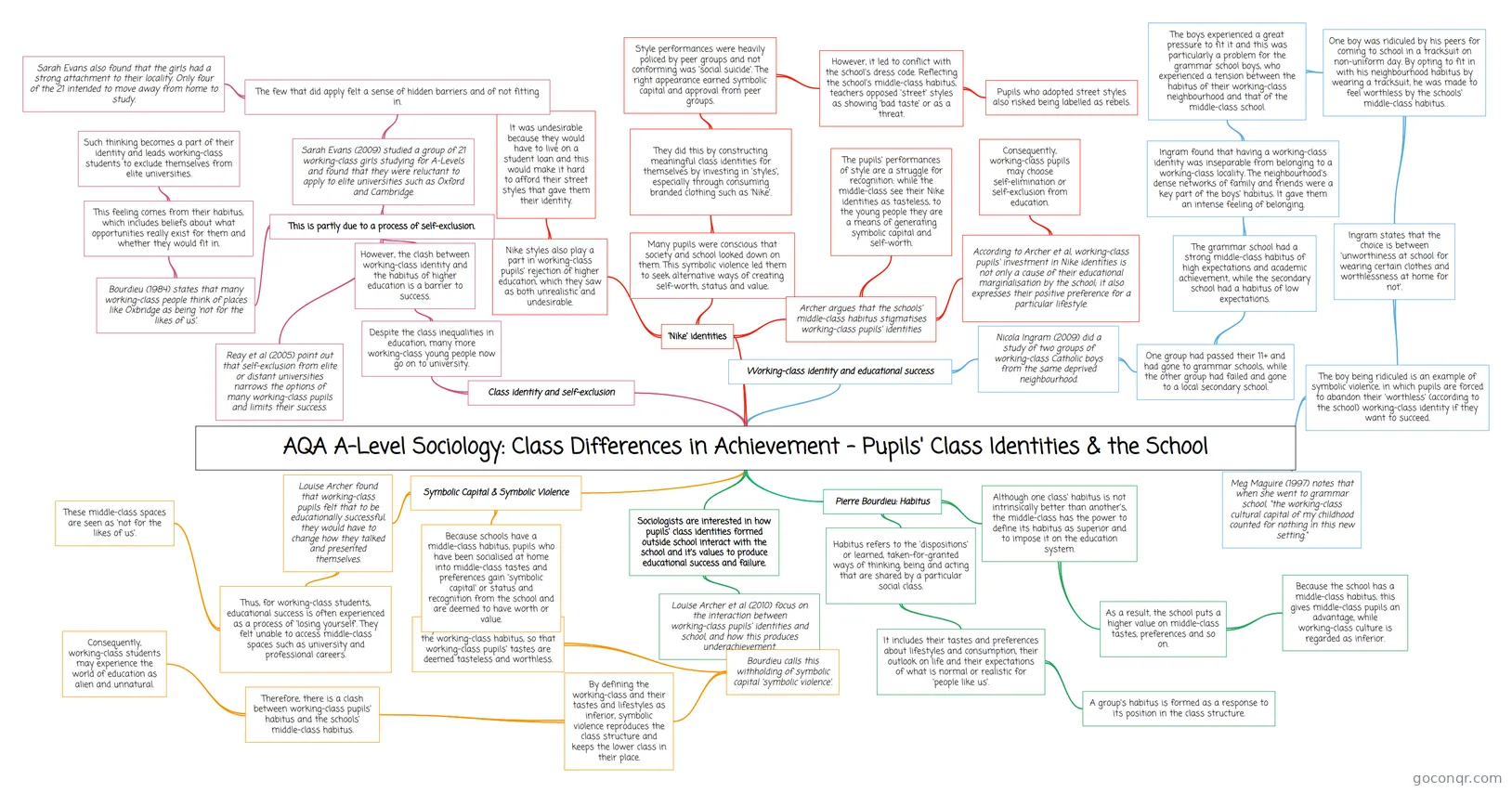 Mind map AQA A-Level Sociology: Class Differences in Achievement - Pupils' Class Identities & the School All credit goes to the 'AQA A Level Sociology Book One [Including AS Level]'. Any opinions expressed are th...
-
 Mind map Roles of Education AS Sociology mind map on the roles of education for the Unit 2 Exam
-
67 cardsFlashcards on Educational Policy and Inequality (2.6) Before the industrial revolution, state schools did not exist. Education was only available to a minority o...
-
39 questionsSCLY2 - Topic 3 - Ethnicity and Education (AQA AS Sociology)
-
45 questionsSCLY 2 - Education - Topic 1 - Class (AQA AS sociology)
-
18 questionsSociology GCSE - Education quiz What are the 5 education roles that schools need to fulfill in order for students to get the best education?
Quizzes
See all 16 quizzes-
39 questionsSCLY2 - Topic 3 - Ethnicity and Education (AQA AS Sociology)
-
45 questionsSCLY 2 - Education - Topic 1 - Class (AQA AS sociology)
-
18 questionsSociology GCSE - Education quiz What are the 5 education roles that schools need to fulfill in order for students to get the best education?
-
11 questionsEthnic Differences in educational achievement According to Sewell(1998) - the sub culture ' Conformists ' are the isolated individuals who disconnected t...
-
10 questionsRoles of education. What is meritocracy?
-
6 questionsInternal and External Factors of Class Differences in Education Quiz Internal factors in differences in children's education are...
-
28 questionsSCLY2 - Topic 2 - Education - Class - Internal factors (AQA AS sociology)
-
21 questionsSCLY2 - Topic 4 - Gender (AQA AS Sociology)
Mind maps
See all 170 mind maps-
External Factors in Class Differences in Educational Achievement [Cultural Deprivation]
-
AQA A-Level Sociology: Class Differences in Achievement - Pupils' Class Identities & the School All credit goes to the 'AQA A Level Sociology Book One [Including AS Level]'. Any opinions expressed are th...
-
Roles of Education AS Sociology mind map on the roles of education for the Unit 2 Exam
-
GENDER DIFFERENCES IN ACHIEVEMENT PART I
-
AQA A-Level Sociology: Gender Differences in Education - Internal Factors All credit goes to the 'AQA A Level Sociology Book One [Including AS Level]'. Any opinions expressed are th...
-
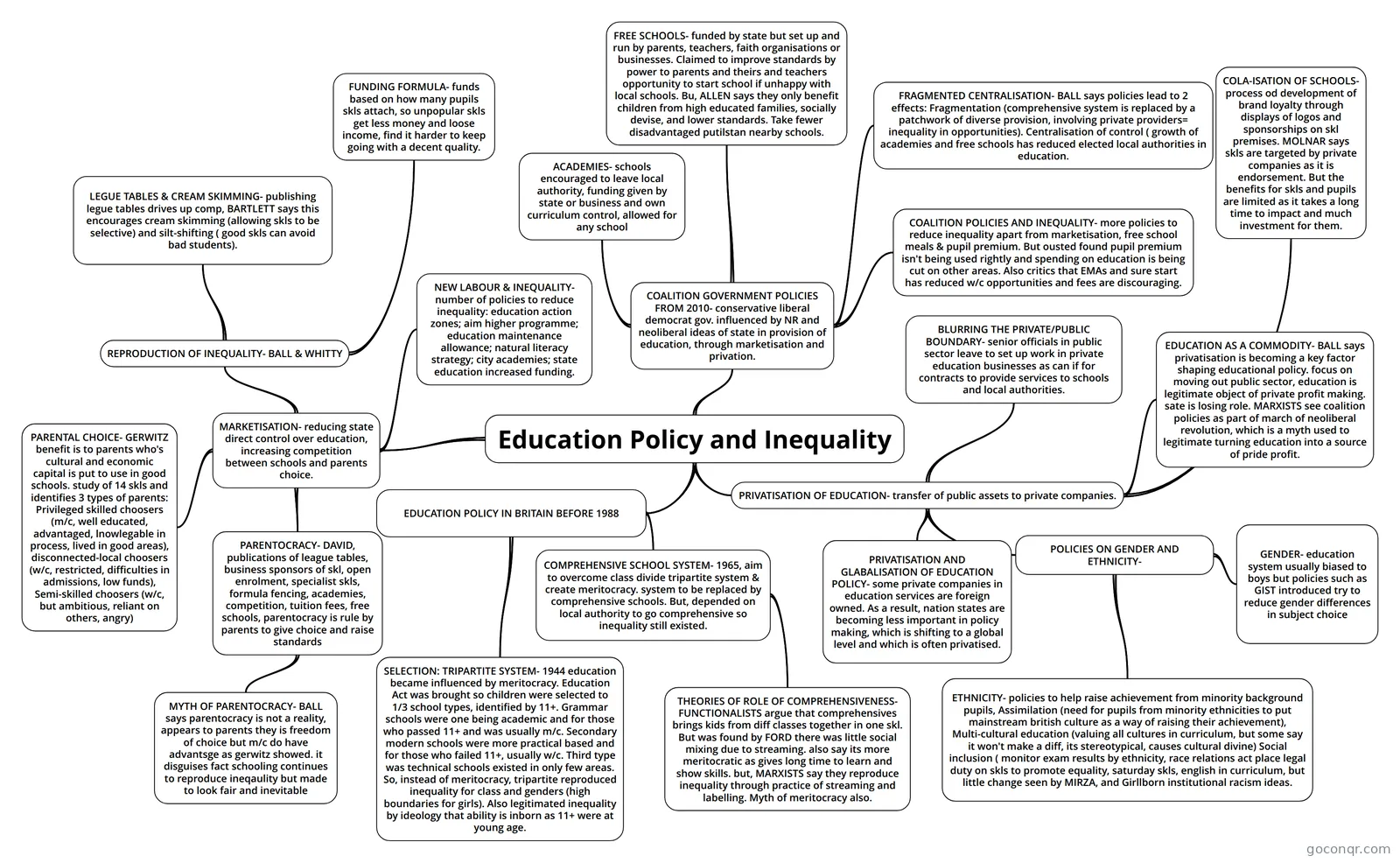 Education Policy and Inequality
-
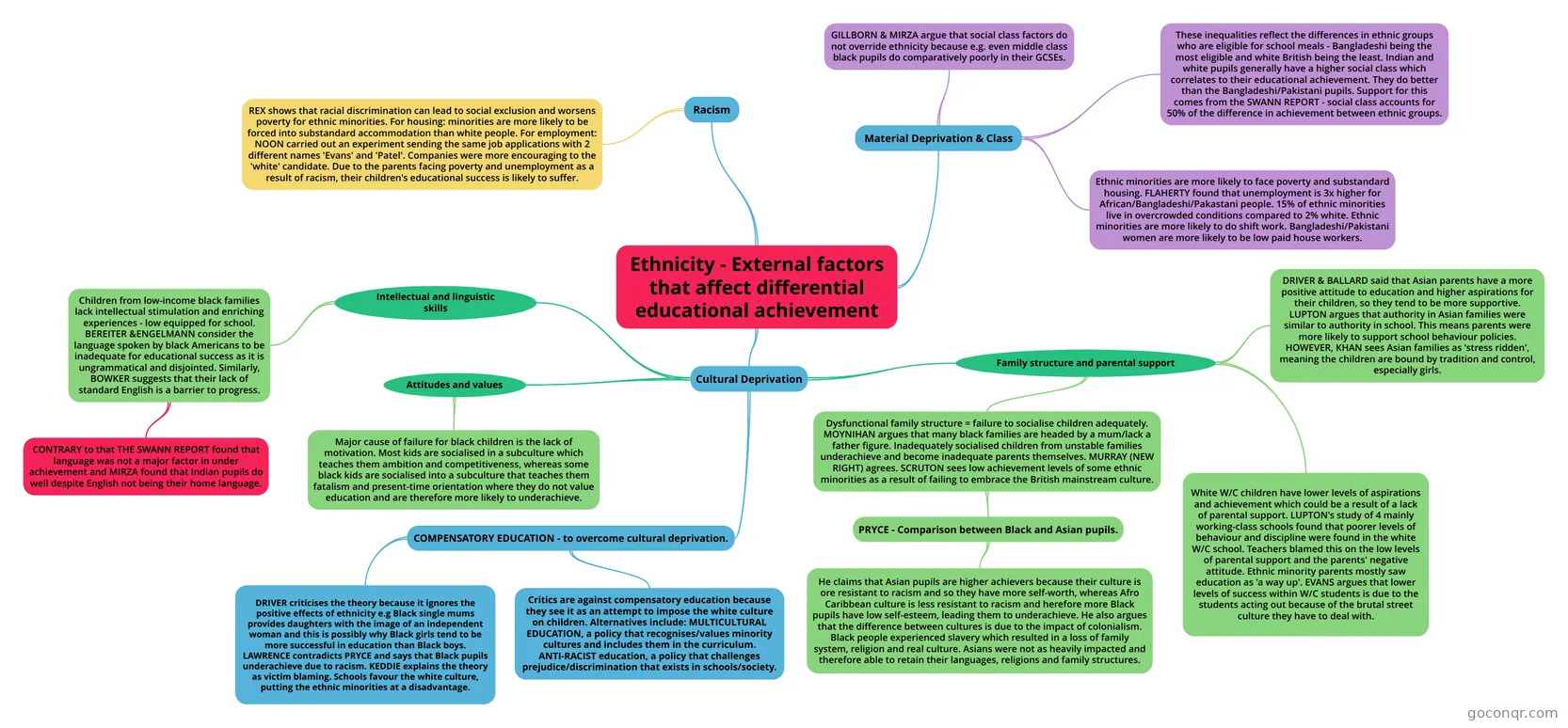 Ethnicity - External factors that affect differential educational achievement
-
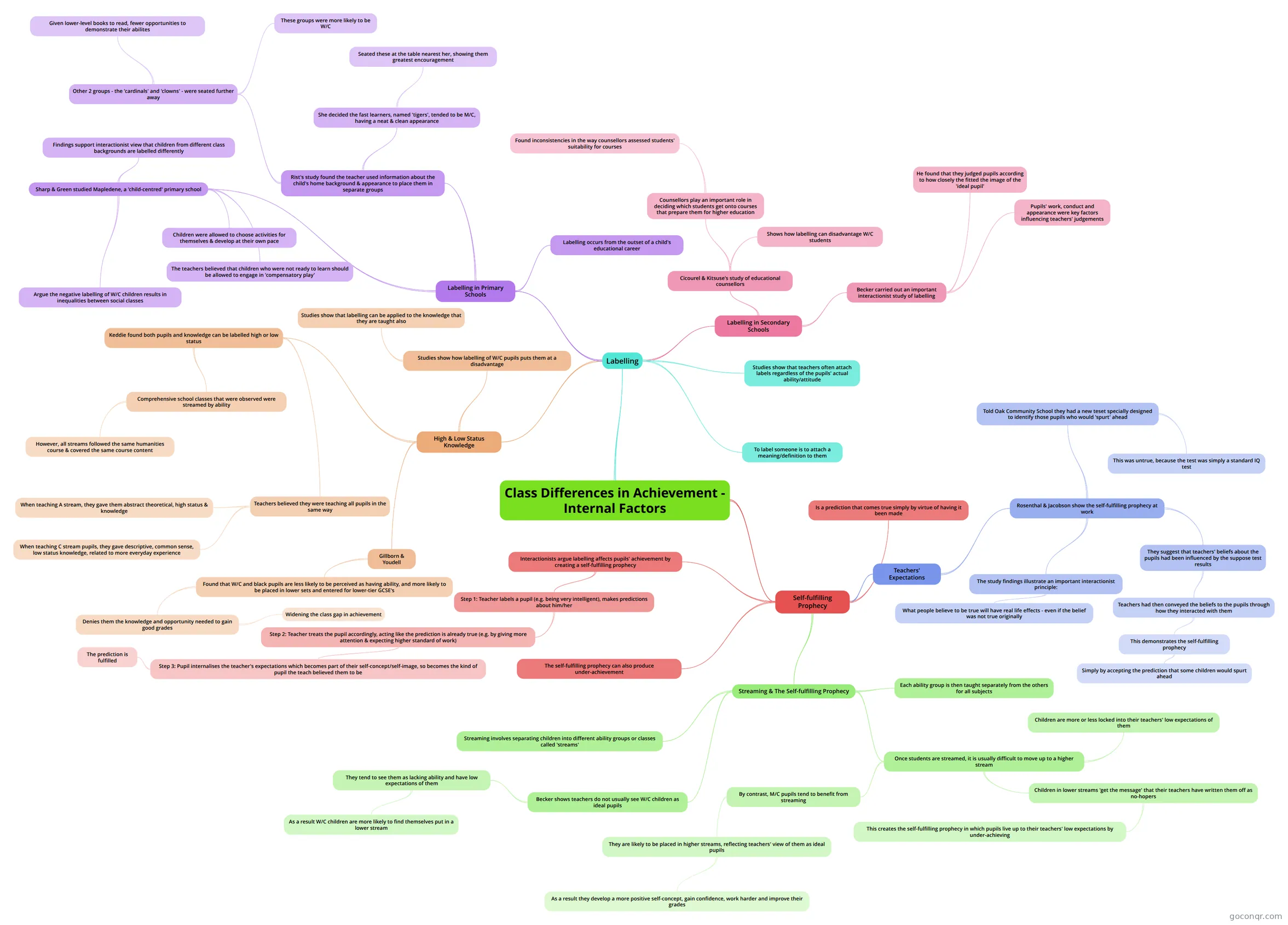 Class Differences in Achievement - Internal Factors
Flashcards
See all 99 flashcards-
106 cardsFlashcards on Ethnic Differences in Achievement (2.3) How do Tony Lawson and Joan Garrod define ethnic groups?
-
67 cardsFlashcards on Educational Policy and Inequality (2.6) Before the industrial revolution, state schools did not exist. Education was only available to a minority o...
-
30 cardsCultural expectations of social calls difference in educational achievement Cultural expectations of social class difference in educational achievement
-
24 cardsEthnicity (external) - cultural deprivation Why do ethnic minorities underachieve?
-
10 cardsEducation Policies Education Reform Act 1988 - Marketisation Of Education
-
21 cardsFUNCTIONALIST ROLE OF EDUCATION What are the two basic functions education performs according to Durkheim? (FUNCTIONALIST)
-
13 cardsSociology GCSE AQA Education - Flash Cards Sociology GCSE AQA Education Flip card for table of contents.
-
9 cardsTopic 5 What were the two main functions of education identified by the founder of functionalism, Durkheim?
Notes
-
EVIDENCE Gender and Education: Sue Sharpe said that girls were increasingly wary of marriage. They had seen adult relationships break up all around them. They had also seen women coping alone in what once was a "man'...
-
Gender Differences in Achievement The gender gap in educational achievement is narrowing: Girls do better in coursework tasks, whilst boys generally do better in exam conditions. The abolition of coursework-based assessment meant that girls' achieveme...
-
Education SOCIAL CLASS AND EDUCATION Statistics on education show us that students from poorer backgrounds statistically achieve significantly worse in school than students from richer backgrounds.The best way of predicting edu...
-
External Class Differences in Education and Achievement Key words and theorists Theorists: Douglas Feinstein Bernstein Bernstein and Young Bourdieu Lawton Reay Tizard Plummer Sugarman Leech and Campos Key words: collectivism - belief that the interests of the group are mor...
-
Sociology - Education Functionlism Equal chance to succeed in education system welleducated workforce lead economic growth. Skill Provision Education teaches people the skills that are needed in a include basic skills like numeracy + liter...
-
Education Key Words Education AcademiesAnti- school subcultureCitizenship Comprehensive school systemCultural capitalDe-schoolingFormal curriculumEthnocentric curriculumFree schoolsFurther/ higher educationHidden curriculum Home schoolin...
-
Labelling process and its effects on social class,gender and ethnic differences in education Labelling: To label someone is to attach a meaning or definition to them. e.g. A teacher may label a pupil as either clever or thick How labelling effects pupils in general: Rebelling, having a teacher give up on...
-
Gender differences in education Gender gap in achievement In 2013, teacher assessments had shown that at the end of one year, girls were ahead of boys by between 7 and 17 percentage points in all seven areas of learning assessed. At key stages 1 to ...
Slides
More Sociology topics
About Sociology of Education and Education Policy
GoConqr OriginalWhat this unit covers
The resources follow the usual shape of an education topic. The Roles of Education mind map sets out the functionalist view that schools meet the needs of the economy through socialisation, selection and skills. Other maps cover the Marxist and New Right perspectives, so you can compare theories side by side.
Achievement and inequality
A large share of the page looks at differences in achievement. For social class, there are maps on external factors such as cultural deprivation, language and speech codes, and on internal factors such as pupils' class identities and the school, drawing on Louise Archer et al (2010). For gender, there are maps on internal and external factors and on femininity and masculinity. For ethnicity, you will find maps, notes, flashcards and quizzes on both sets of factors.
Policy
Policy is covered by Marketisation and selection policies, Education Policy and Inequality, Diversity and Choice and a flashcard timeline of education policies. The notes on the main phases of educational policy in Britain give a quick overview.
Where to start
- Begin with the key terms flashcards, which define functionalism, hidden curriculum, meritocracy, labelling and more.
- Read the Roles of Education map, then the Functionalist and Marxist maps.
- Work through class, gender and ethnicity in turn, one map at a time.
- Finish with the policy maps and flashcards.
Using quizzes with maps
Read a map first, then take the matching quiz, such as the Sociology GCSE education quiz or the quiz on ethnic differences in educational achievement. Any question you miss tells you which branch of the map to revisit. Sociology sits in the Education strand of the wider subject, so these resources work well alongside other sociology topics.
Pick one theme today, try its quiz, and then build a map or flashcard set of your own.
Frequently asked questions
Which resource should I open first?
Start with the Roles of Education mind map, which introduces socialisation, selection and skills from a functionalist angle. Then try the Sociology: Education key terms flashcards to check the vocabulary. After that, move on to the class, gender and ethnicity maps, and finish with the policy resources.
What do the mind maps cover?
They cover the main perspectives on education, including functionalism, Marxism and the New Right. They also cover class, gender and ethnic differences in achievement, split into internal and external factors, plus pupil subcultures, teacher stereotyping, marketisation and education policy and inequality.
Are there quizzes for exam practice?
Yes. There are quizzes such as the Sociology GCSE education quiz, the roles of education quiz and quizzes on class and on ethnicity and education labelled for AQA AS Sociology. Use them after reading a map to find the areas you need to revisit.
Which exams do these resources suit?
The listed resources mention A-level Sociology, AQA AS Sociology, AQA Sociology and GCSE Sociology. Most are written for school students at those levels, so they suit revision and teachers looking for ready-made material. Check the exact wording of your own specification as well.
Are the resources free, and who made them?
Every resource here is free to open, study and take, with no account needed. They were made by GoConqr users, not by GoConqr itself. A free account also saves your quiz scores and lets you create your own quizzes, mind maps, flashcards and notes.
What if I can't find a topic I need?
Browse the flashcard decks and notes, since many are named by topic number or general headings like Education Key Terms and may cover what you need. You can also make your own set on the missing topic and keep it for revision.