
Mind map
Wilson and the Labour Govs
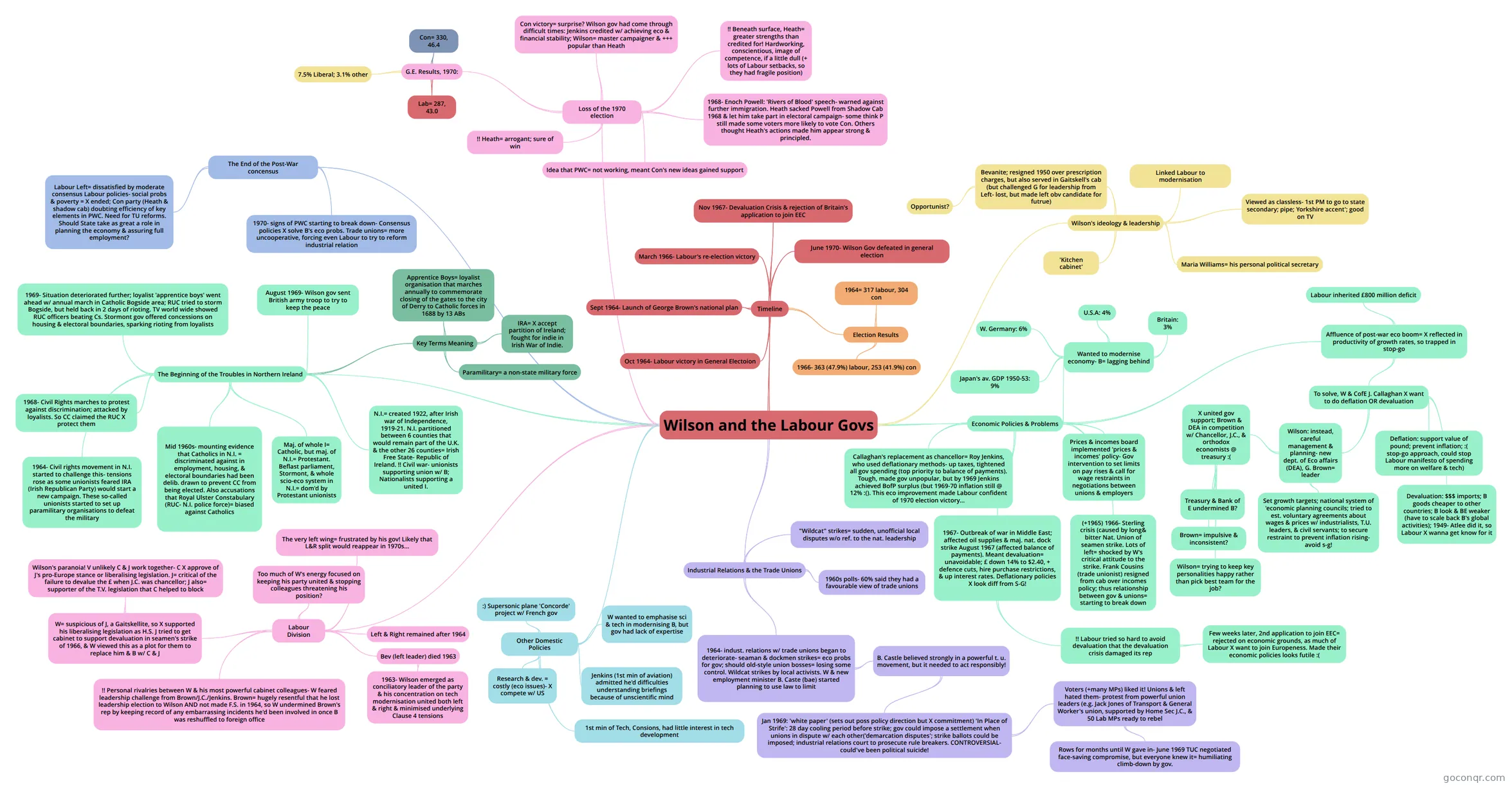
Mind map: Wilson and the Labour Government
Map content
Wilson and the Labour Govs
Timeline
- Oct 1964- Labour victory in General Electoion
- Sept 1964- Launch of George Brown's national plan
- March 1966- Labour's re-election victory
- Nov 1967- Devaluation Crisis & rejection of Britain's application to join EEC
- June 1970- Wilson Gov defeated in general election
- Election Results
- 1964= 317 labour, 304 con
- 1966- 363 (47.9%) labour, 253 (41.9%) con
Wilson's ideology & leadership
- Bevanite; resigned 1950 over prescription charges, but also served in Gaitskell's cab (but challenged G for leadership from Left- lost, but made left obv candidate for futrue)
- Opportunist?
- Linked Labour to modernisation
- Viewed as classless- 1st PM to go to state secondary; pipe; Yorkshire accent'; good on TV
- Maria Williams= his personal political secretary
- 'Kitchen cabinet'
- Bevanite; resigned 1950 over prescription charges, but also served in Gaitskell's cab (but challenged G for leadership from Left- lost, but made left obv candidate for futrue)
Economic Policies & Problems
- Wanted to modernise economy- B= lagging behind
- Japan's av. GDP 1950-53: 9%
- W. Germany: 6%
- U.S.A: 4%
- Britain: 3%
- Affluence of post-war eco boom= X reflected in productivity of growth rates, so trapped in stop-go
- Labour inherited £800 million deficit
- To solve, W & CofE J. Callaghan X want to do deflation OR devaluation
- Deflation: support value of pound; prevent inflation; :( stop-go approach, could stop Labour manifesto of spending more on welfare & tech)
- Devaluation: $$$ imports; B goods cheaper to other countries; B look & BE weaker (have to scale back B's global activities); 1949- Atlee did it, so Labour X wanna get know for it
- Wilson: instead, careful management & planning- new dept. of Eco affairs (DEA), G. Brown= leader
- Set growth targets; national system of 'economic planning councils; tried to est. voluntary agreements about wages & prices w/ industrialists, T.U. leaders, & civil servants; to secure restraint to prevent inflation rising- avoid s-g!
- X united gov support; Brown & DEA in competition w/ Chancellor, J.C., & orthodox economists @ treasury :(
- Brown= impulsive & inconsistent?
- Treasury & Bank of E undermined B?
- Wilson= trying to keep key personalities happy rather than pick best team for the job?
- Prices & incomes board implemented 'prices & incomes' policy- Gov intervention to set limits on pay rises & call for wage restraints in negotiations between unions & employers
- (+1965) 1966- Sterling crisis (caused by long& bitter Nat. Union of seamen strike. Lots of left= shocked by W's critical attitude to the strike. Frank Cousins (trade unionist) resigned from cab over incomes policy; thus relationship between gov & unions= starting to break down
- 1967- Outbreak of war in Middle East; affected oil supplies & maj. nat. dock strike August 1967 (affected balance of payments). Meant devaluation= unavoidable; £ down 14% to $2.40, + defence cuts, hire purchase restrictions, & up interest rates. Deflationary policies X look diff from S-G!
- !! Labour tried so hard to avoid devaluation that the devaluation crisis damaged its rep
- Few weeks later, 2nd application to join EEC= rejected on economic grounds, as much of Labour X want to join Europeness. Made their economic policies looks futile :(
- !! Labour tried so hard to avoid devaluation that the devaluation crisis damaged its rep
- Callaghan's replacement as chancellor= Roy Jenkins, who used deflationary methods- up taxes, tightened all gov spending (top priority to balance of payments). Tough, made gov unpopular, but by 1969 Jenkins achieved BofP surplus (but 1969-70 inflation still @ 12% :(). This eco improvement made Labour confident of 1970 election victory...
- Wanted to modernise economy- B= lagging behind
Industrial Relations & the Trade Unions
- "Wildcat" strikes= sudden, unofficial local disputes w/o ref. to the nat. leadership
- 1960s polls- 60% said they had a favourable view of trade unions
- 1964- indust. relations w/ trade unions began to deteriorate- seaman & dockmen strikes= eco probs for gov; should old-style union bosses= losing some control. Wildcat strikes by local activists. W & new employment minister B. Caste (bae) started planning to use law to limit
- B. Castle believed strongly in a powerful t. u. movement, but it needed to act responsibly!
- Jan 1969: 'white paper' (sets out poss policy direction but X commitment) 'In Place of Strife': 28 day cooling period before strike; gov could impose a settlement when unions in dispute w/ each other('demarcation disputes'; strike ballots could be imposed; industrial relations court to prosecute rule breakers. CONTROVERSIAL- could've been political suicide!
- Voters (+many MPs) liked it! Unions & left hated them- protest from powerful union leaders (e.g. Jack Jones of Transport & General Worker's union, supported by Home Sec J.C., & 50 Lab MPs ready to rebel
- Rows for months until W gave in- June 1969 TUC negotiated face-saving compromise, but everyone knew it= humiliating climb-down by gov.
- Voters (+many MPs) liked it! Unions & left hated them- protest from powerful union leaders (e.g. Jack Jones of Transport & General Worker's union, supported by Home Sec J.C., & 50 Lab MPs ready to rebel
- Jan 1969: 'white paper' (sets out poss policy direction but X commitment) 'In Place of Strife': 28 day cooling period before strike; gov could impose a settlement when unions in dispute w/ each other('demarcation disputes'; strike ballots could be imposed; industrial relations court to prosecute rule breakers. CONTROVERSIAL- could've been political suicide!
- B. Castle believed strongly in a powerful t. u. movement, but it needed to act responsibly!
Other Domestic Policies
- W wanted to emphasise sci & tech in modernising B, but gov had lack of expertise
- Jenkins (1st min of aviation) admitted he'd difficulties understanding briefings because of unscientific mind
- 1st min of Tech, Consions, had little interest in tech development
- Research & dev. = costly (eco issues)- X compete w/ US
- :) Supersonic plane 'Concorde' project w/ French gov
Labour Division
- Left & Right remained after 1964
- Bev (left leader) died 1963
- 1963- Wilson emerged as conciliatory leader of the party & his concentration on tech modernisation united both left & right & minimised underlying Clause 4 tensions
- !! Personal rivalries between W & his most powerful cabinet colleagues- W feared leadership challenge from Brown/J.C./Jenkins. Brown= hugely resentful that he lost leadership election to Wilson AND not made F.S. in 1964, so W undermined Brown's rep by keeping record of any embarrassing incidents he'd been involved in once B was reshuffled to foreign office
- W= suspicious of J, a Gaitskellite, so X supported his liberalising legislation as H.S. J tried to get cabinet to support devaluation in seamen's strike of 1966, & W viewed this as a plot for them to replace him & B w/ C & J
- Wilson's paranoia! V unlikely C & J work together- C X approve of J's pro-Europe stance or liberalising legislation. J= critical of the failure to devalue the £ when J.C. was chancellor; J also= supporter of the T.V. legislation that C helped to block
- Too much of W's energy focused on keeping his party united & stopping colleagues threatening his position?
- The very left wing= frustrated by his gov! Likely that L&R split would reappear in 1970s...
The Beginning of the Troubles in Northern Ireland
- N.I.= created 1922, after Irish war of Independence, 1919-21. N.I. partitioned between 6 counties that would remain part of the U.K. & the other 26 counties= Irish Free State- Republic of Ireland. !! Civil war- unionists supporting union w/ B; Nationalists supporting a united I.
- Maj. of whole I= Catholic, but maj. of N.I.= Protestant. Beflast parliament, Stormont, & whole scio-eco system in N.I.= dom'd by Protestant unionists
- Mid 1960s- mounting evidence that Catholics in N.I. = discriminated against in employment, housing, & electoral boundaries had been delib. drawn to prevent CC from being elected. Also accusations that Royal Ulster Constabulary (RUC- N.I. police force)= biased against Catholics
- 1968- Civil Rights marches to protest against discrimination; attacked by loyalists. So CC claimed the RUC X protect them
- 1964- Civil rights movement in N.I. started to challenge this- tensions rose as some unionists feared IRA (Irish Republican Party) would start a new campaign. These so-called unionists started to set up paramilitary organisations to defeat the military
- 1969- Situation deteriorated further; loyalist 'apprentice boys' went ahead w/ annual march in Catholic Bogside area; RUC tried to storm Bogside, but held back in 2 days of rioting. TV world wide showed RUC officers beating Cs. Stormont gov offered concessions on housing & electoral boundaries, sparking rioting from loyalists
- August 1969- Wilson gov sent British army troop to try to keep the peace
- Key Terms Meaning
- IRA= X accept partition of Ireland; fought for indie in Irish War of Indie.
- Paramilitary= a non-state military force
- Apprentice Boys= loyalist organisation that marches annually to commemorate closing of the gates to the city of Derry to Catholic forces in 1688 by 13 ABs
The End of the Post-War concensus
- 1970- signs of PWC starting to break down- Consensus policies X solve B's eco probs. Trade unions= more uncooperative, forcing even Labour to try to reform industrial relation
- Labour Left= dissatisfied by moderate consensus Labour policies- social probs & poverty = X ended; Con party (Heath & shadow cab) doubting efficiency of key elements in PWC. Need for TU reforms. Should State take as great a role in planning the economy & assuring full employment?
Loss of the 1970 election
- Con victory= surprise? Wilson gov had come through difficult times: Jenkins credited w/ achieving eco & financial stability; Wilson= master campaigner & +++ popular than Heath
- !! Beneath surface, Heath= greater strengths than credited for! Hardworking, conscientious, image of competence, if a little dull (+ lots of Labour setbacks, so they had fragile position)
- 1968- Enoch Powell: 'Rivers of Blood' speech- warned against further immigration. Heath sacked Powell from Shadow Cab 1968 & let him take part in electoral campaign- some think P still made some voters more likely to vote Con. Others thought Heath's actions made him appear strong & principled.
- Idea that PWC= not working, meant Con's new ideas gained support
- !! Heath= arrogant; sure of win
- G.E. Results, 1970:
- Con= 330, 46.4
- Lab= 287, 43.0
- 7.5% Liberal; 3.1% other
Information
- Description
- - Making of Modern Britain Mind Map on Wilson and the Labour Govs, created by Miranda Daniel on 08/01/2016.
- Created by
- Miranda Daniel
- Views
- 1
- Rating