
Mind map
Chromatography (1)
Map content
Chromatography (1)
What are the different types of chromatography?
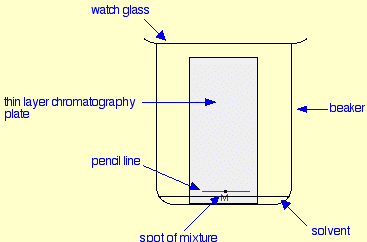
- Thin Layer Chromatography (TLC)
- Mobile Phase
- A suitable solvent which will dissolve the components of the mixture
- Stationary Phase
- Polar Silica Gel or alumina which has some sort of fluorescent dye
- Experimental Procedure
- A line drawn in pencil, is drawn at the bottom of the stationary phase. Then the mixture as a small dot on the line, using a micro pipette After this you place the stationary phase in the beaker in shallow level of the mobile phase. Allow mixtures to separate out until the top is reached (at least 80%)
- Calculating Rf Values
- Rf values of each separate component can be calculated. Rf= Distance moved by component/ distance moved by the solvent (mobile phase)
- Methods of showing the components
- Using a substance which becomes fluorescent in the UV
- Using ninhydrin for all amino acid. Usually to give brown or purple colours
- Using ferric acid for free phenol groups
- How does it work?
- The silica gel has -OH groups on its surface so is highly polar. The distance the component moves up the silica plate is determined by the attraction between the component and the mobile and stationary phase.
- Mobile Phase
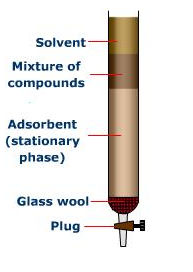
- Column Chromatography
- Stationary Phase
- Silica gel or alumina which is packed into a column
- Mobile Phase
- A suitable solvent which is placed at the top of the column above the liquid mixture
- Experimental Procedure
- Set up the apparatus as seen on the right. Then open the tap, collecting the solvent at the bottom using a beaker.The separated components can be collected. Ensure new mobile phase is constantly added to the top of the beaker
- How does it work?
- Again the silica gel or alumina are both polar. The more polar the component the more attracted it is to the stationary phase
- Stationary Phase
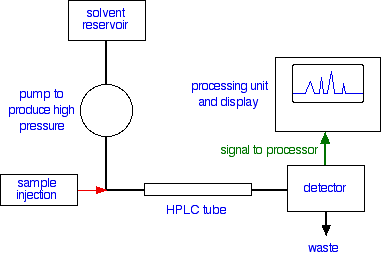
- High Performance Liquid Chromatography (HPLC)
- Forms of HPLC
- Normal Phase
- Solvent (moving phase) is non polar
- Stationary phase is polar silica particles packed into the column
- Reverse Phase
- Stationary Phase is non polar silica. Created by joining hydrocarbons to silica gel
- Solvent (moving phase) is polar
- Normal Phase
- How does it work?
- In normal phase polar components are attracted to the silica so they spend longer than non polar
- In reverse phase the stationary pase is non polar so non polar components take longer to leave the column that polar components
- Retention Time
- The time it takes for a component to travel through the column to the detector. Used to work out which compound has passed though the column
- It depends of the pressure, temperature, nature of the solvent and the mobile
- The time it takes for a component to travel through the column to the detector. Used to work out which compound has passed though the column
- Process
- Mixture dissolved in solvent injected into the column (sample injector) Then detected by the detector usually a UV detector
- You can also attach a mass spectrometer to workout the compounds present
- Mixture dissolved in solvent injected into the column (sample injector) Then detected by the detector usually a UV detector
- Forms of HPLC
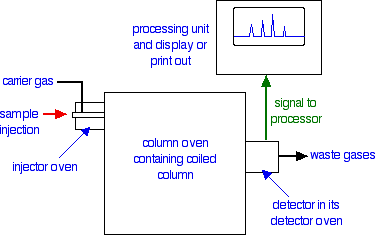
- Gas-Liquid Chromatography (GLC)
- Mobile Phase
- An inert carrier gas such as Helium
- Stationary Phase
- A high boiling liquid absorbed onto a solid in small stainless steel coiled column
- Process
- Small amounts of the sample you wish to seperate are injected into the machine and an oven causes the sample to be boiled and carried by the gas
- The more the component spends time with the gas the faster it moves through the column
- Small amounts of the sample you wish to seperate are injected into the machine and an oven causes the sample to be boiled and carried by the gas
- Retention Time
- Depends on the solubility to the liquid phase (higher solubility = slower RT), the boiling point of the components (higher BP= slower RT) and the temperature of the column (lower temperature = slower RT)
- Mobile Phase
- Thin Layer Chromatography (TLC)
Images and files in the map


Information
- Description
- Degree Pharmacy (PH1405 - Drug Molecules, Mechanisms and Analysis) Mind Map on Chromatography (1), created by Has Maj on 18/01/2016.
- Created by
- Has Maj
- Views
- 0
- Rating