
Mind map
IMBALANCES (Blood Gases)
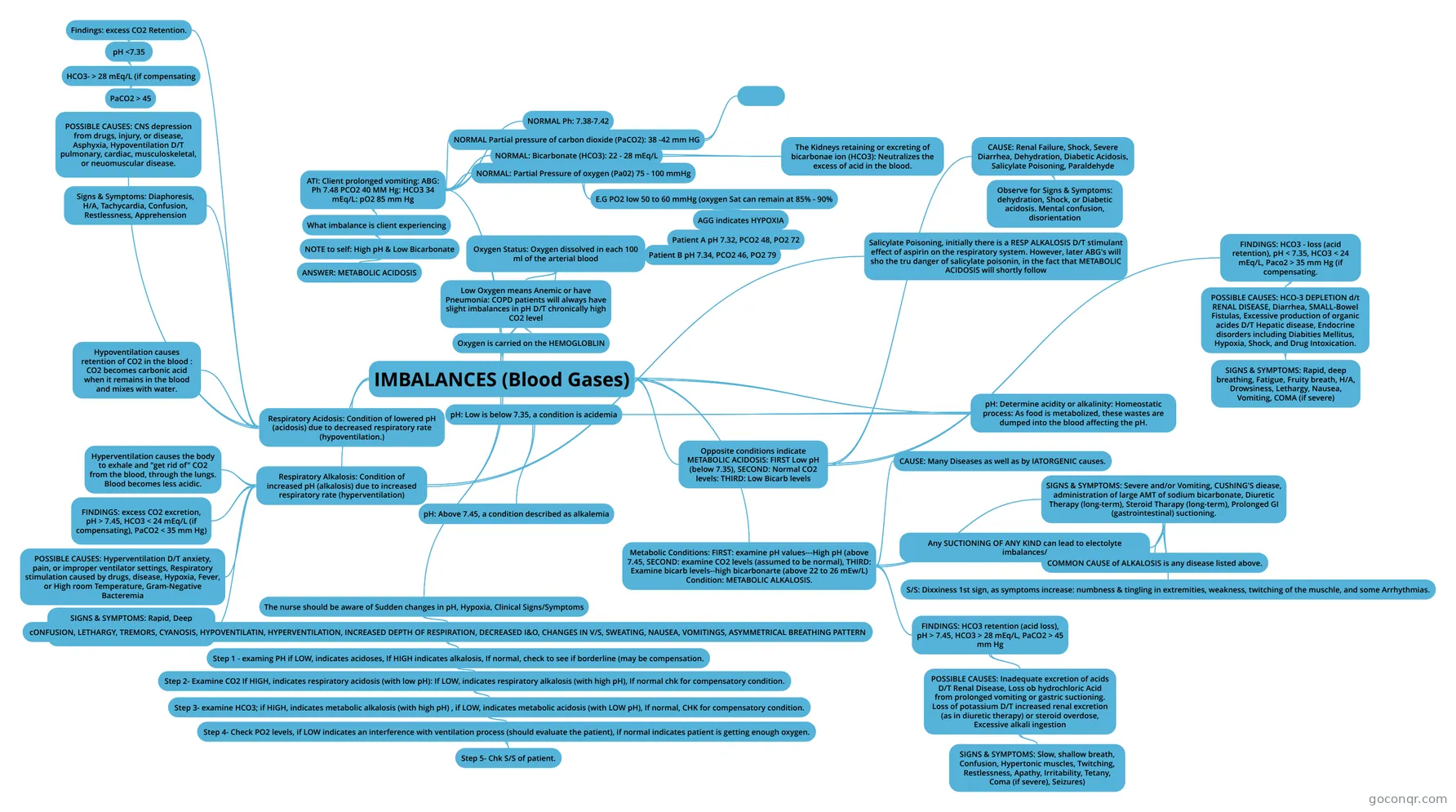
Mind map: Blood gas imbalances
Map content
IMBALANCES (Blood Gases)
ATI: Client prolonged vomiting: ABG: Ph 7.48 PCO2 40 MM Hg: HCO3 34 mEq/L: pO2 85 mm Hg
- NORMAL Ph: 7.38-7.42
- NORMAL Partial pressure of carbon dioxide (PaCO2): 38 -42 mm HG
- NORMAL: Bicarbonate (HCO3): 22 - 28 mEq/L
- The Kidneys retaining or excreting of bicarbonae ion (HCO3): Neutralizes the excess of acid in the blood.
- NORMAL: Partial Pressure of oxygen (Pa02) 75 - 100 mmHg
- E.G PO2 low 50 to 60 mmHg (oxygen Sat can remain at 85% - 90%
- AGG indicates HYPOXIA
- Patient A pH 7.32, PCO2 48, PO2 72
- Patient B pH 7.34, PCO2 46, PO2 79
- Patient A pH 7.32, PCO2 48, PO2 72
- AGG indicates HYPOXIA
- E.G PO2 low 50 to 60 mmHg (oxygen Sat can remain at 85% - 90%
- What imbalance is client experiencing
- NOTE to self: High pH & Low Bicarbonate
- ANSWER: METABOLIC ACIDOSIS
- NOTE to self: High pH & Low Bicarbonate
Respiratory Acidosis: Condition of lowered pH (acidosis) due to decreased respiratory rate (hypoventilation.)
- Hypoventilation causes retention of CO2 in the blood : CO2 becomes carbonic acid when it remains in the blood and mixes with water.
- Findings: excess CO2 Retention.
- pH <7.35
- HCO3- > 28 mEq/L (if compensating
- PaCO2 > 45
- HCO3- > 28 mEq/L (if compensating
- pH <7.35
- POSSIBLE CAUSES: CNS depression from drugs, injury, or disease, Asphyxia, Hypoventilation D/T pulmonary, cardiac, musculoskeletal, or neuomuscular disease.
- Signs & Symptoms: Diaphoresis, H/A, Tachycardia, Confusion, Restlessness, Apprehension
Respiratory Alkalosis: Condition of increased pH (alkalosis) due to increased respiratory rate (hyperventilation)
- Hyperventilation causes the body to exhale and "get rid of" CO2 from the blood, through the lungs. Blood becomes less acidic.
- FINDINGS: excess CO2 excretion, pH > 7.45, HCO3 < 24 mEq/L (if compensating), PaCO2 < 35 mm Hg)
- POSSIBLE CAUSES: Hyperventilation D/T anxiety, pain, or improper ventilator settings, Respiratory stimulation caused by drugs, disease, Hypoxia, Fever, or High room Temperature, Gram-Negative Bacteremia
- SIGNS & SYMPTOMS: Rapid, Deep breathing, Parasthesia, Ligh-headedness, Twitching, Twitching, Anxiety, Fear
- Salicylate Poisoning, initially there is a RESP ALKALOSIS D/T stimulant effect of aspirin on the respiratory system. However, later ABG's will sho the tru danger of salicylate poisonin, in the fact that METABOLIC ACIDOSIS will shortly follow
pH: Determine acidity or alkalinity: Homeostatic process: As food is metabolized, these wastes are dumped into the blood affecting the pH.
- pH: Low is below 7.35, a condition is acidemia
- pH: Above 7.45, a condition described as alkalemia
- pH: Low is below 7.35, a condition is acidemia
Metabolic Conditions: FIRST: examine pH values---High pH (above 7.45, SECOND: examine CO2 levels (assumed to be normal), THIRD: Examine bicarb levels--high bicarbonarte (above 22 to 26 mEw/L) Condition: METABOLIC ALKALOSIS.
- CAUSE: Many Diseases as well as by IATORGENIC causes.
- SIGNS & SYMPTOMS: Severe and/or Vomiting, CUShING'S diease, administration of large AMT of sodium bicarbonate, Diuretic Therapy (long-term), Steroid Tharapy (long-term), Prolonged GI (gastrointestinal) suctioning.
- Any SUCTIONING OF ANY KIND can lead to electolyte imbalances/
- COMMON CAUSE of ALKALOSIS is any disease listed above.
- S/S: Dixxiness 1st sign, as symptoms increase: numbness & tingling in extremities, weakness, twitching of the muschle, and some Arrhythmias.
- FINDINGS: HCO3 retention (acid loss), pH > 7.45, HCO3 > 28 mEq/L, PaCO2 > 45 mm Hg
- POSSIBLE CAUSES: Inadequate excretion of acids D/T Renal Disease, Loss ob hydrochloric Acid from prolonged vomiting or gastric suctioning. Loss of potassium D/T increased renal excretion (as in diuretic therapy) or steroid overdose, Excessive alkali ingestion
- SIGNS & SYMPTOMS: Slow, shallow breath, Confusion, Hypertonic muscles, Twitching, Restlessness, Apathy, Irritability, Tetany, Coma (if severe), Seizures)
- POSSIBLE CAUSES: Inadequate excretion of acids D/T Renal Disease, Loss ob hydrochloric Acid from prolonged vomiting or gastric suctioning. Loss of potassium D/T increased renal excretion (as in diuretic therapy) or steroid overdose, Excessive alkali ingestion
Opposite conditions indicate METABOLIC ACIDOSIS: FIRST Low pH (below 7.35), SECOND: Normal CO2 levels: THIRD: Low Bicarb levels
- CAUSE: Renal Failure, Shock, Severe Diarrhea, Dehydration, Diabetic Acidosis, Salicylate Poisoning, Paraldehyde
- Observe for Signs & Symptoms: dehydration, Shock, or Diabetic acidosis. Mental confusion, disorientation
- FINDINGS: HCO3 - loss (acid retention), pH < 7.35, HCO3 < 24 mEq/L, Paco2 > 35 mm Hg (if compensating.
- POSSIBLE CAUSES: HCO-3 DEPLETION d/t RENAL DISEASE, Diarrhea, SMALL-Bowel Fistulas, Excessive production of organic acides D/T Hepatic disease, Endocrine disorders including Diabities Mellitus, Hypoxia, Shock, and Drug Intoxication.
- SIGNS & SYMPTOMS: Rapid, deep breathing, Fatigue, Fruity breath, H/A, Drowsiness, Lethargy, Nausea, Vomiting, COMA (if severe)
- POSSIBLE CAUSES: HCO-3 DEPLETION d/t RENAL DISEASE, Diarrhea, SMALL-Bowel Fistulas, Excessive production of organic acides D/T Hepatic disease, Endocrine disorders including Diabities Mellitus, Hypoxia, Shock, and Drug Intoxication.
- CAUSE: Renal Failure, Shock, Severe Diarrhea, Dehydration, Diabetic Acidosis, Salicylate Poisoning, Paraldehyde
Oxygen Status: Oxygen dissolved in each 100 ml of the arterial blood
- Low Oxygen means Anemic or have Pneumonia: COPD patients will always have slight imbalances in pH D/T chronically high CO2 level
- Oxygen is carried on the HEMOGLOBLIN
- Low Oxygen means Anemic or have Pneumonia: COPD patients will always have slight imbalances in pH D/T chronically high CO2 level
The nurse should be aware of Sudden changes in pH, Hypoxia, Clinical Signs/Symptoms
- cONFUSION, LETHARGY, TREMORS, CYANOSIS, HYPOVENTILATIN, HYPERVENTILATION, INCREASED DEPTH OF RESPIRATION, DECREASED I&O, CHANGES IN V/S, SWEATING, NAUSEA, VOMITINGS, ASYMMETRICAL BREATHING PATTERN
- Step 1 - examing PH if LOW, indicates acidoses, If HIGH indicates alkalosis, If normal, check to see if borderline (may be compensation.
- Step 2- Examine CO2 If HIGH, indicates respiratory acidosis (with low pH): If LOW, indicates respiratory alkalosis (with high pH), If normal chk for compensatory condition.
- Step 3- examine HCO3; if HIGH, indicates metabolic alkalosis (with high pH) , if LOW, indicates metabolic acidosis (with LOW pH), If normal, CHK for compensatory condition.
- Step 4- Check PO2 levels, if LOW indicates an interference with ventilation process (should evaluate the patient), if normal indicates patient is getting enough oxygen.
- Step 5- Chk S/S of patient.
- Step 4- Check PO2 levels, if LOW indicates an interference with ventilation process (should evaluate the patient), if normal indicates patient is getting enough oxygen.
- Step 3- examine HCO3; if HIGH, indicates metabolic alkalosis (with high pH) , if LOW, indicates metabolic acidosis (with LOW pH), If normal, CHK for compensatory condition.
- Step 2- Examine CO2 If HIGH, indicates respiratory acidosis (with low pH): If LOW, indicates respiratory alkalosis (with high pH), If normal chk for compensatory condition.
- Step 1 - examing PH if LOW, indicates acidoses, If HIGH indicates alkalosis, If normal, check to see if borderline (may be compensation.
- cONFUSION, LETHARGY, TREMORS, CYANOSIS, HYPOVENTILATIN, HYPERVENTILATION, INCREASED DEPTH OF RESPIRATION, DECREASED I&O, CHANGES IN V/S, SWEATING, NAUSEA, VOMITINGS, ASYMMETRICAL BREATHING PATTERN
Information
- Description
- 3rd Year Nursing LABS Mind Map on IMBALANCES (Blood Gases), created by Jamie R Pascual on 20/02/2016.
- Created by
- Jamie R Pascual
- Views
- 0
- Tags
- Rating
More on Acid-Base Balance and Disorders