
Mind map
Market Structures: A Monopoly (Chapter 14)
Map content
Market Structures: A Monopoly (Chapter 14)
Imperfect Competition
- Imperfect Competition - where firms are able to differentiate their product in some way and so can have some influence over price
- Market Share - the proportion of total shares in a market accounted for by a particular firm
- Market Power - where a firm is able to raise the price of its product and not lose all it sales to rivals
Why Monopoly's Arise
- Monopoly- a firm that is the sole seller of a product without close substitutes
- Barriers to Entry - anything which prevents a firm from entering a market or industry
- Barriers to Entry have 4 Main Sources:
- 1. A key resource is owned by a single firm
- 2. The government gives a single firm exclusive rights to produce a good/service
- 3. The costs of production make one producer more effiecient
- 4. One firm is able to gain control of other firms in the market, growing in size
- Patent - the right conferred on the owner to prevent anyone else making or using an invention or manufacturing process without permission
- Copyright - the right of an individual or organisation to own things they create in the same way as a physical object to prevent others from copying or reproducing the creation
- Natural Monopoly - a monopoly that arises because a single firm can supply services/goods to an entire monopoly at a smaller cost than two or more firms could
Pricing and Production Decisions
- Monopoly vs Competition - the key difference is the ability to influence the price of a product
- The Output Effect - more output is sold, so Q is higher, which tends to increase total revenue
- The Price Effect - the price falls, so P is lower, which tends to decrease total revenue
- For a competitive firm: P = MR = MC
- For a monopoly firm: P > MR = MC
- A Monopoly's Profit
- π = TR - TC
- π = (TR/Q - TC/Q) x Q
- π = (P - ATC) x Q
Price Discrimination
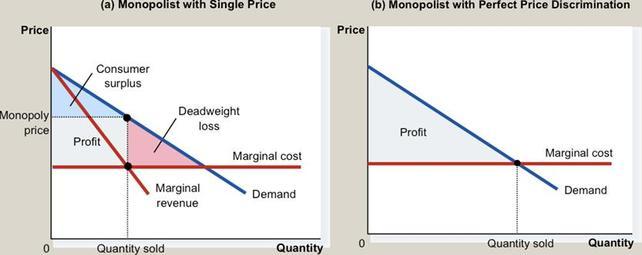
- Price Discrimination - the business practice of selling the same good at different pirces to different customers
- Arbitrage - the prcess of buying a good in one market at a low price and selling it in another market at a higher price in order to profit from the price difference
- Perfect Price Discrimination - a situation in which the monopolist knows exactly the willingness of each customer and can charge each customer at that different price
Public Policy
- Four ways:
- 1. Try to increase competition
- 2. Regulate behaviour of Monopolies
- 3. Turning some private monopolies into publuc enterprises
- 4. Doing nothing at all
- 3 Main Areas of Legislation:
- 1. Acting against cartels where they are preventing free rrade
- 2. Banning pricing stratigies which are anti-competitive eg price fixing
- 3. Monitoring and supervising joint ventures
- Synergies - where the percieved benefits of the conbined operations of a merged organisation are greater than those which would arise if the firms stayed separate
- Four ways:
Images and files in the map
Information
- Description
- Mind Map on Market Structures: A Monopoly (Chapter 14), created by franvmiller on 23/02/2016.
- Created by
- franvmiller
- Views
- 1
- Rating