
Mind map
Ch. 32&33 invertebrates
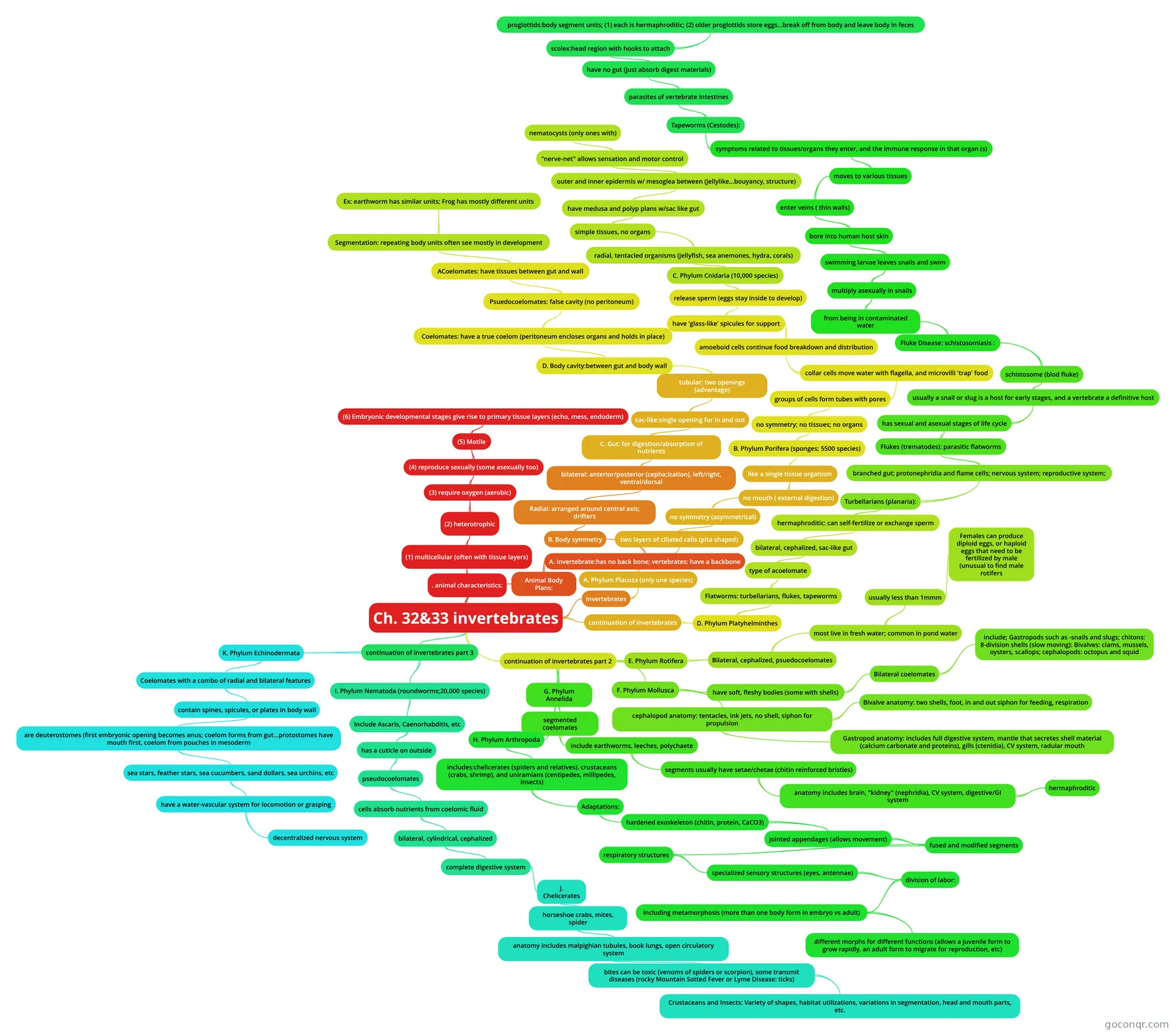
Mind map: Invertebrates
Map content
Ch. 32&33 invertebrates
. animal characteristics:
- (1) multicellular (often with tissue layers)
- (2) heterotrophic
- (3) require oxygen (aerobic)
- (4) reproduce sexually (some asexually too)
- (5) Motile
- (6) Embryonic developmental stages give rise to primary tissue layers (echo, mess, endoderm)
- (5) Motile
- (4) reproduce sexually (some asexually too)
- (3) require oxygen (aerobic)
- (2) heterotrophic
- (1) multicellular (often with tissue layers)
Animal Body Plans:
- A. Invertebrate:has no back bone; vertebrates: have a backbone
- B. Body symmetry
- Radial: arranged around central axis; drifters
- bilateral: anterior/posterior (cepha;ization), left/right, ventral/dorsal
- C. Gut: for digestion/absorption of nutrients
- sac-like:single opening for in and out
- tubular: two openings (advantage)
- D. Body cavity:between gut and body wall
- Coelomates: have a true coelom (peritoneum encloses organs and holds in place)
- Psuedocoelomates: false cavity (no peritoneum)
- ACoelomates: have tissues between gut and wall
- Segmentation: repeating body units often see mostly in development
- Ex: earthworm has similar units; Frog has mostly different units
- Segmentation: repeating body units often see mostly in development
- ACoelomates: have tissues between gut and wall
- Psuedocoelomates: false cavity (no peritoneum)
- Coelomates: have a true coelom (peritoneum encloses organs and holds in place)
- D. Body cavity:between gut and body wall
- tubular: two openings (advantage)
- sac-like:single opening for in and out
- C. Gut: for digestion/absorption of nutrients
- bilateral: anterior/posterior (cepha;ization), left/right, ventral/dorsal
- Radial: arranged around central axis; drifters
- B. Body symmetry
- A. Invertebrate:has no back bone; vertebrates: have a backbone
Invertebrates
- A. Phylum Placoza (only one species)
- two layers of ciliated cells (pita shaped)
- no symmetry (asymmetrical)
- no mouth ( external digestion)
- like a single tissue organism
- B. Phylum Porifera (sponges; 5500 species)
- no symmetry; no tissues; no organs
- groups of cells form tubes with pores
- collar cells move water with flagella, and microvilli 'trap' food
- amoeboid cells continue food breakdown and distribution
- have 'glass-like' spicules for support
- release sperm (eggs stay inside to develop)
- C. Phylum Cnidaria (10,000 species)
- radial, tentacled organisms (jellyfish, sea anemones, hydra, corals)
- simple tissues, no organs
- have medusa and polyp plans w/sac like gut
- outer and inner epidermis w/ mesoglea between (jellylike...bouyancy, structure)
- "nerve-net" allows sensation and motor control
- nematocysts (only ones with)
- "nerve-net" allows sensation and motor control
- outer and inner epidermis w/ mesoglea between (jellylike...bouyancy, structure)
- have medusa and polyp plans w/sac like gut
- simple tissues, no organs
- radial, tentacled organisms (jellyfish, sea anemones, hydra, corals)
- C. Phylum Cnidaria (10,000 species)
- release sperm (eggs stay inside to develop)
- have 'glass-like' spicules for support
- amoeboid cells continue food breakdown and distribution
- collar cells move water with flagella, and microvilli 'trap' food
- groups of cells form tubes with pores
- no symmetry; no tissues; no organs
- B. Phylum Porifera (sponges; 5500 species)
- like a single tissue organism
- no mouth ( external digestion)
- no symmetry (asymmetrical)
- two layers of ciliated cells (pita shaped)
- A. Phylum Placoza (only one species)
continuation of invertebrates
- D. Phylum Platyhelminthes
- Flatworms: turbellarians, flukes, tapeworms
- type of acoelomate
- bilateral, cephalized, sac-like gut
- hermaphroditic: can self-fertilize or exchange sperm
- Turbellarians (planaria):
- branched gut; protonephridia and flame cells; nervous system; reproductive system;
- Flukes (trematodes): parasitic flatworms
- has sexual and asexual stages of life cycle
- usually a snail or slug is a host for early stages, and a vertebrate a definitive host
- schistosome (blod fluke)
- Fluke Disease: schistosomiasis :
- from being in contaminated water
- multiply asexually in snails
- swimming larvae leaves snails and swim
- bore into human host skin
- enter veins ( thin walls)
- moves to various tissues
- symptoms related to tissues/organs they enter, and the immune response in that organ (s)
- Tapeworms (Cestodes):
- parasites of vertebrate intestines
- have no gut (just absorb digest materials)
- scolex:head region with hooks to attach
- proglottids:body segment units; (1) each is hermaphroditic; (2) older proglottids store eggs...break off from body and leave body in feces
- scolex:head region with hooks to attach
- have no gut (just absorb digest materials)
- parasites of vertebrate intestines
- Tapeworms (Cestodes):
- symptoms related to tissues/organs they enter, and the immune response in that organ (s)
- moves to various tissues
- enter veins ( thin walls)
- bore into human host skin
- swimming larvae leaves snails and swim
- multiply asexually in snails
- from being in contaminated water
- Fluke Disease: schistosomiasis :
- schistosome (blod fluke)
- usually a snail or slug is a host for early stages, and a vertebrate a definitive host
- has sexual and asexual stages of life cycle
- Flukes (trematodes): parasitic flatworms
- branched gut; protonephridia and flame cells; nervous system; reproductive system;
- Turbellarians (planaria):
- hermaphroditic: can self-fertilize or exchange sperm
- bilateral, cephalized, sac-like gut
- type of acoelomate
- Flatworms: turbellarians, flukes, tapeworms
- D. Phylum Platyhelminthes
continuation of invertebrates part 2
- E. Phylum Rotifera
- Bilateral, cephalized, psuedocoelomates
- most live in fresh water; common in pond water
- usually less than 1mmm
- Females can produce diploid eggs, or haploid eggs that need to be fertilized by male (unusual to find male rotifers
- usually less than 1mmm
- most live in fresh water; common in pond water
- Bilateral, cephalized, psuedocoelomates
- F. Phylum Mollusca
- have soft, fleshy bodies (some with shells)
- Bilateral coelomates
- include; Gastropods such as -snails and slugs; chitons: 8-division shells (slow moving): Bivalves: clams, mussels, oysters, scallops; cephalopods: octopus and squid
- Bilateral coelomates
- cephalopod anatomy: tentacles, ink jets, no shell, siphon for propulsion
- Bivalve anatomy: two shells, foot, in and out siphon for feeding, respiration
- Gastropod anatomy: includes full digestive system, mantle that secretes shell material (calcium carbonate and proteins), gills (ctenidia), CV system, radular mouth
- have soft, fleshy bodies (some with shells)
- G. Phylum Annelida
- segmented coelomates
- include earthworms, leeches, polychaete
- segments usually have setae/chetae (chitin reinforced bristles)
- anatomy includes brain, "kidney" (nephridia), CV system, digestive/GI system
- hermaphroditic
- anatomy includes brain, "kidney" (nephridia), CV system, digestive/GI system
- segments usually have setae/chetae (chitin reinforced bristles)
- include earthworms, leeches, polychaete
- segmented coelomates
- H. Phylum Arthropoda
- includes:chelicerates (spiders and relatives), crustaceans (crabs, shrimp), and uniramians (centipedes, millipedes, insects)
- Adaptations:
- hardened exoskeleton (chitin, protein, CaCO3)
- jointed appendages (allows movement)
- fused and modified segments
- respiratory structures
- specialized sensory structures (eyes, antennae)
- division of labor:
- including metamorphosis (more than one body form in embryo vs adult)
- different morphs for different functions (allows a juvenile form to grow rapidly, an adult form to migrate for reproduction, etc)
- including metamorphosis (more than one body form in embryo vs adult)
- division of labor:
- specialized sensory structures (eyes, antennae)
- respiratory structures
- fused and modified segments
- jointed appendages (allows movement)
- hardened exoskeleton (chitin, protein, CaCO3)
- Adaptations:
- includes:chelicerates (spiders and relatives), crustaceans (crabs, shrimp), and uniramians (centipedes, millipedes, insects)
- E. Phylum Rotifera
continuation of invertebrates part 3
- I. Phylum Nematoda (roundworms;20,000 species)
- Include Ascaris, Caenorhabditis, etc
- has a cuticle on outside
- pseudocoelomates
- cells absorb nutrients from coelomic fluid
- bilateral, cylindrical, cephalized
- complete digestive system
- J. Chelicerates
- horseshoe crabs, mites, spider
- anatomy includes malpighian tubules, book lungs, open circulatory system
- bites can be toxic (venoms of spiders or scorpion), some transmit diseases (rocky Mountain Sotted Fever or Lyme Disease: ticks)
- Crustaceans and Insects: Variety of shapes, habitat utilizations, variations in segmentation, head and mouth parts, etc.
- bites can be toxic (venoms of spiders or scorpion), some transmit diseases (rocky Mountain Sotted Fever or Lyme Disease: ticks)
- anatomy includes malpighian tubules, book lungs, open circulatory system
- horseshoe crabs, mites, spider
- J. Chelicerates
- complete digestive system
- bilateral, cylindrical, cephalized
- cells absorb nutrients from coelomic fluid
- pseudocoelomates
- has a cuticle on outside
- Include Ascaris, Caenorhabditis, etc
- K. Phylum Echinodermata
- Coelomates with a combo of radial and bilateral features
- contain spines, spicules, or plates in body wall
- are deuterostomes (first embryonic opening becomes anus; coelom forms from gut...protostomes have mouth first, coelom from pouches in mesoderm
- sea stars, feather stars, sea cucumbers, sand dollars, sea urchins, etc
- have a water-vascular system for locomotion or grasping
- decentralized nervous system
- have a water-vascular system for locomotion or grasping
- sea stars, feather stars, sea cucumbers, sand dollars, sea urchins, etc
- are deuterostomes (first embryonic opening becomes anus; coelom forms from gut...protostomes have mouth first, coelom from pouches in mesoderm
- contain spines, spicules, or plates in body wall
- Coelomates with a combo of radial and bilateral features
- I. Phylum Nematoda (roundworms;20,000 species)
Information
- Description
- Mind Map on Ch. 32&33 invertebrates, created by my511girl on 29/02/2016.
- Created by
- my511girl
- Views
- 0
- Rating