
Mind map
Biological Explanations of Aggression
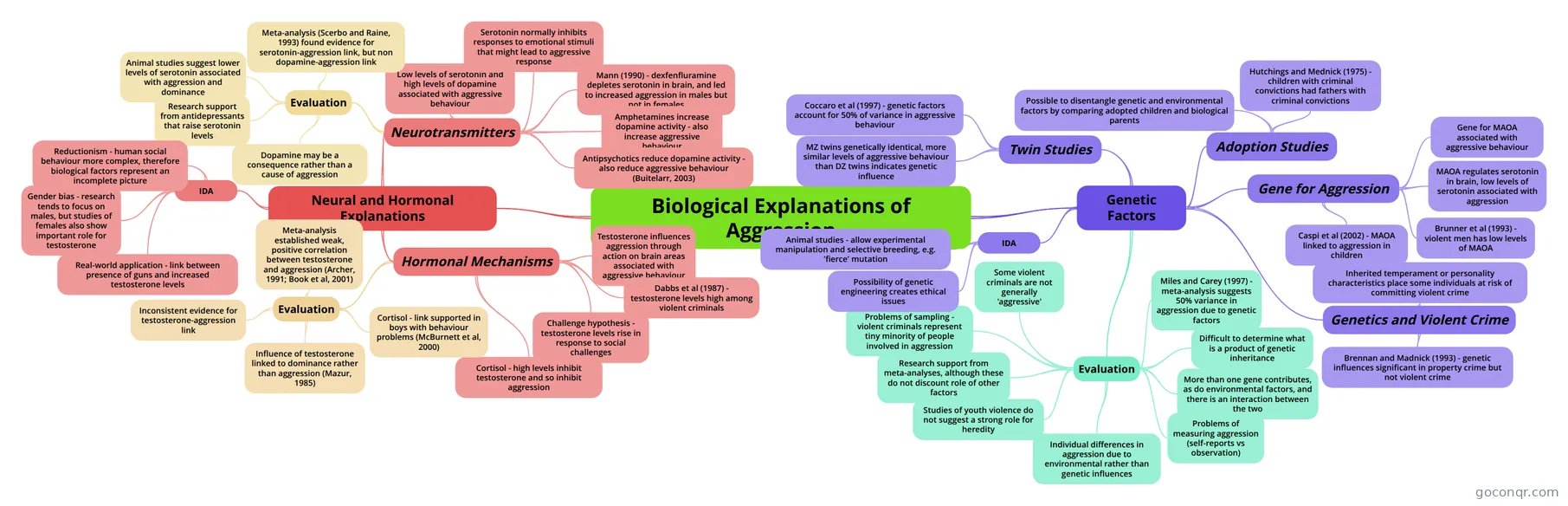
Mind map: Biological Explanations of Aggression
Map content
Biological Explanations of Aggression
Neural and Hormonal Explanations
- Neurotransmitters
- Evaluation
- Meta-analysis (Scerbo and Raine, 1993) found evidence for serotonin-aggression link, but non dopamine-aggression link
- Animal studies suggest lower levels of serotonin associated with aggression and dominance
- Research support from antidepressants that raise serotonin levels
- Dopamine may be a consequence rather than a cause of aggression
- Low levels of serotonin and high levels of dopamine associated with aggressive behaviour
- Serotonin normally inhibits responses to emotional stimuli that might lead to aggressive response
- Mann (1990) - dexfenfluramine depletes serotonin in brain, and led to increased aggression in males but not in females
- Amphetamines increase dopamine activity - also increase aggressive behaviour
- Antipsychotics reduce dopamine activity - also reduce aggressive behaviour (Buitelarr, 2003)
- Evaluation
- Hormonal Mechanisms
- Testosterone influences aggression through action on brain areas associated with aggressive behaviour
- Dabbs et al (1987) - testosterone levels high among violent criminals
- Challenge hypothesis - testosterone levels rise in response to social challenges
- Cortisol - high levels inhibit testosterone and so inhibit aggression
- Evaluation
- Meta-analysis established weak, positive correlation between testosterone and aggression (Archer, 1991; Book et al, 2001)
- Inconsistent evidence for testosterone-aggression link
- Influence of testosterone linked to dominance rather than aggression (Mazur, 1985)
- Cortisol - link supported in boys with behaviour problems (McBurnett et al, 2000)
- IDA
- Reductionism - human social behaviour more complex, therefore biological factors represent an incomplete picture
- Gender bias - research tends to focus on males, but studies of females also show important role for testosterone
- Real-world application - link between presence of guns and increased testosterone levels
- Neurotransmitters
Genetic Factors
- Twin Studies
- MZ twins genetically identical, more similar levels of aggressive behaviour than DZ twins indicates genetic influence
- Coccaro et al (1997) - genetic factors account for 50% of variance in aggressive behaviour
- Adoption Studies
- Possible to disentangle genetic and environmental factors by comparing adopted children and biological parents
- Hutchings and Mednick (1975) - children with criminal convictions had fathers with criminal convictions
- Gene for Aggression
- Gene for MAOA associated with aggressive behaviour
- MAOA regulates serotonin in brain, low levels of serotonin associated with aggression
- Brunner et al (1993) - violent men has low levels of MAOA
- Caspi et al (2002) - MAOA linked to aggression in children
- Genetics and Violent Crime
- Inherited temperament or personality characteristics place some individuals at risk of committing violent crime
- Brennan and Madnick (1993) - genetic influences significant in property crime but not violent crime
- Evaluation
- Miles and Carey (1997) - meta-analysis suggests 50% variance in aggression due to genetic factors
- Difficult to determine what is a product of genetic inheritance
- More than one gene contributes, as do environmental factors, and there is an interaction between the two
- Problems of measuring aggression (self-reports vs observation)
- Individual differences in aggression due to environmental rather than genetic influences
- Studies of youth violence do not suggest a strong role for heredity
- Research support from meta-analyses, although these do not discount role of other factors
- Problems of sampling - violent criminals represent tiny minority of people involved in aggression
- Some violent criminals are not generally 'aggressive'
- IDA
- Animal studies - allow experimental manipulation and selective breeding, e.g. 'fierce' mutation
- Possibility of genetic engineering creates ethical issues
- Twin Studies
Information
- Description
- Mind Map on Biological Explanations of Aggression, created by emkstar13 on 08/01/2014.
- Created by
- emkstar13
- Views
- 58
- Rating
More on Biological explanations of aggression