
Mind map
The Cell #2
Map content
The Cell #2
Apoptosis
- Cells shrink and dissociate from surrounding cells. Results plasma membrane structure eg microvilli. Organelles retain definition until late stages. Membrane blebbing - membrane bound extentions of cytoplasm
- APOPTOIS - Cells split into a cluster of membrane bound bodies containing organelles = apoptopic bodies, Apoptotic bodies are taken up by neighbouring cells, or cells from the immune system, Apoptotic cells are removed quickly from the tissue, lasting just a few hours, Cells do not spill their contents into the tissue which means there is no damage to surronding cells
- Thought to function during - tissue remodelling, removal of potentially harmful cells, removal of non functional immune cells
- In adult tissue, homeostasis is achieved when the rate of proliferation equals apoptosis. Not all tissues will be in perfect balance all of the time in order to allow your body to adapt to its environment.
- Apoptosis is during metamorphisis of a tadpole into a frog. Tail cells undergo apoptosis and the tail is lost. Stimulated by hormones from the thyroid gland
- A change in apoptosis without a change in proliferation leads to disease of cancer ( insufficient cell death) or excess cell death (AIDS)
- Summary
- Cells die during growth, development and remodelling of tissues, due to trauma, toxicity and lack of oxygen. Controlled or programmed cell death is called apoptosis. Apoptosis leads to development of small packages containing the cell contents (apoptotic bodies) that are cleared (ingested) by other cells. This prevents damage to surrounding tissue. Necrosis is uncontrolled and leads to leakage of damaging enzymes that impact on surrounding cells. Failure of apoptosis can lead to uncontrolled cell proliferation and tumour development. Excess apoptosis leads to loss of cells, for example loss of immune cells in AIDS.
Necrosis
- Cells swell and burst, uncontrolled degradation via enzyme action. Cell contents are released. Damage surrounding cells. Inflammation occurs which can cause further damage
ER and golgi apparatus
- The endoplasmic reticulum (ER) and the Golgi apparatus are the major components of the endomembrane system. They are single membrane organelles formed of tubules and inter connecting flattened sacs of membrane
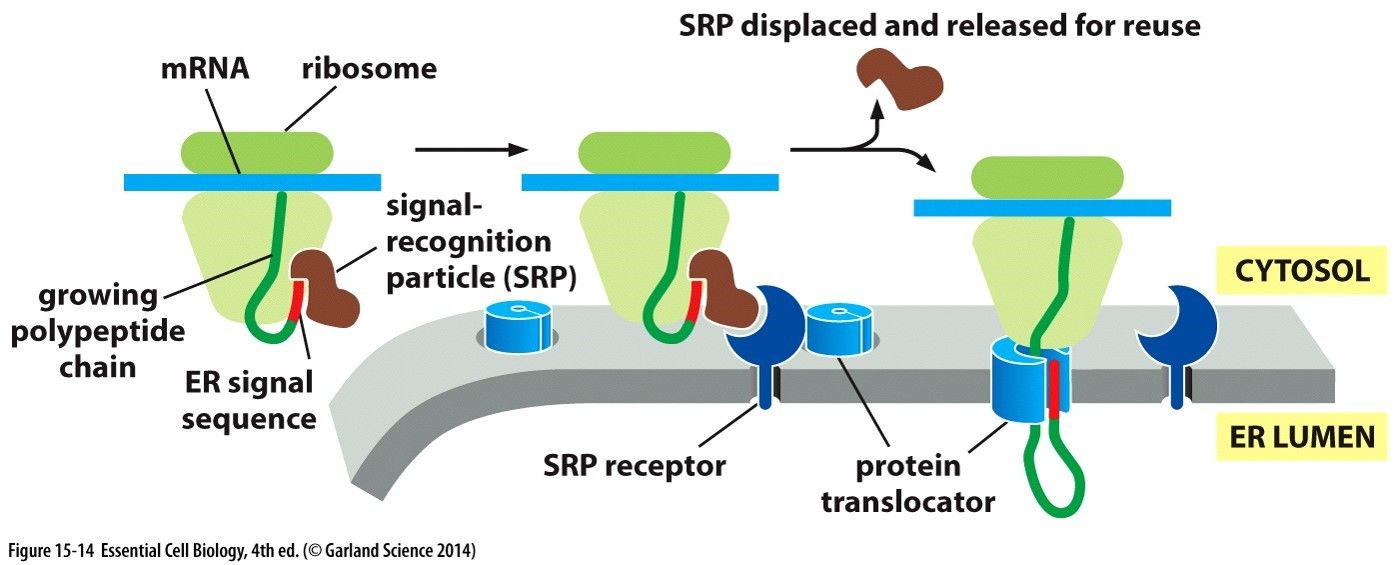
- The Rough Endoplasmic Reticulum (RER) is a membranous network permeating through much of the cytoplasm. 10% of a cell’s volume is enclosed within it. It is responsible for protein synthesis folding modification and transport to other endomembrane organelles The first step is when the mRNA exits the nucleus and binds to a ribosome in the cytosol… or often, more than one ribosome
- What the “co-translational protein transport pathway” means is that as the mRNA is being translated on the ribosome, the initial amino acid sequence which extrudes from the ribosome starts its transport pathway through the endoplasmic reticulum, so translation and transport are occurring at the same time (hence the prefix “co”). This distinguishes this pathway from the “post translational protein transport pathway” , where translation of the mRNA to protein happens on ribosomes in the cytosol. Here, translation finishes, the protein leaves the ribosome, and then begins its transport pathway – so transport happens after translation ( hence the prefix “post” ).
- Signal Sequence
- The mRNA transcripts for proteins that need to be processed through the ER have the code for a signal sequence. Once this is translated, this sequence of amino acids is recognised by a complex called the signal recognition particle (SRP).
- It ensures that the ribosome moves and binds the ER surface and the rest of the protein synthesis takes place on the rough ER. The protein is inserted through the ER membrane. Once in the lumen of the rough ER, the signal sequence is cleaved away from the rest of the molecule.
- During extrusion into the rough ER, protein transfer is stopped... by a hydrophobic stop transfer or membrane anchor signal in the protein. The protein is moved from the translocon channel to the RER membrane.
- It ensures that the ribosome moves and binds the ER surface and the rest of the protein synthesis takes place on the rough ER. The protein is inserted through the ER membrane. Once in the lumen of the rough ER, the signal sequence is cleaved away from the rest of the molecule.
- Molecular chaperones (chaperonins) prevent premature folding as protein enters ER Chaperonins bind to irreversibly misfolded proteins and retain them in the ER Proteolytic enzymes in the ER can degrade misfolded proteins or they can be transported out of the ER.
- The smooth ER network tends to consist of rounded sacs and tubules. It doesn’t have ribosomes associated with its surface. The functions of the smooth endoplasmic reticulum vary, depending on the cell type in which it is found. It is known to be involved in: synthesis of lipids; detoxification of lipid soluble substances; metabolism of carbohydrates; storing pools of calcium ions (required for cell signalling); the addition of receptors to cell membrane proteins.
- SER SUMMARY - is contiguous with the rough ER; is a network of tubules and pockets; synthesises lipids; detoxifies lipid soluble substances; metabolises carbohydrates; stores pools of calcium ions (required for cell signalling); adds receptors to cell membrane proteins.
- The mRNA transcripts for proteins that need to be processed through the ER have the code for a signal sequence. Once this is translated, this sequence of amino acids is recognised by a complex called the signal recognition particle (SRP).
- Once inside the RER, the protein is: folded into its correct tertiary structure with the help of chaparonins. modified: e.g. many proteins processed in the ER become glycosylated: i.e. they are modified by the addition of sugar side chains; e.g. some membrane proteins have an anchor sequence (which attaches them to membranes) added in the ER. transported to the appropriate destination* in transport vesicles – their final destinations are also governed by signal sequences found in the protein sequence.
Images and files in the map
Information
- Description
- 2 Cell and molecular Mind Map on The Cell #2, created by Kayleena Razaram on 11/03/2016.
- Created by
- Kayleena Razaram
- Views
- 1
- Rating