
Mind map
Market Structures III: Oligopoly (Chapter 16)
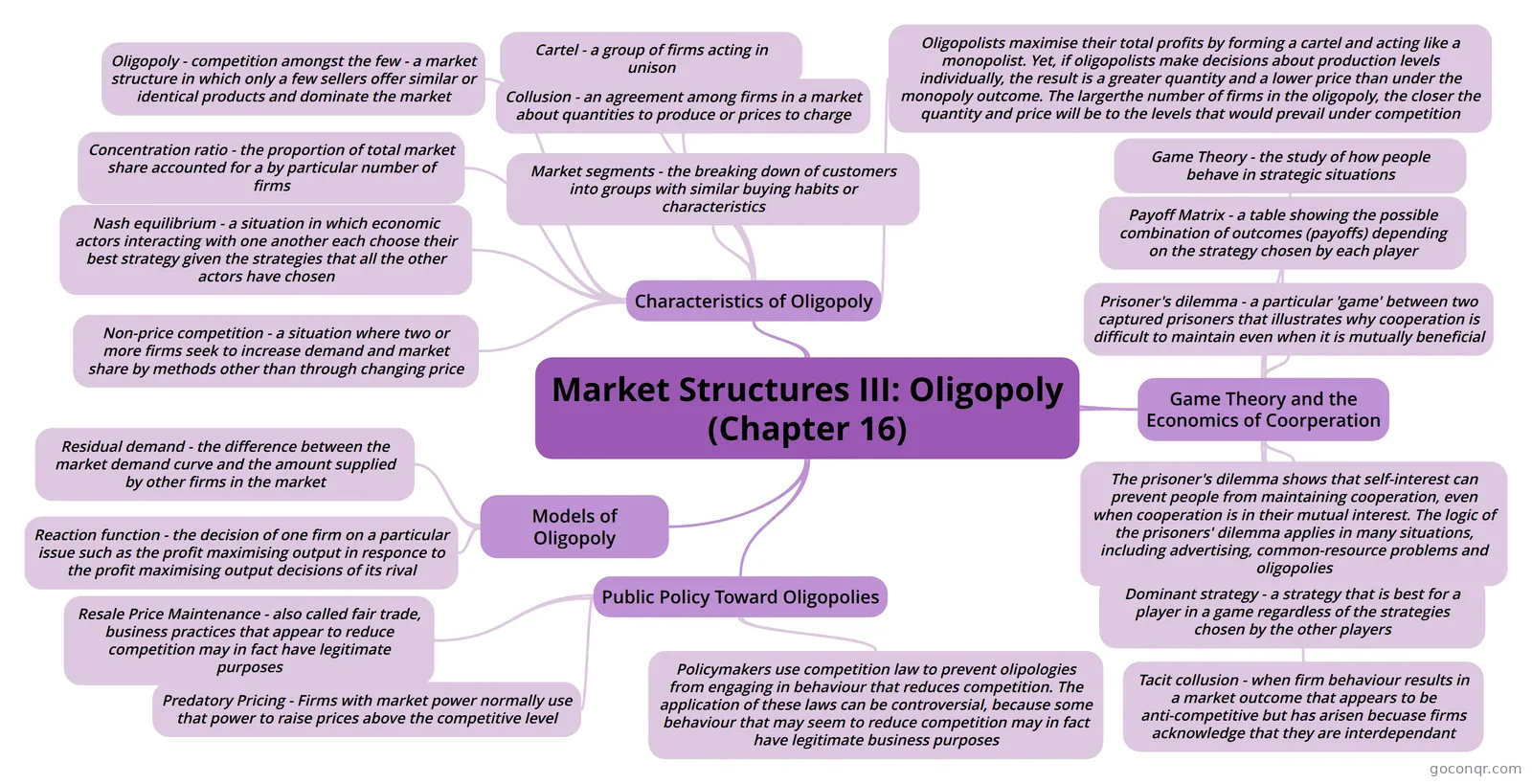
Mind map: Market Structures III: Oligopoly (Chapter 16)
Map content
Market Structures III: Oligopoly (Chapter 16)
Characteristics of Oligopoly
- Oligopoly - competition amongst the few - a market structure in which only a few sellers offer similar or identical products and dominate the market
- Concentration ratio - the proportion of total market share accounted for a by particular number of firms
- Market segments - the breaking down of customers into groups with similar buying habits or characteristics
- Collusion - an agreement among firms in a market about quantities to produce or prices to charge
- Cartel - a group of firms acting in unison
- Nash equilibrium - a situation in which economic actors interacting with one another each choose their best strategy given the strategies that all the other actors have chosen
- Non-price competition - a situation where two or more firms seek to increase demand and market share by methods other than through changing price
- Oligopolists maximise their total profits by forming a cartel and acting like a monopolist. Yet, if oligopolists make decisions about production levels individually, the result is a greater quantity and a lower price than under the monopoly outcome. The largerthe number of firms in the oligopoly, the closer the quantity and price will be to the levels that would prevail under competition
Game Theory and the Economics of Coorperation
- Game Theory - the study of how people behave in strategic situations
- Payoff Matrix - a table showing the possible combination of outcomes (payoffs) depending on the strategy chosen by each player
- Prisoner's dilemma - a particular 'game' between two captured prisoners that illustrates why cooperation is difficult to maintain even when it is mutually beneficial
- Dominant strategy - a strategy that is best for a player in a game regardless of the strategies chosen by the other players
- Tacit collusion - when firm behaviour results in a market outcome that appears to be anti-competitive but has arisen becuase firms acknowledge that they are interdependant
- The prisoner's dilemma shows that self-interest can prevent people from maintaining cooperation, even when cooperation is in their mutual interest. The logic of the prisoners' dilemma applies in many situations, including advertising, common-resource problems and oligopolies
Models of Oligopoly
- Residual demand - the difference between the market demand curve and the amount supplied by other firms in the market
- Reaction function - the decision of one firm on a particular issue such as the profit maximising output in responce to the profit maximising output decisions of its rival
Public Policy Toward Oligopolies
- Resale Price Maintenance - also called fair trade, business practices that appear to reduce competition may in fact have legitimate purposes
- Predatory Pricing - Firms with market power normally use that power to raise prices above the competitive level
- Policymakers use competition law to prevent olipologies from engaging in behaviour that reduces competition. The application of these laws can be controversial, because some behaviour that may seem to reduce competition may in fact have legitimate business purposes
Information
- Description
- Mind Map on Market Structures III: Oligopoly (Chapter 16), created by franvmiller on 20/03/2016.
- Created by
- franvmiller
- Views
- 0
- Rating