
Mind map
Orientalism & the Other
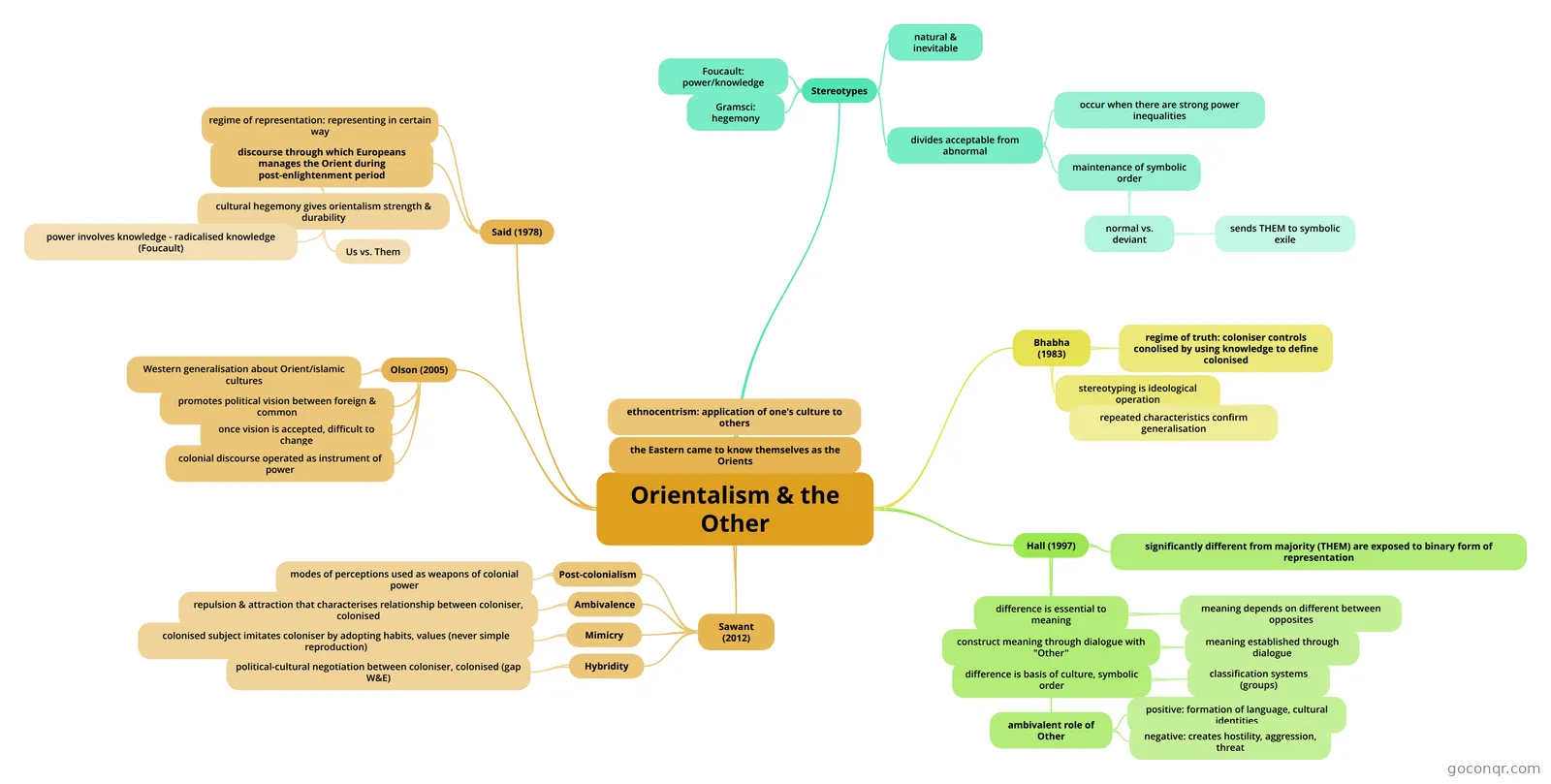
Mind map: Orientalism and the Other
Map content
Orientalism & the Other
Said (1978)
- discourse through which Europeans manages the Orient during post-enlightenment period
- cultural hegemony gives orientalism strength & durability
- Us vs. Them
- power involves knowledge - radicalised knowledge (Foucault)
- cultural hegemony gives orientalism strength & durability
- regime of representation: representing in certain way
- discourse through which Europeans manages the Orient during post-enlightenment period
Olson (2005)
- promotes political vision between foreign & common
- once vision is accepted, difficult to change
- Western generalisation about Orient/islamic cultures
- colonial discourse operated as instrument of power
the Eastern came to know themselves as the Orients
- ethnocentrism: application of one's culture to others
Sawant (2012)
- Post-colonialism
- modes of perceptions used as weapons of colonial power
- Ambivalence
- repulsion & attraction that characterises relationship between coloniser, colonised
- Mimicry
- colonised subject imitates coloniser by adopting habits, values (never simple reproduction)
- Hybridity
- political-cultural negotiation between coloniser, colonised (gap W&E)
- Post-colonialism
Bhabha (1983)
- stereotyping is ideological operation
- repeated characteristics confirm generalisation
- regime of truth: coloniser controls conolised by using knowledge to define colonised
- stereotyping is ideological operation
Hall (1997)
- significantly different from majority (THEM) are exposed to binary form of representation
- difference is essential to meaning
- meaning depends on different between opposites
- construct meaning through dialogue with "Other"
- meaning established through dialogue
- difference is basis of culture, symbolic order
- classification systems (groups)
- ambivalent role of Other
- positive: formation of language, cultural identities
- negative: creates hostility, aggression, threat
Stereotypes
- divides acceptable from abnormal
- maintenance of symbolic order
- normal vs. deviant
- sends THEM to symbolic exile
- normal vs. deviant
- occur when there are strong power inequalities
- maintenance of symbolic order
- Foucault: power/knowledge
- Gramsci: hegemony
- natural & inevitable
- divides acceptable from abnormal
Information
- Description
- 2nd Year Media: Messages & Meanings (Orientalism & The Other) Mind Map on Orientalism & the Other, created by Jade Jannotti on 01/19/2014.
- Created by
- Jade Jannotti
- Views
- 138
- Tags
- Rating