
Mind map
Reflection, total internal reflection and Refraction
Map content
Reflection, total internal reflection and Refraction
waves can be reflected
- when a wave hits a boundary some of its energy can be reflected
- A plane mirror is perfectly flat, and you see an exact image of yourself. Light consists of waves. The law of reflection states that for any light ray reflected by a plane mirror, The angle of incidence = the angle of reflection:
- The image formed by a plane mirror is virtual, upright (the same way up as the object) and can laterally invert (back to front but not upside down). A virtual image can’t be projected onto a screen like to movie images that you see at a cinema. An image on a screen is described as a real image because it is formed by focusing light rays onto the screen.
Waves can be refracted
- Light waves change direction when they pass from one medium to another at an angle to the interface. This is called refraction. Refraction is a property of all forms of waves. The change of speed at the boundary, or interface, causes them to change direction/be refracted.
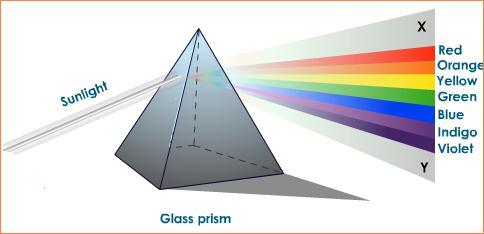
- The change in wave speed is different for different wavelengths/colours, which is why white light dispersed by a prism creates a rainbow. This image shows what happens when a narrow beam of white light passes through a triangular glass prism. The ray comes out of the prism in a different direction to the incident ray and is split into the colours of the spectrum because white light contains all of these colours. This is called dispersion.
- The amount of overall refraction caused by a prism can be expressed by D. D is the angle between the incident ray and the refracted ray and it varies with wavelength. This angle of Deviation shows the total change of direction in the ray.
- The change in wave speed is different for different wavelengths/colours, which is why white light dispersed by a prism creates a rainbow. This image shows what happens when a narrow beam of white light passes through a triangular glass prism. The ray comes out of the prism in a different direction to the incident ray and is split into the colours of the spectrum because white light contains all of these colours. This is called dispersion.
- - Towards the normal when light travels from air into glass. The angle of refraction is smaller than the angle of incidence
- - Away from the normal when light travels from glass to air. The angle of refraction is greater than the angle of incidence
- Light waves change direction when they pass from one medium to another at an angle to the interface. This is called refraction. Refraction is a property of all forms of waves. The change of speed at the boundary, or interface, causes them to change direction/be refracted.
Real images
- a real images is where the light from an images joins together to form an image on a screen.
- With the object at different distances beyond the principal focus of the lens, adjust the position of the screen until you see a clear image of the object on it. This is called a real image because it is formed on the screen where the light rays meet.
- a real images is where the light from an images joins together to form an image on a screen.
virtual images
- rays are diverging so the object appears to be coming from a different location. Used in mirrors and magnifying glasses
Refractive Index
- When a light ray travels from air into a transparent medium, the angle of refraction depends on the medium as well as the angle of incidence. For example, for the same angle of incidence, glass refracts a light ray more than water does. The ratio of the velocity in air (free space) to the velocity in the material is called the material’s refractive index.
- Refractive index can be defined in terms of wave spped: speed of light in vacuum (air)/ speed of light in the medium
- The relationship between refractive index n, angle of incidence i and angle of refraction r is: n = sin i / sin r
- Refractive index can be defined in terms of wave spped: speed of light in vacuum (air)/ speed of light in the medium
- When a light ray travels from air into a transparent medium, the angle of refraction depends on the medium as well as the angle of incidence. For example, for the same angle of incidence, glass refracts a light ray more than water does. The ratio of the velocity in air (free space) to the velocity in the material is called the material’s refractive index.
Total internal reflection
- There is an angle of incidence above which light is no longer refracted, but is instead reflected by the interface. This angle of incidence is known as the critical angle, and can be found when the refracted angle is 90,
- Optical fibres are very thin fibres that are designed to transmit light or infrared radiation. We use them in medicine to see inside the body, without cutting the body open by using an endoscope. In telecommunications they are used to send signals securely. The light rays can’t escape from the fibre. Each light ray entering a fibre at one end leaves the fibre at the other end even if the fibre bends round. This is because a light ray in the fibre is totally internally reflected each time it reaches the fibre’s boundary, repeatedly. High speed internet works by sending vast amounts of information through optical fibres.
- - If the angle of incidence in the glass is gradually increased, the angle of refraction increases until the refracted ray emerged along the boundary. The angle of incidence at this position is referred to as the critical angle, c.
- If the angle of incidence is increased beyond the critical angle, the light ray is totally internally reflected. When this occurs angle i is equal to angle r.
- The relationship between the refractive index and the critical angle is The relationship between refractive index n and critical angle c is: n = 1 / sin c
- There is an angle of incidence above which light is no longer refracted, but is instead reflected by the interface. This angle of incidence is known as the critical angle, and can be found when the refracted angle is 90,
Converging/Convex Lens
- incoming parallel rays of light are brought to a focus at the principal focus/focal point. The distance from the lens to the principal focus is called the focal length, f.
- When the object is a long distance away, the image is formed at the principal focus of the lens. This is because the rays from any point on the object are effectively parallel to each other when they reach the lens. If the object is moved nearer the lens towards its principal focus, the screen must be moved further from the lens to see a clear image. The nearer the object is to the lens, the larger the image is.
- Lens makers working for opticians need to make contact lenses exactly the right shape to obtain the exact focal length for each lens. The focal length of a lens depends on the refractive index of the lens material and the curvature of the two lens surfaces.
- - The larger the refractive index or the greater the curvature of the lens surfaces, the greater the power of a lens, and the shorter the focal length
- - For a lens of a given focal length, the greater the refractive index of the material, the flatter and thinner the lens can be manufactured. This is because the lens surfaces would be less curved.
- Lens makers working for opticians need to make contact lenses exactly the right shape to obtain the exact focal length for each lens. The focal length of a lens depends on the refractive index of the lens material and the curvature of the two lens surfaces.
- When the object is a long distance away, the image is formed at the principal focus of the lens. This is because the rays from any point on the object are effectively parallel to each other when they reach the lens. If the object is moved nearer the lens towards its principal focus, the screen must be moved further from the lens to see a clear image. The nearer the object is to the lens, the larger the image is.
- incoming parallel rays of light are brought to a focus at the principal focus/focal point. The distance from the lens to the principal focus is called the focal length, f.
Diverging/Concave lens
- Incoming rays of light diverge as if coming from the principal focus. The image formed by a diverging lens is always virtual, upright and smaller than the object.
- Incoming rays of light diverge as if coming from the principal focus. The image formed by a diverging lens is always virtual, upright and smaller than the object.
Laser Treatment
- A laser produces a narrow concentrated beam of light. High-power lasers can be used to burn through metal. Low-power lasers are also dangerous because laser light entering the eye will damage the retina. Special protective eye goggles should be worn. They are used in medicine to cut tissue and seal blood vessels (cauterising). They are also used to correct sight defects. For example, short sight can be corrected by using a special laser called an ‘excimer’ to make part of the cornea slightly thinner. This has the same effect as a diverging correction lens because it cancels out some of the ‘excess’ focusing power of the eye lens.
Eye defects
- The eye has a range from around 25cm to infinity. Objects can be seen clearly within this range. The near point of the eye is the nearest point to the eye which you can keep in focus, whereas the far point of the eye is the furthest point from the eye where you can keep an object in focus.
- Short-sightedness (myopia) this occurs when the image formed in front of the retina and is caused by the lens being too powerful or the eye being too long. A diverging/concave lens helps to correct this
- Long-sightedness (hyperopia) this occurs when the image is formed behind the retina and is caused by the lens being too weak or the eye being too long. A converging/convex lens helps to correct long-sightedness.
- The eye has a range from around 25cm to infinity. Objects can be seen clearly within this range. The near point of the eye is the nearest point to the eye which you can keep in focus, whereas the far point of the eye is the furthest point from the eye where you can keep an object in focus.
Images and files in the map
Information
- Description
- GCSE Physics Mind Map on Reflection, total internal reflection and Refraction, created by Tatiana Hamakarim on 03/04/2016.
- Created by
- Tatiana Hamakarim
- Views
- 0
- Tags
- History
-
- Created by eleanordaisy · Apr 3, 2016
- Copied by Tatiana Hamakarim · Apr 3, 2016
- Rating