
Mind map
A2 - Turning to Crime - Book 1
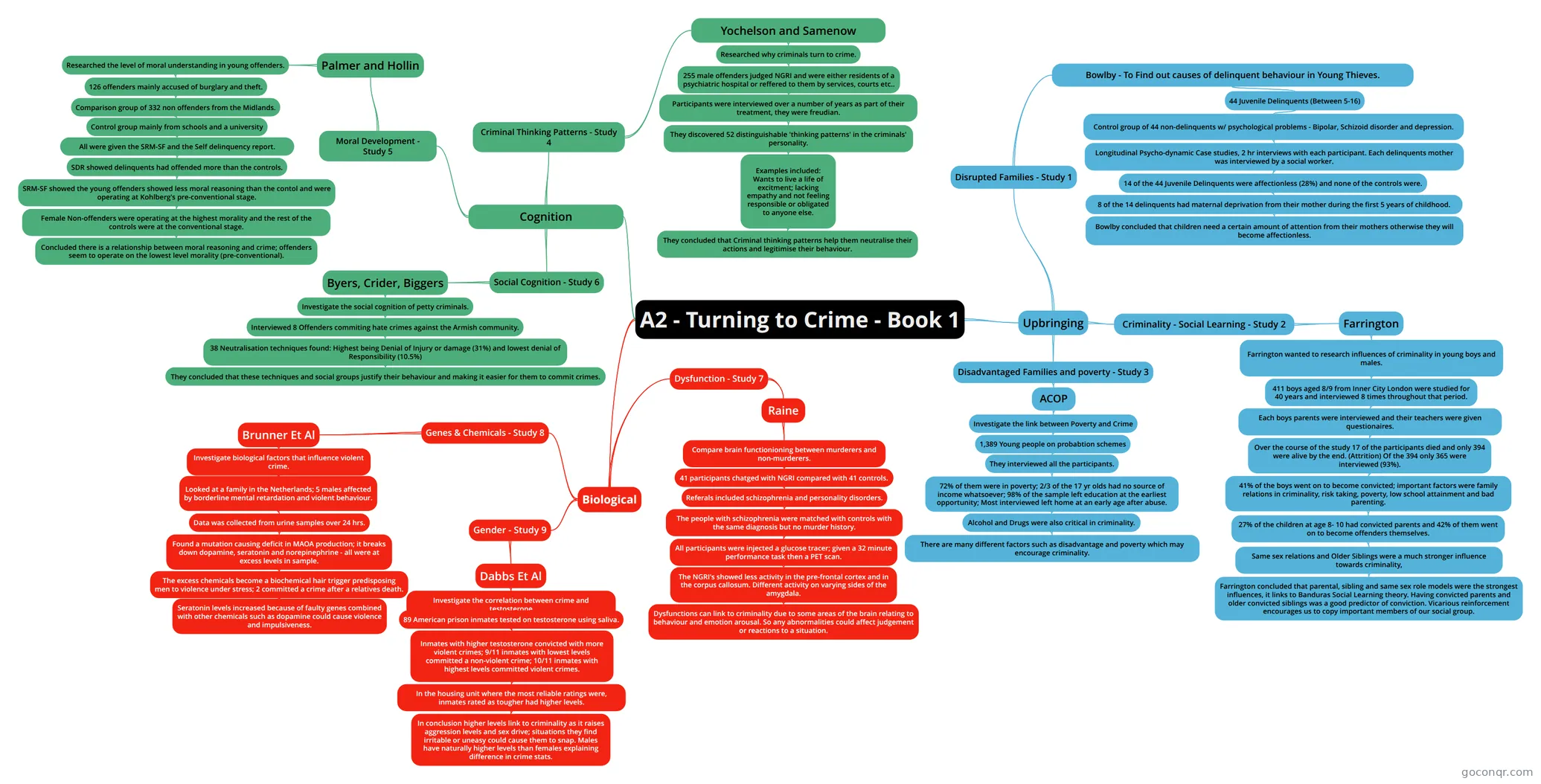
Mind map: Turning to crime
Map content
A2 - Turning to Crime - Book 1
Upbringing
- Disrupted Families - Study 1
- Bowlby - To Find out causes of delinquent behaviour in Young Thieves.
- 44 Juvenile Delinquents (Between 5-16)
- Control group of 44 non-delinquents w/ psychological problems - Bipolar, Schizoid disorder and depression.
- Longitudinal Psycho-dynamic Case studies, 2 hr interviews with each participant. Each delinquents mother was interviewed by a social worker.
- 14 of the 44 Juvenile Delinquents were affectionless (28%) and none of the controls were.
- 8 of the 14 delinquents had maternal deprivation from their mother during the first 5 years of childhood.
- Bowlby concluded that children need a certain amount of attention from their mothers otherwise they will become affectionless.
- 8 of the 14 delinquents had maternal deprivation from their mother during the first 5 years of childhood.
- 14 of the 44 Juvenile Delinquents were affectionless (28%) and none of the controls were.
- Longitudinal Psycho-dynamic Case studies, 2 hr interviews with each participant. Each delinquents mother was interviewed by a social worker.
- Control group of 44 non-delinquents w/ psychological problems - Bipolar, Schizoid disorder and depression.
- 44 Juvenile Delinquents (Between 5-16)
- Bowlby - To Find out causes of delinquent behaviour in Young Thieves.
- Criminality - Social Learning - Study 2
- Farrington
- Farrington wanted to research influences of criminality in young boys and males.
- 411 boys aged 8/9 from Inner City London were studied for 40 years and interviewed 8 times throughout that period.
- Each boys parents were interviewed and their teachers were given questionaires.
- Over the course of the study 17 of the participants died and only 394 were alive by the end. (Attrition) Of the 394 only 365 were interviewed (93%).
- 41% of the boys went on to become convicted; important factors were family relations in criminality, risk taking, poverty, low school attainment and bad parenting.
- 27% of the children at age 8- 10 had convicted parents and 42% of them went on to become offenders themselves.
- Same sex relations and Older Siblings were a much stronger influence towards criminality,
- Farrington concluded that parental, sibling and same sex role models were the strongest influences, it links to Banduras Social Learning theory. Having convicted parents and older convicted siblings was a good predictor of conviction. Vicarious reinforcement encourages us to copy important members of our social group.
- Same sex relations and Older Siblings were a much stronger influence towards criminality,
- 27% of the children at age 8- 10 had convicted parents and 42% of them went on to become offenders themselves.
- 41% of the boys went on to become convicted; important factors were family relations in criminality, risk taking, poverty, low school attainment and bad parenting.
- Over the course of the study 17 of the participants died and only 394 were alive by the end. (Attrition) Of the 394 only 365 were interviewed (93%).
- Each boys parents were interviewed and their teachers were given questionaires.
- 411 boys aged 8/9 from Inner City London were studied for 40 years and interviewed 8 times throughout that period.
- Farrington wanted to research influences of criminality in young boys and males.
- Farrington
- Disadvantaged Families and poverty - Study 3
- ACOP
- Investigate the link between Poverty and Crime
- 1,389 Young people on probabtion schemes
- They interviewed all the participants.
- 72% of them were in poverty; 2/3 of the 17 yr olds had no source of income whatsoever; 98% of the sample left education at the earliest opportunity; Most interviewed left home at an early age after abuse.
- Alcohol and Drugs were also critical in criminality.
- There are many different factors such as disadvantage and poverty which may encourage criminality.
- Alcohol and Drugs were also critical in criminality.
- 72% of them were in poverty; 2/3 of the 17 yr olds had no source of income whatsoever; 98% of the sample left education at the earliest opportunity; Most interviewed left home at an early age after abuse.
- They interviewed all the participants.
- 1,389 Young people on probabtion schemes
- Investigate the link between Poverty and Crime
- ACOP
- Disrupted Families - Study 1
Cognition
- Criminal Thinking Patterns - Study 4
- Yochelson and Samenow
- Researched why criminals turn to crime.
- 255 male offenders judged NGRI and were either residents of a psychiatric hospital or reffered to them by services, courts etc..
- Participants were interviewed over a number of years as part of their treatment, they were freudian.
- They discovered 52 distinguishable 'thinking patterns' in the criminals' personality.
- Examples included: Wants to live a life of excitment; lacking empathy and not feeling responsible or obligated to anyone else.
- They concluded that Criminal thinking patterns help them neutralise their actions and legitimise their behaviour.
- Examples included: Wants to live a life of excitment; lacking empathy and not feeling responsible or obligated to anyone else.
- They discovered 52 distinguishable 'thinking patterns' in the criminals' personality.
- Participants were interviewed over a number of years as part of their treatment, they were freudian.
- 255 male offenders judged NGRI and were either residents of a psychiatric hospital or reffered to them by services, courts etc..
- Researched why criminals turn to crime.
- Yochelson and Samenow
- Moral Development - Study 5
- Palmer and Hollin
- Researched the level of moral understanding in young offenders.
- 126 offenders mainly accused of burglary and theft.
- Comparison group of 332 non offenders from the Midlands.
- Control group mainly from schools and a university
- All were given the SRM-SF and the Self delinquency report.
- SDR showed delinquents had offended more than the controls.
- SRM-SF showed the young offenders showed less moral reasoning than the contol and were operating at Kohlberg's pre-conventional stage.
- Female Non-offenders were operating at the highest morality and the rest of the controls were at the conventional stage.
- Concluded there is a relationship between moral reasoning and crime; offenders seem to operate on the lowest level morality (pre-conventional).
- Female Non-offenders were operating at the highest morality and the rest of the controls were at the conventional stage.
- SRM-SF showed the young offenders showed less moral reasoning than the contol and were operating at Kohlberg's pre-conventional stage.
- SDR showed delinquents had offended more than the controls.
- All were given the SRM-SF and the Self delinquency report.
- Control group mainly from schools and a university
- Comparison group of 332 non offenders from the Midlands.
- 126 offenders mainly accused of burglary and theft.
- Researched the level of moral understanding in young offenders.
- Palmer and Hollin
- Social Cognition - Study 6
- Byers, Crider, Biggers
- Investigate the social cognition of petty criminals.
- Interviewed 8 Offenders commiting hate crimes against the Armish community.
- 38 Neutralisation techniques found: Highest being Denial of Injury or damage (31%) and lowest denial of Responsibility (10.5%)
- They concluded that these techniques and social groups justify their behaviour and making it easier for them to commit crimes.
- 38 Neutralisation techniques found: Highest being Denial of Injury or damage (31%) and lowest denial of Responsibility (10.5%)
- Interviewed 8 Offenders commiting hate crimes against the Armish community.
- Investigate the social cognition of petty criminals.
- Byers, Crider, Biggers
- Criminal Thinking Patterns - Study 4
Biological
- Dysfunction - Study 7
- Raine
- Compare brain functionioning between murderers and non-murderers.
- 41 participants chatged with NGRI compared with 41 controls.
- Referals included schizophrenia and personality disorders.
- The people with schizophrenia were matched with controls with the same diagnosis but no murder history.
- All participants were injected a glucose tracer; given a 32 minute performance task then a PET scan.
- The NGRI's showed less activity in the pre-frontal cortex and in the corpus callosum. Different activity on varying sides of the amygdala.
- Dysfunctions can link to criminality due to some areas of the brain relating to behaviour and emotion arousal. So any abnormalities could affect judgement or reactions to a situation.
- The NGRI's showed less activity in the pre-frontal cortex and in the corpus callosum. Different activity on varying sides of the amygdala.
- All participants were injected a glucose tracer; given a 32 minute performance task then a PET scan.
- The people with schizophrenia were matched with controls with the same diagnosis but no murder history.
- Referals included schizophrenia and personality disorders.
- 41 participants chatged with NGRI compared with 41 controls.
- Compare brain functionioning between murderers and non-murderers.
- Raine
- Genes & Chemicals - Study 8
- Brunner Et Al
- Investigate biological factors that influence violent crime.
- Looked at a family in the Netherlands; 5 males affected by borderline mental retardation and violent behaviour.
- Data was collected from urine samples over 24 hrs.
- Found a mutation causing deficit in MAOA production; it breaks down dopamine, seratonin and norepinephrine - all were at excess levels in sample.
- The excess chemicals become a biochemical hair trigger predisposing men to violence under stress; 2 committed a crime after a relatives death.
- Seratonin levels increased because of faulty genes combined with other chemicals such as dopamine could cause violence and impulsiveness.
- The excess chemicals become a biochemical hair trigger predisposing men to violence under stress; 2 committed a crime after a relatives death.
- Found a mutation causing deficit in MAOA production; it breaks down dopamine, seratonin and norepinephrine - all were at excess levels in sample.
- Data was collected from urine samples over 24 hrs.
- Looked at a family in the Netherlands; 5 males affected by borderline mental retardation and violent behaviour.
- Investigate biological factors that influence violent crime.
- Brunner Et Al
- Gender - Study 9
- Dabbs Et Al
- Investigate the correlation between crime and testosterone
- 89 American prison inmates tested on testosterone using saliva.
- Inmates with higher testosterone convicted with more violent crimes; 9/11 inmates with lowest levels committed a non-violent crime; 10/11 inmates with highest levels committed violent crimes.
- In the housing unit where the most reliable ratings were, inmates rated as tougher had higher levels.
- In conclusion higher levels link to criminality as it raises aggression levels and sex drive; situations they find irritable or uneasy could cause them to snap. Males have naturally higher levels than females explaining difference in crime stats.
- In the housing unit where the most reliable ratings were, inmates rated as tougher had higher levels.
- Inmates with higher testosterone convicted with more violent crimes; 9/11 inmates with lowest levels committed a non-violent crime; 10/11 inmates with highest levels committed violent crimes.
- 89 American prison inmates tested on testosterone using saliva.
- Investigate the correlation between crime and testosterone
- Dabbs Et Al
- Dysfunction - Study 7
Information
- Description
- Mind Map on A2 - Turning to Crime - Book 1, created by ryan cook on 17/04/2016.
- Created by
- ryan cook
- Views
- 2
- Rating