
Mind map
Ecosystems
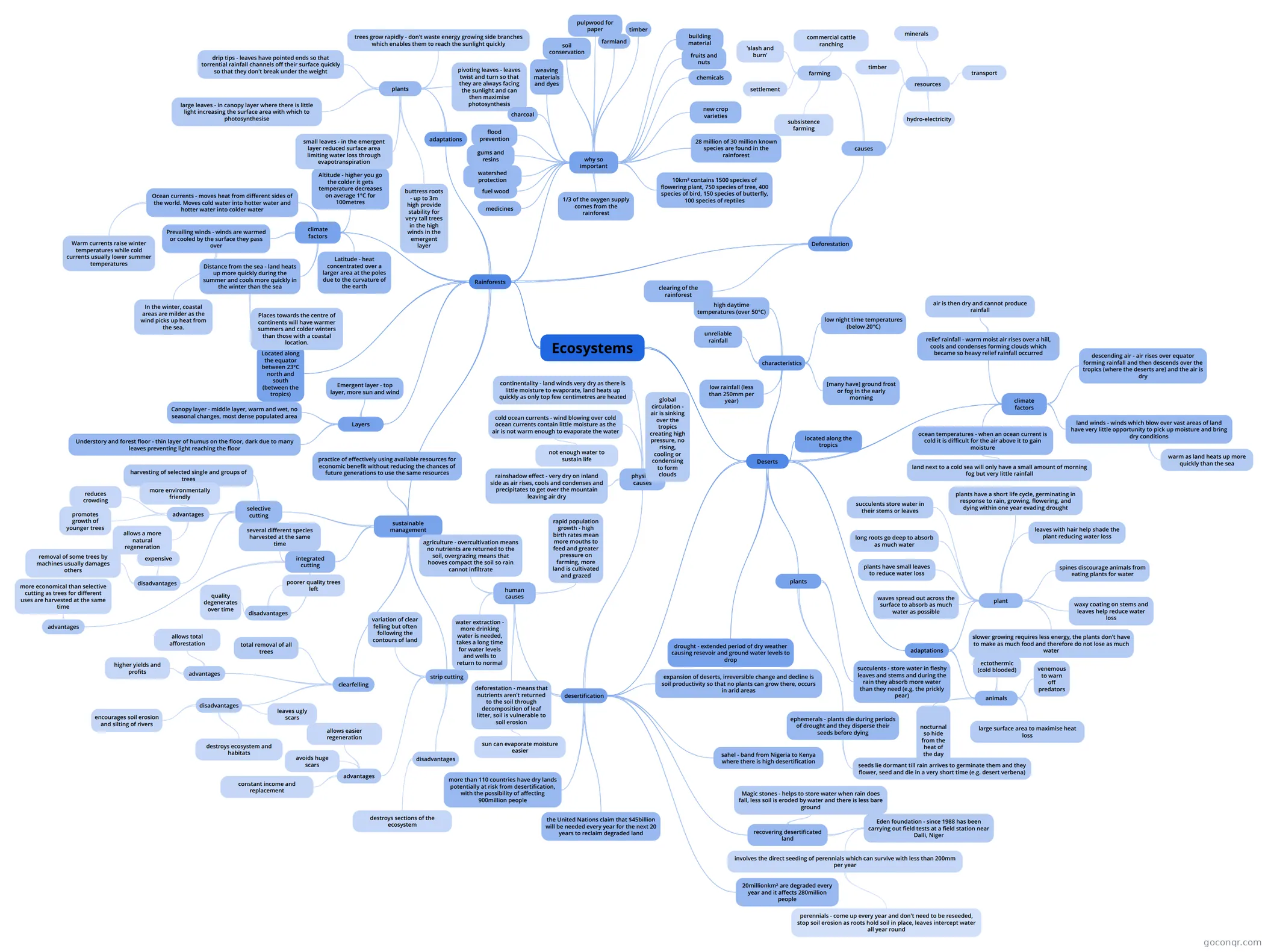
Mind map: Ecosystems
Map content
Ecosystems
Rainforests
- climate factors
- Latitude - heat concentrated over a larger area at the poles due to the curvature of the earth
- Distance from the sea - land heats up more quickly during the summer and cools more quickly in the winter than the sea
- Places towards the centre of continents will have warmer summers and colder winters than those with a coastal location.
- Prevailing winds - winds are warmed or cooled by the surface they pass over
- In the winter, coastal areas are milder as the wind picks up heat from the sea.
- Ocean currents - moves heat from different sides of the world. Moves cold water into hotter water and hotter water into colder water
- Warm currents raise winter temperatures while cold currents usually lower summer temperatures
- Altitude - higher you go the colder it gets temperature decreases on average 1°C for 100metres
- Located along the equator between 23°C north and south (between the tropics)
- Layers
- Emergent layer - top layer, more sun and wind
- Canopy layer - middle layer, warm and wet, no seasonal changes, most dense populated area
- Understory and forest floor - thin layer of humus on the floor, dark due to many leaves preventing light reaching the floor
- adaptations
- plants
- buttress roots - up to 3m high provide stability for very tall trees in the high winds in the emergent layer
- small leaves - in the emergent layer reduced surface area limiting water loss through evapotranspiration
- large leaves - in canopy layer where there is little light increasing the surface area with which to photosynthesise
- drip tips - leaves have pointed ends so that torrential rainfall channels off their surface quickly so that they don't break under the weight
- trees grow rapidly - don't waste energy growing side branches which enables them to reach the sunlight quickly
- pivoting leaves - leaves twist and turn so that they are always facing the sunlight and can then maximise photosynthesis
- plants
- why so important
- farmland
- timber
- pulpwood for paper
- building material
- fruits and nuts
- chemicals
- soil conservation
- weaving materials and dyes
- charcoal
- new crop varieties
- medicines
- fuel wood
- flood prevention
- gums and resins
- watershed protection
- 28 million of 30 million known species are found in the rainforest
- 10km² contains 1500 species of flowering plant, 750 species of tree, 400 species of bird, 150 species of butterfly, 100 species of reptiles
- 1/3 of the oxygen supply comes from the rainforest
- Deforestation
- clearing of the rainforest
- causes
- farming
- 'slash and burn'
- subsistence farming
- settlement
- commercial cattle ranching
- resources
- timber
- minerals
- hydro-electricity
- transport
- farming
- sustainable management
- practice of effectively using available resources for economic benefit without reducing the chances of future generations to use the same resources
- selective cutting
- harvesting of selected single and groups of trees
- advantages
- reduces crowding
- promotes growth of younger trees
- allows a more natural regeneration
- more environmentally friendly
- disadvantages
- expensive
- removal of some trees by machines usually damages others
- integrated cutting
- several different species harvested at the same time
- advantages
- more economical than selective cutting as trees for different uses are harvested at the same time
- disadvantages
- poorer quality trees left
- quality degenerates over time
- clearfelling
- total removal of all trees
- advantages
- allows total afforestation
- higher yields and profits
- disadvantages
- leaves ugly scars
- destroys ecosystem and habitats
- encourages soil erosion and silting of rivers
- strip cutting
- variation of clear felling but often following the contours of land
- advantages
- avoids huge scars
- allows easier regeneration
- constant income and replacement
- disadvantages
- destroys sections of the ecosystem
- climate factors
Deserts
- characteristics
- low rainfall (less than 250mm per year)
- unreliable rainfall
- high daytime temperatures (over 50°C)
- low night time temperatures (below 20°C)
- [many have] ground frost or fog in the early morning
- climate factors
- relief rainfall - warm moist air rises over a hill, cools and condenses forming clouds which became so heavy relief rainfall occurred
- air is then dry and cannot produce rainfall
- descending air - air rises over equator forming rainfall and then descends over the tropics (where the deserts are) and the air is dry
- land winds - winds which blow over vast areas of land have very little opportunity to pick up moisture and bring dry conditions
- warm as land heats up more quickly than the sea
- ocean temperatures - when an ocean current is cold it is difficult for the air above it to gain moisture
- land next to a cold sea will only have a small amount of morning fog but very little rainfall
- relief rainfall - warm moist air rises over a hill, cools and condenses forming clouds which became so heavy relief rainfall occurred
- located along the tropics
- adaptations
- plant
- succulents store water in their stems or leaves
- plants have small leaves to reduce water loss
- long roots go deep to absorb as much water
- waves spread out across the surface to absorb as much water as possible
- plants have a short life cycle, germinating in response to rain, growing, flowering, and dying within one year evading drought
- leaves with hair help shade the plant reducing water loss
- spines discourage animals from eating plants for water
- waxy coating on stems and leaves help reduce water loss
- slower growing requires less energy, the plants don't have to make as much food and therefore do not lose as much water
- animals
- nocturnal so hide from the heat of the day
- ectothermic (cold blooded)
- venemous to warn off predators
- large surface area to maximise heat loss
- plant
- plants
- succulents - store water in fleshy leaves and stems and during the rain they absorb more water than they need (e.g. the prickly pear)
- ephemerals - plants die during periods of drought and they disperse their seeds before dying
- seeds lie dormant till rain arrives to germinate them and they flower, seed and die in a very short time (e.g. desert verbena)
- drought - extended period of dry weather causing resevoir and ground water levels to drop
- desertification
- physical causes
- global circulation - air is sinking over the tropics creating high pressure, no rising, cooling or condensing to form clouds
- continentality - land winds very dry as there is little moisture to evaporate, land heats up quickly as only top few centimetres are heated
- cold ocean currents - wind blowing over cold ocean currents contain little moisture as the air is not warm enough to evaporate the water
- not enough water to sustain life
- rainshadow effect - very dry on inland side as air rises, cools and condenses and precipitates to get over the mountain leaving air dry
- expansion of deserts, irreversible change and decline is soil productivity so that no plants can grow there, occurs in arid areas
- human causes
- agriculture - overcultivation means no nutrients are returned to the soil, overgrazing means that hooves compact the soil so rain cannot infiltrate
- rapid population growth - high birth rates mean more mouths to feed and greater pressure on farming, more land is cultivated and grazed
- deforestation - means that nutrients aren't returned to the soil through decomposition of leaf litter, soil is vulnerable to soil erosion
- sun can evaporate moisture easier
- water extraction - more drinking water is needed, takes a long time for water levels and wells to return to normal
- sahel - band from Nigeria to Kenya where there is high desertification
- recovering desertificated land
- Magic stones - helps to store water when rain does fall, less soil is eroded by water and there is less bare ground
- Eden foundation - since 1988 has been carrying out field tests at a field station near Dalli, Niger
- involves the direct seeding of perennials which can survive with less than 200mm per year
- perennials - come up every year and don't need to be reseeded, stop soil erosion as roots hold soil in place, leaves intercept water all year round
- involves the direct seeding of perennials which can survive with less than 200mm per year
- 20millionkm² are degraded every year and it affects 280million people
- more than 110 countries have dry lands potentially at risk from desertification, with the possibility of affecting 900million people
- the United Nations claim that $45billion will be needed every year for the next 20 years to reclaim degraded land
- physical causes
- characteristics
Information
- Description
- Geography Mind Map on Ecosystems, created by hughes.lucy on 20/04/2013.
- Created by
- hughes.lucy
- Views
- 63
- Tags
- Rating