
Mind map
10 Common Email & Internet Scams – How to Avoid Them
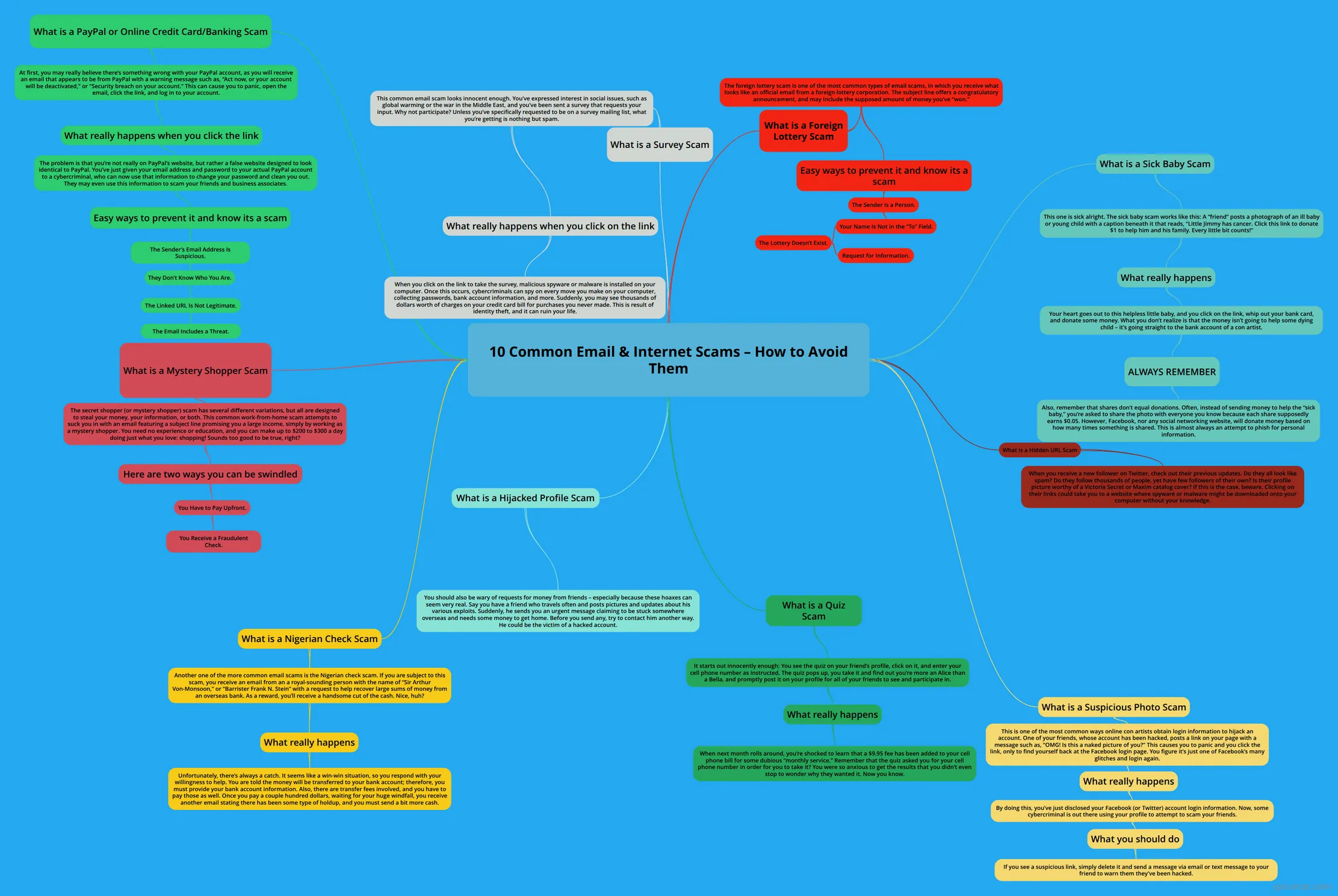
Mind map: Common email and internet scams
Map content
10 Common Email & Internet Scams – How to Avoid Them
What is a Quiz Scam
- It starts out innocently enough: You see the quiz on your friend’s profile, click on it, and enter your cell phone number as instructed. The quiz pops up, you take it and find out you’re more an Alice than a Bella, and promptly post it on your profile for all of your friends to see and participate in.
- What really happens
- When next month rolls around, you’re shocked to learn that a $9.95 fee has been added to your cell phone bill for some dubious “monthly service.” Remember that the quiz asked you for your cell phone number in order for you to take it? You were so anxious to get the results that you didn’t even stop to wonder why they wanted it. Now you know.
- What really happens
- It starts out innocently enough: You see the quiz on your friend’s profile, click on it, and enter your cell phone number as instructed. The quiz pops up, you take it and find out you’re more an Alice than a Bella, and promptly post it on your profile for all of your friends to see and participate in.
What is a PayPal or Online Credit Card/Banking Scam
- At first, you may really believe there’s something wrong with your PayPal account, as you will receive an email that appears to be from PayPal with a warning message such as, “Act now, or your account will be deactivated,” or “Security breach on your account.” This can cause you to panic, open the email, click the link, and log in to your account.
- What really happens when you click the link
- The problem is that you’re not really on PayPal’s website, but rather a false website designed to look identical to PayPal. You’ve just given your email address and password to your actual PayPal account to a cybercriminal, who can now use that information to change your password and clean you out. They may even use this information to scam your friends and business associates.
- Easy ways to prevent it and know its a scam
- The Sender’s Email Address Is Suspicious.
- They Don’t Know Who You Are.
- The Linked URL Is Not Legitimate.
- The Email Includes a Threat.
- The Linked URL Is Not Legitimate.
- They Don’t Know Who You Are.
- The Sender’s Email Address Is Suspicious.
- Easy ways to prevent it and know its a scam
- The problem is that you’re not really on PayPal’s website, but rather a false website designed to look identical to PayPal. You’ve just given your email address and password to your actual PayPal account to a cybercriminal, who can now use that information to change your password and clean you out. They may even use this information to scam your friends and business associates.
- What really happens when you click the link
- At first, you may really believe there’s something wrong with your PayPal account, as you will receive an email that appears to be from PayPal with a warning message such as, “Act now, or your account will be deactivated,” or “Security breach on your account.” This can cause you to panic, open the email, click the link, and log in to your account.
What is a Mystery Shopper Scam
- The secret shopper (or mystery shopper) scam has several different variations, but all are designed to steal your money, your information, or both. This common work-from-home scam attempts to suck you in with an email featuring a subject line promising you a large income, simply by working as a mystery shopper. You need no experience or education, and you can make up to $200 to $300 a day doing just what you love: shopping! Sounds too good to be true, right?
- Here are two ways you can be swindled
- You Have to Pay Upfront.
- You Receive a Fraudulent Check.
- You Have to Pay Upfront.
- Here are two ways you can be swindled
- The secret shopper (or mystery shopper) scam has several different variations, but all are designed to steal your money, your information, or both. This common work-from-home scam attempts to suck you in with an email featuring a subject line promising you a large income, simply by working as a mystery shopper. You need no experience or education, and you can make up to $200 to $300 a day doing just what you love: shopping! Sounds too good to be true, right?
What is a Nigerian Check Scam
- Another one of the more common email scams is the Nigerian check scam. If you are subject to this scam, you receive an email from an a royal-sounding person with the name of “Sir Arthur Von-Monsoon,” or “Barrister Frank N. Stein” with a request to help recover large sums of money from an overseas bank. As a reward, you’ll receive a handsome cut of the cash. Nice, huh?
- What really happens
- Unfortunately, there’s always a catch. It seems like a win-win situation, so you respond with your willingness to help. You are told the money will be transferred to your bank account; therefore, you must provide your bank account information. Also, there are transfer fees involved, and you have to pay those as well. Once you pay a couple hundred dollars, waiting for your huge windfall, you receive another email stating there has been some type of holdup, and you must send a bit more cash.
- What really happens
- Another one of the more common email scams is the Nigerian check scam. If you are subject to this scam, you receive an email from an a royal-sounding person with the name of “Sir Arthur Von-Monsoon,” or “Barrister Frank N. Stein” with a request to help recover large sums of money from an overseas bank. As a reward, you’ll receive a handsome cut of the cash. Nice, huh?
What is a Sick Baby Scam
- This one is sick alright. The sick baby scam works like this: A “friend” posts a photograph of an ill baby or young child with a caption beneath it that reads, “Little Jimmy has cancer. Click this link to donate $1 to help him and his family. Every little bit counts!”
- What really happens
- Your heart goes out to this helpless little baby, and you click on the link, whip out your bank card, and donate some money. What you don’t realize is that the money isn’t going to help some dying child – it’s going straight to the bank account of a con artist.
- ALWAYS REMEMBER
- Also, remember that shares don’t equal donations. Often, instead of sending money to help the “sick baby,” you’re asked to share the photo with everyone you know because each share supposedly earns $0.05. However, Facebook, nor any social networking website, will donate money based on how many times something is shared. This is almost always an attempt to phish for personal information.
- ALWAYS REMEMBER
- Your heart goes out to this helpless little baby, and you click on the link, whip out your bank card, and donate some money. What you don’t realize is that the money isn’t going to help some dying child – it’s going straight to the bank account of a con artist.
- What really happens
- This one is sick alright. The sick baby scam works like this: A “friend” posts a photograph of an ill baby or young child with a caption beneath it that reads, “Little Jimmy has cancer. Click this link to donate $1 to help him and his family. Every little bit counts!”
What is a Foreign Lottery Scam
- The foreign lottery scam is one of the most common types of email scams, in which you receive what looks like an official email from a foreign lottery corporation. The subject line offers a congratulatory announcement, and may include the supposed amount of money you’ve “won.”
- Easy ways to prevent it and know its a scam
- The Sender Is a Person.
- Your Name Is Not in the “To” Field.
- The Lottery Doesn’t Exist.
- Request for Information.
- The Lottery Doesn’t Exist.
- Your Name Is Not in the “To” Field.
- The Sender Is a Person.
- Easy ways to prevent it and know its a scam
- The foreign lottery scam is one of the most common types of email scams, in which you receive what looks like an official email from a foreign lottery corporation. The subject line offers a congratulatory announcement, and may include the supposed amount of money you’ve “won.”
What is a Hijacked Profile Scam
- You should also be wary of requests for money from friends – especially because these hoaxes can seem very real. Say you have a friend who travels often and posts pictures and updates about his various exploits. Suddenly, he sends you an urgent message claiming to be stuck somewhere overseas and needs some money to get home. Before you send any, try to contact him another way. He could be the victim of a hacked account.
What is a Suspicious Photo Scam
- This is one of the most common ways online con artists obtain login information to hijack an account. One of your friends, whose account has been hacked, posts a link on your page with a message such as, “OMG! Is this a naked picture of you?” This causes you to panic and you click the link, only to find yourself back at the Facebook login page. You figure it’s just one of Facebook’s many glitches and login again.
- What really happens
- By doing this, you’ve just disclosed your Facebook (or Twitter) account login information. Now, some cybercriminal is out there using your profile to attempt to scam your friends.
- What you should do
- If you see a suspicious link, simply delete it and send a message via email or text message to your friend to warn them they’ve been hacked.
- What you should do
- By doing this, you’ve just disclosed your Facebook (or Twitter) account login information. Now, some cybercriminal is out there using your profile to attempt to scam your friends.
- What really happens
- This is one of the most common ways online con artists obtain login information to hijack an account. One of your friends, whose account has been hacked, posts a link on your page with a message such as, “OMG! Is this a naked picture of you?” This causes you to panic and you click the link, only to find yourself back at the Facebook login page. You figure it’s just one of Facebook’s many glitches and login again.
What is a Survey Scam
- This common email scam looks innocent enough. You’ve expressed interest in social issues, such as global warming or the war in the Middle East, and you’ve been sent a survey that requests your input. Why not participate? Unless you’ve specifically requested to be on a survey mailing list, what you’re getting is nothing but spam.
- What really happens when you click on the link
- When you click on the link to take the survey, malicious spyware or malware is installed on your computer. Once this occurs, cybercriminals can spy on every move you make on your computer, collecting passwords, bank account information, and more. Suddenly, you may see thousands of dollars worth of charges on your credit card bill for purchases you never made. This is result of identity theft, and it can ruin your life.
- What really happens when you click on the link
- This common email scam looks innocent enough. You’ve expressed interest in social issues, such as global warming or the war in the Middle East, and you’ve been sent a survey that requests your input. Why not participate? Unless you’ve specifically requested to be on a survey mailing list, what you’re getting is nothing but spam.
What is a Hidden URL Scam
- When you receive a new follower on Twitter, check out their previous updates. Do they all look like spam? Do they follow thousands of people, yet have few followers of their own? Is their profile picture worthy of a Victoria Secret or Maxim catalog cover? If this is the case, beware. Clicking on their links could take you to a website where spyware or malware might be downloaded onto your computer without your knowledge.
Information
- Description
- Mind Map on 10 Common Email & Internet Scams – How to Avoid Them, created by Amro Alsayed on 20/04/2016.
- Created by
- Amro Alsayed
- Views
- 1
- Rating
More on Phishing and online scams