
Mind map
Creating Innovation: A Strategic Approach
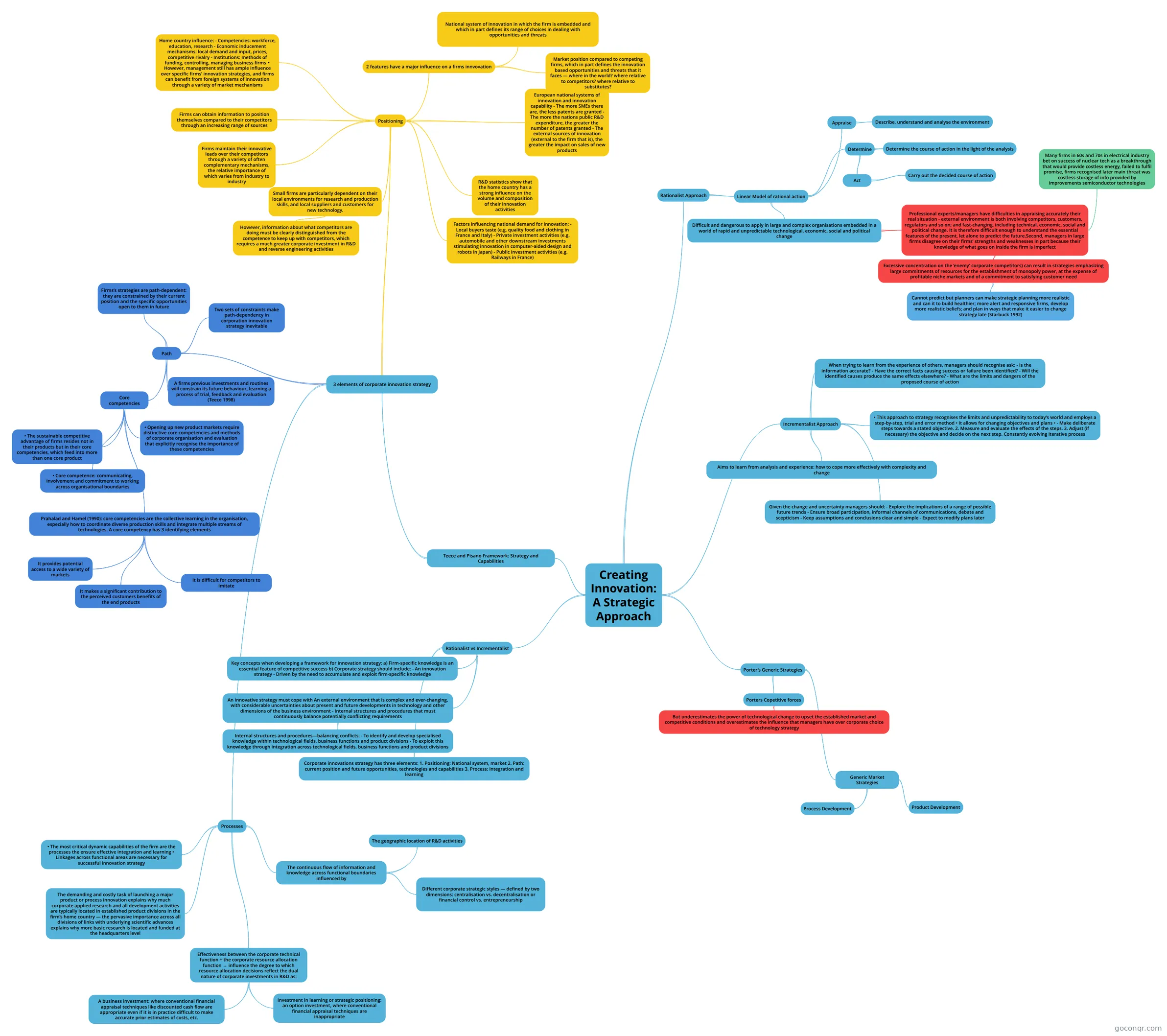
Mind map: Creating innovation: a strategic approach
Map content
Creating Innovation: A Strategic Approach
Rationalist Approach
- Linear Model of rational action
- Appraise
- Describe, understand and analyse the environment
- Determine
- Determine the course of action in the light of the analysis
- Act
- Carry out the decided course of action
- Difficult and dangerous to apply in large and complex organisations embedded in a world of rapid and unpredictable technological, economic, social and political change
- Professional experts/managers have difficulties in appraising accurately their real situation - external environment is both involving competitors, customers, regulators and so on; and fast-changing, including technical, economic, social and political change. It is therefore difficult enough to understand the essential features of the present, let alone to predict the future.Second, managers in large firms disagree on their firms’ strengths and weaknesses in part because their knowledge of what goes on inside the firm is imperfect
- Excessive concentration on the ‘enemy’ corporate competitors) can result in strategies emphasizing large commitments of resources for the establishment of monopoly power, at the expense of profitable niche markets and of a commitment to satisfying customer need
- Cannot predict but planners can make strategic planning more realistic and can it to build healthier; more alert and responsive firms, develop more realistic beliefs; and plan in ways that make it easier to change strategy late (Starbuck 1992)
- Many firms in 60s and 70s in electrical industry bet on success of nuclear tech as a breakthrough that would provide costless energy, failed to fulfil promise, firms recognised later main threat was costless storage of info provided by improvements semiconductor technologies
- Excessive concentration on the ‘enemy’ corporate competitors) can result in strategies emphasizing large commitments of resources for the establishment of monopoly power, at the expense of profitable niche markets and of a commitment to satisfying customer need
- Professional experts/managers have difficulties in appraising accurately their real situation - external environment is both involving competitors, customers, regulators and so on; and fast-changing, including technical, economic, social and political change. It is therefore difficult enough to understand the essential features of the present, let alone to predict the future.Second, managers in large firms disagree on their firms’ strengths and weaknesses in part because their knowledge of what goes on inside the firm is imperfect
- Appraise
- Linear Model of rational action
Incrementalist Approach
- • This approach to strategy recognises the limits and unpredictability to today’s world and employs a step-by-step, trial and error method • It allows for changing objectives and plans • - Make deliberate steps towards a stated objective. 2. Measure and evaluate the effects of the steps. 3. Adjust (if necessary) the objective and decide on the next step. Constantly evolving iterative process
- Aims to learn from analysis and experience: how to cope more effectively with complexity and change
- Given the change and uncertainty managers should: - Explore the implications of a range of possible future trends - Ensure broad participation, informal channels of communications, debate and scepticism - Keep assumptions and conclusions clear and simple - Expect to modify plans later
- When trying to learn from the experience of others, managers should recognise ask: - Is the information accurate? - Have the correct facts causing success or failure been identified? - Will the identified causes produce the same effects elsewhere? - What are the limits and dangers of the proposed course of action
Porter’s Generic Strategies
- Porters Copetitive forces
- But underestimates the power of technological change to upset the established market and competitive conditions and overestimates the influence that managers have over corporate choice of technology strategy
- Generic Market Strategies
- Product Development
- Cost Leadership - Lower material inputs Differentiation - Enhance quality, Enhance features Cost focus - Minimum features Differentiation focus - Niche Market
- Process Development
- Cost Leadership - Ease of manufacture Improve logics Learning curve Economies of scale Differentiation - Deliverability Precision Quality Control Response time Cost focus - Minimise costs Differentiation Focus - Precision, quality control, response time
- Product Development
- Porters Copetitive forces
Rationalist vs Incrementalist
- Key concepts when developing a framework for innovation strategy: a) Firm-specific knowledge is an essential feature of competitive success b) Corporate strategy should include: - An innovation strategy - Driven by the need to accumulate and exploit firm-specific knowledge
- An innovative strategy must cope with An external environment that is complex and ever-changing, with considerable uncertainties about present and future developments in technology and other dimensions of the business environment - Internal structures and procedures that must continuously balance potentially conflicting requirements
- Internal structures and procedures—balancing conflicts: - To identify and develop specialised knowledge within technological fields, business functions and product divisions - To exploit this knowledge through integration across technological fields, business functions and product divisions
- Corporate innovations strategy has three elements: 1. Positioning: National system, market 2. Path: current position and future opportunities, technologies and capabilities 3. Process: integration and learning
Teece and Pisano Framework: Strategy and Capabilities
- 3 elements of corporate innovation strategy
- Positioning
- 2 features have a major influence on a firms innvovation
- National system of innovation in which the firm is embedded and which in part defines its range of choices in dealing with opportunities and threats
- Market position compared to competing firms, which in part defines the innovation based opportunities and threats that it faces — where in the world? where relative to competitors? where relative to substitutes?
- R&D statistics show that the home country has a strong influence on the volume and composition of their innovation activities
- European national systems of innovation and innovation capability - The more SMEs there are, the less patents are granted - The more the nations public R&D expenditure, the greater the number of patents granted - The external sources of innovation (external to the firm that is), the greater the impact on sales of new products
- Home country influence: - Competencies: workforce, education, research - Economic inducement mechanisms: local demand and input, prices, competitive rivalry - Institutions: methods of funding, controlling, managing business firms ‣ However, management still has ample influence over specific firms’ innovation strategies, and firms can benefit from foreign systems of innovation through a variety of market mechanisms
- Firms can obtain information to position themselves compared to their competitors through an increasing range of sources
- Firms maintain their innovative leads over their competitors through a variety of often complementary mechanisms, the relative importance of which varies from industry to industry
- Small firms are particularly dependent on their local environments for research and production skills, and local suppliers and customers for new technology.
- However, information about what competitors are doing must be clearly distinguished from the competence to keep up with competitors, which requires a much greater corporate investment in R&D and reverse engineering activities
- Factors influencing national demand for innovation: - Local buyers taste (e.g. quality food and clothing in France and Italy) - Private investment activities (e.g. automobile and other downstream investments stimulating innovation in computer-aided design and robots in Japan) - Public investment activities (e.g. Railways in France)
- 2 features have a major influence on a firms innvovation
- Path
- Firms’s strategies are path-dependent: they are constrained by their current position and the specific opportunities open to them in future
- Two sets of constraints make path-dependency in corporation innovation strategy inevitable
- - Those of the present and likely future state of technological knowledge - Those of the limits of corporate competence
- Core competencies
- • The sustainable competitive advantage of firms resides not in their products but in their core competencies, which feed into more than one core product
- • Core competence: communicating, involvement and commitment to working across organisational boundaries
- • Opening up new product markets require distinctive core competencies and methods of corporate organisation and evaluation that explicitly recognise the importance of these competencies
- Prahalad and Hamel (1990): core competencies are the collective learning in the organisation, especially how to coordinate diverse production skills and integrate multiple streams of technologies. A core competency has 3 identifying elements
- It provides potential access to a wide variety of markets
- It makes a significant contribution to the perceived customers benefits of the end products
- It is difficult for competitors to imitate
- - This approach is useful in distress with rapid rates of technical progress - Overestimates the importance of corporate visions - Underestimates the importance of competence and experimentation over an ever wider range of technologies - Small firms have distinctive technological trajectories - Greatest attention has been given to superstars who grow into large firms through innovations and new technology based firms whose founders emerge mainly from the laboratories of larger institutions, whilst most small firms depend heavily on their suppliers and customers for their innovative opportunities
- A firms previous investments and routines will constrain its future behaviour, learning a process of trial, feedback and evaluation (Teece 1998)
- Processes
- • The most critical dynamic capabilities of the firm are the processes the ensure effective integration and learning • Linkages across functional areas are necessary for successful innovation strategy
- The continuous flow of information and knowledge across functional boundaries influenced by
- The geographic location of R&D activities
- Different corporate strategic styles — defined by two dimensions: centralisation vs. decentralisation or financial control vs. entrepreneurship
- The demanding and costly task of launching a major product or process innovation explains why much corporate applied research and all development activities are typically located in established product divisions in the firm’s home country — the pervasive importance across all divisions of links with underlying scientific advances explains why more basic research is located and funded at the headquarters level
- Effectiveness between the corporate technical function + the corporate resource allocation function → influence the degree to which resource allocation decisions reflect the dual nature of corporate investments in R&D as:
- A business investment: where conventional financial appraisal techniques like discounted cash flow are appropriate even if it is in practice difficult to make accurate prior estimates of costs, etc.
- Investment in learning or strategic positioning: an option investment, where conventional financial appraisal techniques are inappropriate
- Positioning
- 3 elements of corporate innovation strategy
Information
- Description
- University Mkgt 315 (Creating Innovation: A Strategic Approach) Mind Map on Creating Innovation: A Strategic Approach, created by joshuaadisa on 07/05/2016.
- Created by
- joshuaadisa
- Views
- 0
- Rating