
Mind map
Early vertebrates and Primitive fish
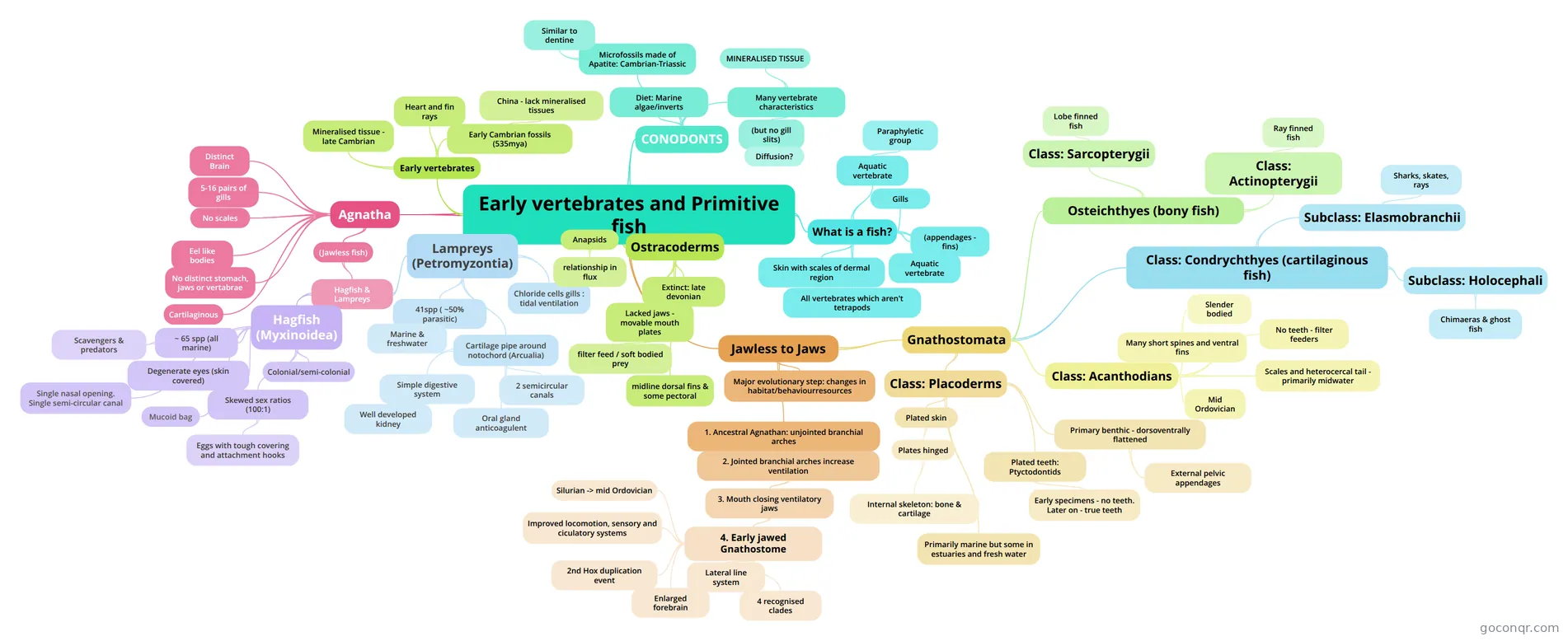
Mind map: Early vertebrates and primitive fish
Map content
Early vertebrates and Primitive fish
What is a fish?
- All vertebrates which aren't tetrapods
- Aquatic vertebrate
- (appendages - fins)
- Gills
- Aquatic vertebrate
- Paraphyletic group
- Skin with scales of dermal region
Early vertebrates
- Early Cambrian fossils (535mya)
- China - lack mineralised tissues
- Heart and fin rays
- Mineralised tissue - late Cambrian
- Early Cambrian fossils (535mya)
CONODONTS
- Microfossils made of Apatite: Cambrian-Triassic
- Similar to dentine
- Diet: Marine algae/inverts
- Many vertebrate characteristics
- (but no gill slits)
- Diffusion?
- MINERALISED TISSUE
- (but no gill slits)
- Microfossils made of Apatite: Cambrian-Triassic
Agnatha
- (Jawless fish)
- Hagfish & Lampreys
- Hagfish (Myxinoidea)
- ~ 65 spp (all marine)
- Scavengers & predators
- Single nasal opening. Single semi-circular canal
- Degenerate eyes (skin covered)
- Mucoid bag
- Skewed sex ratios (100:1)
- Eggs with tough covering and attachment hooks
- Colonial/semi-colonial
- ~ 65 spp (all marine)
- Lampreys (Petromyzontia)
- 41spp ( ~50% parasitic)
- Marine & freshwater
- Cartilage pipe around notochord (Arcualia)
- Simple digestive system
- Well developed kidney
- Oral gland anticoagulent
- 2 semicircular canals
- Simple digestive system
- Chloride cells gills : tidal ventilation
- 41spp ( ~50% parasitic)
- Hagfish (Myxinoidea)
- Hagfish & Lampreys
- No scales
- Eel like bodies
- No distinct stomach, jaws or vertabrae
- Cartilaginous
- 5-16 pairs of gills
- Distinct Brain
- (Jawless fish)
Ostracoderms
- Anapsids
- relationship in flux
- Lacked jaws - movable mouth plates
- filter feed / soft bodied prey
- midline dorsal fins & some pectoral
- Extinct: late devonian
- Anapsids
Jawless to Jaws
- Major evolutionary step: changes in habitat/behaviourresources
- 1. Ancestral Agnathan: unjointed branchial arches
- 2. Jointed branchial arches increase ventilation
- 3. Mouth closing ventilatory jaws
- 4. Early jawed Gnathostome
- Improved locomotion, sensory and ciculatory systems
- Silurian -> mid Ordovician
- 2nd Hox duplication event
- Enlarged forebrain
- Lateral line system
- 4 recognised clades
- 4. Early jawed Gnathostome
- 3. Mouth closing ventilatory jaws
- 2. Jointed branchial arches increase ventilation
- Gnathostomata
- Class: Placoderms
- Plated skin
- Plates hinged
- Internal skeleton: bone & cartilage
- Plates hinged
- Plated teeth: Ptyctodontids
- Early specimens - no teeth. Later on - true teeth
- Primarily marine but some in estuaries and fresh water
- Primary benthic - dorsoventrally flattened
- External pelvic appendages
- Plated skin
- Class: Acanthodians
- Many short spines and ventral fins
- Slender bodied
- Mid Ordovician
- Scales and heterocercal tail - primarily midwater
- No teeth - filter feeders
- Many short spines and ventral fins
- Class: Condrychthyes (cartilaginous fish)
- Subclass: Elasmobranchii
- Sharks, skates, rays
- Subclass: Holocephali
- Chimaeras & ghost fish
- Subclass: Elasmobranchii
- Osteichthyes (bony fish)
- Class: Sarcopterygii
- Lobe finned fish
- Class: Actinopterygii
- Ray finned fish
- Class: Sarcopterygii
- Class: Placoderms
Information
- Description
- Vertebrate Zoology (Early vertebrates/primitive fish) Mind Map on Early vertebrates and Primitive fish, created by Litty Carter on 23/04/2013.
- Created by
- Litty Carter
- Views
- 149
- Tags
- Rating