
Mind map
Language and Gender Theories
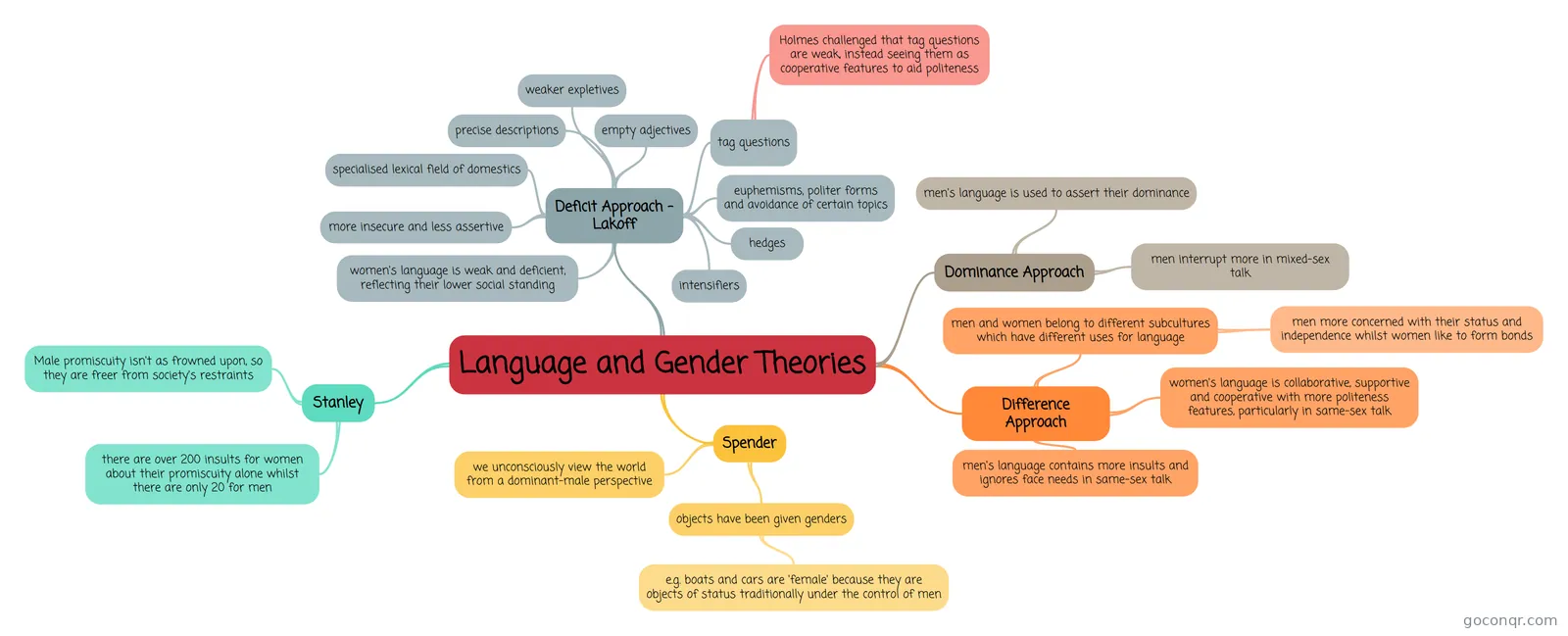
Mind map: Language and gender theories
Map content
Language and Gender Theories
Deficit Approach - Lakoff
- women's language is weak and deficient, reflecting their lower social standing
- more insecure and less assertive
- specialised lexical field of domestics
- precise descriptions
- weaker expletives
- empty adjectives
- tag questions
- Holmes challenged that tag questions are weak, instead seeing them as cooperative features to aid politeness
- euphemisms, politer forms and avoidance of certain topics
- hedges
- intensifiers
Dominance Approach
- men's language is used to assert their dominance
- men interrupt more in mixed-sex talk
Difference Approach
- men and women belong to different subcultures which have different uses for language
- men more concerned with their status and independence whilst women like to form bonds
- women's language is collaborative, supportive and cooperative with more politeness features, particularly in same-sex talk
- men's language contains more insults and ignores face needs in same-sex talk
- men and women belong to different subcultures which have different uses for language
Spender
- objects have been given genders
- e.g. boats and cars are 'female' because they are objects of status traditionally under the control of men
- we unconsciously view the world from a dominant-male perspective
- objects have been given genders
Stanley
- there are over 200 insults for women about their promiscuity alone whilst there are only 20 for men
- Male promiscuity isn't as frowned upon, so they are freer from society's restraints
Information
- Description
- Mind-map of Language and Gender theories for A-Level English Language
- Created by
- Eleanor H
- Views
- 1,210
- Tags
- Rating