
Mind map
Faunal Evolution to the Anthropocene
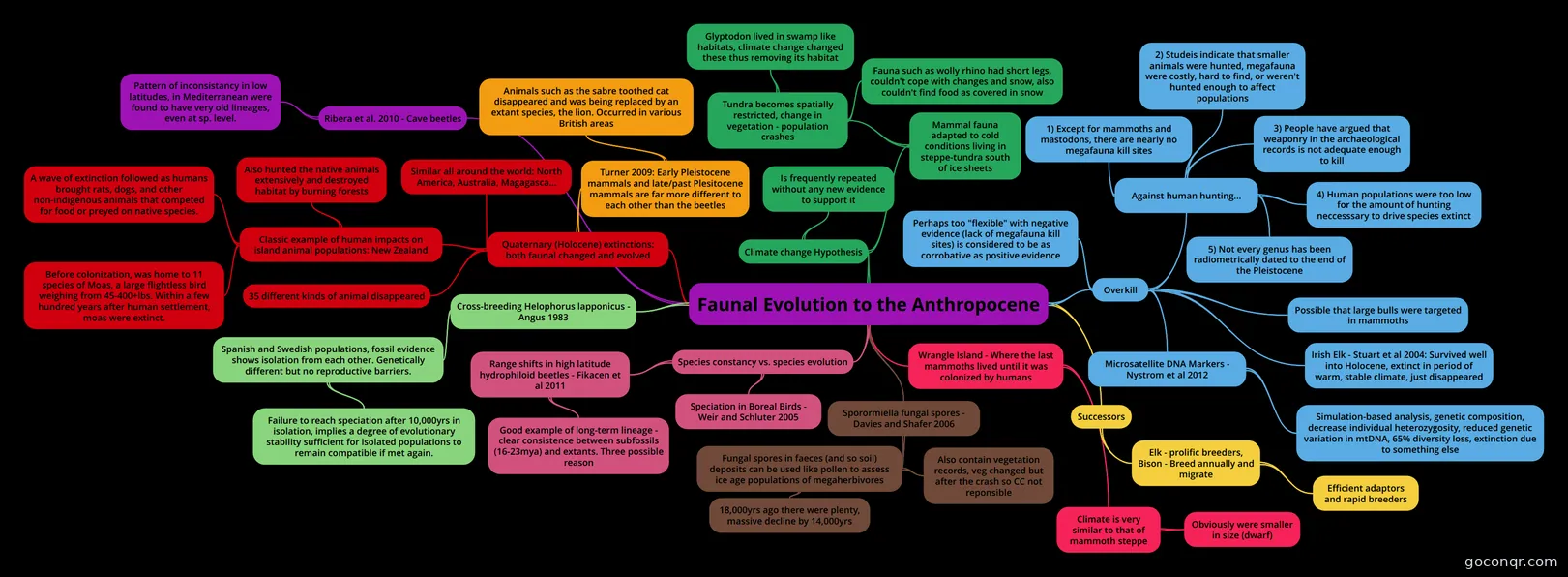
Mind map: Faunal Evolution to the Anthropocene
Map content
Faunal Evolution to the Anthropocene
Species constancy vs. species evolution
- Speciation in Boreal Birds - Weir and Schluter 2005
- Isolation of populations by ice sheets may have driven the recent divergence of sister taxa. Compared boreal with sub-boreal and tropic taxa to see when the sister taxa diverged. All boreal dated to the pleistocene, 56% sub-boreal, 46% tropical - lower latitudes - older species and fewer extinctions - High latitudes - more recent specieation
- Range shifts in high latitude hydrophiloid beetles - Fikacen et al 2011
- Good example of long-term lineage - clear consistence between subfossils (16-23mya) and extants. Three possible reason
- Three possible ways to explain the survival of these species since the Tertiary era: 1) Life-style of the species is associated with a habitat which is stable over time 2) The species was able to track suitable environmental conditions though the climate changed over time 3) The species is surviving in a single area with stable environmental condition over several millions of years. Cannot exclude that some locally limited ecosystems of south-western Siberia might have been stable enough since the late Tertiary, allowing the survival of H.sibiricus and other Tertiary species.
- Good example of long-term lineage - clear consistence between subfossils (16-23mya) and extants. Three possible reason
- Speciation in Boreal Birds - Weir and Schluter 2005
Cross-breeding Helophorus lapponicus - Angus 1983
- Spanish and Swedish populations, fossil evidence shows isolation from each other. Genetically different but no reproductive barriers.
- Failure to reach speciation after 10,000yrs in isolation, implies a degree of evolutionary stability sufficient for isolated populations to remain compatible if met again.
- Spanish and Swedish populations, fossil evidence shows isolation from each other. Genetically different but no reproductive barriers.
Quaternary (Holocene) extinctions: both faunal changed and evolved
- 35 different kinds of animal disappeared
- Classic example of human impacts on island animal populations: New Zealand
- Before colonization, was home to 11 species of Moas, a large flightless bird weighing from 45-400+lbs. Within a few hundred years after human settlement, moas were extinct.
- A wave of extinction followed as humans brought rats, dogs, and other non-indigenous animals that competed for food or preyed on native species.
- Also hunted the native animals extensively and destroyed habitat by burning forests
- Similar all around the world: North America, Australia, Magagasca...
- Turner 2009: Early Pleistocene mammals and late/past Plesitocene mammals are far more different to each other than the beetles
- Also lots of evidence for many taxa and lineages of these mammals having gone totally extinct - particularly in late pleistocene and holocene
- Animals such as the sabre toothed cat disappeared and was being replaced by an extant species, the lion. Occurred in various British areas
Climate change Hypothesis
- Is frequently repeated without any new evidence to support it
- Mammal fauna adapted to cold conditions living in steppe-tundra south of ice sheets
- Tundra becomes spatially restricted, change in vegetation - population crashes
- Fauna such as wolly rhino had short legs, couldn't cope with changes and snow, also couldn't find food as covered in snow
- Glyptodon lived in swamp like habitats, climate change changed these thus removing its habitat
- Tundra becomes spatially restricted, change in vegetation - population crashes
Overkill
- Perhaps too "flexible" with negative evidence (lack of megafauna kill sites) is considered to be as corrobative as positive evidence
- Against human hunting...
- 1) Except for mammoths and mastodons, there are nearly no megafauna kill sites
- 2) Studeis indicate that smaller animals were hunted, megafauna were costly, hard to find, or weren't hunted enough to affect populations
- 3) People have argued that weaponry in the archaeological records is not adequate enough to kill
- 4) Human populations were too low for the amount of hunting neccesssary to drive species extinct
- 5) Not every genus has been radiometrically dated to the end of the Pleistocene
- So some may have been extinct before the Clovis people arrives, only 15 of 35 made it until clovis times
- Irish Elk - Stuart et al 2004: Survived well into Holocene, extinct in period of warm, stable climate, just disappeared
- Microsatellite DNA Markers - Nystrom et al 2012
- Simulation-based analysis, genetic composition, decrease individual heterozygosity, reduced genetic variation in mtDNA, 65% diversity loss, extinction due to something else
- Possible that large bulls were targeted in mammoths
- Studies of skeletons show extensive traumatic injury to a female mastodon, caused by another mastodons tusk. Think that large bulls were targeted by humans because they were solitary so were depleted. as a result adolescence males wouldn't hormones/sexual behaviour suppressed and so would rampage in attempts to mate but could accidentally hurt a nearby female in the process (such as behaviour seen in modern day elephants. This would reduce populations enough to possibly have an impact, and could link to the decrease in genetic diversity seen by Nystrom t al 2012 as with a mixture of climate change and males being killed these together could decrease diversity.
Sporormiella fungal spores - Davies and Shafer 2006
- Fungal spores in faeces (and so soil) deposits can be used like pollen to assess ice age populations of megaherbivores
- 18,000yrs ago there were plenty, massive decline by 14,000yrs
- Also contain vegetation records, veg changed but after the crash so CC not reponsible
- Fungal spores in faeces (and so soil) deposits can be used like pollen to assess ice age populations of megaherbivores
Successors
- Elk - prolific breeders, Bison - Breed annually and migrate
- Efficient adaptors and rapid breeders
- Elk - prolific breeders, Bison - Breed annually and migrate
Wrangle Island - Where the last mammoths lived until it was colonized by humans
- Population would have already been small as this is a common pattern for populations living on islands
- Climate is very similar to that of mammoth steppe
- Obviously were smaller in size (dwarf)
Ribera et al. 2010 - Cave beetles
- Pattern of inconsistancy in low latitudes, in Mediterranean were found to have very old lineages, even at sp. level.
Information
- Description
- Undergraduate Global Change Biology Mind Map on Faunal Evolution to the Anthropocene, created by samanthaamcneil on 21/05/2016.
- Created by
- samanthaamcneil
- Views
- 1
- Rating