
Mind map
Topic 12 - Voluntary Disclosure and Regulation
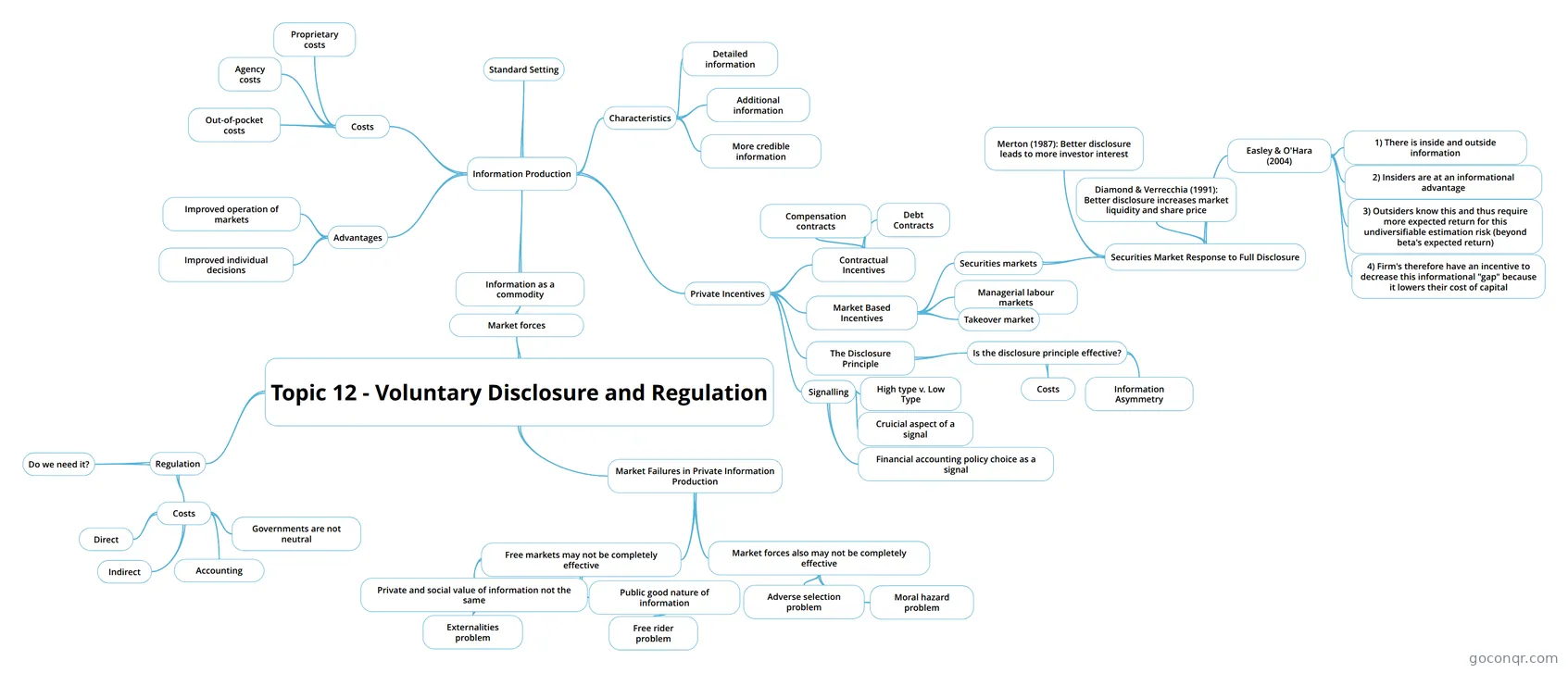
Mind map: Voluntary disclosure and regulation
Map content
Topic 12 - Voluntary Disclosure and Regulation
Market forces
- Information as a commodity
- Information produced by firms and demanded by decision makers. Their information production decisions are regulated
- Information Production
- What is the 'best' amount of information production from society's perspective? until the marginal social cost = marginal social benefit
- Advantages
- Improved individual decisions
- Investors
- Managers
- Improved operation of markets
- Capital markets
- Managerial labour markets
- Improved individual decisions
- Costs
- Out-of-pocket costs
- Time & effort, info systems
- Proprietary costs
- May reveal information to competitors
- Agency costs
- information to investors may reduce contract efficiency
- Out-of-pocket costs
- Standard Setting
- Accounting standards and boards such as IASB, AASB and FASB exist
- Characteristics
- Detailed information
- - Expanded not disclosure - Additional line items
- Additional information
- - Fair Value accounting - MD&A
- More credible information
- - Audit
- Detailed information
- Private Incentives
- Contracts break down if too many parties, so can we rely on market forces to motivate optimal information production?
- Contractual Incentives
- Compensation contracts
- Performance measures need information production (e.g. net income, core earnings)
- Debt Contracts
- - Debt covenants need information production (e.g. working capital, times-interest-earned, debt-to-equity)
- Compensation contracts
- Market Based Incentives
- Securities markets
- Poor disclosure creates estimation risk, raising firm's cost of capital
- Securities Market Response to Full Disclosure
- Merton (1987): Better disclosure leads to more investor interest
- Better disclosure leads to more investor interest
- Diamond & Verrecchia (1991): Better disclosure increases market liquidity and share price
- Better disclosure increases market liquidity and share price
- Easley & O'Hara (2004)
- Better disclosure reduces estimation risk
- 1) There is inside and outside information
- 2) Insiders are at an informational advantage
- 3) Outsiders know this and thus require more expected return for this undiversifiable estimation risk (beyond beta's expected return)
- 4) Firm's therefore have an incentive to decrease this informational "gap" because it lowers their cost of capital
- Merton (1987): Better disclosure leads to more investor interest
- Managerial labour markets
- Poor disclosure lowers manager reputation
- Takeover market
- Poor disclosure increases estimation risk, leading to manager being fired or replaced
- Securities markets
- The Disclosure Principle
- Market knows manager has the information. If the manager does not release the information, the market fears the worse (share price crashes). Thus to avoid this, the manager releases the information.
- Is the disclosure principle effective?
- Does the market know the manager has the information? Cost of disclosure: - such as proprietary costs - investors cannot penalise firm for non-disclosure since they do not know whether info is withheld because it ia i) bad news OR ii) because it is good news but not sufficiently good new to warrant incurring the costs of disclosure. Is disclosure truthful? Conflict between information for investors and for contracting, creating agency costs
- Costs
- Information Asymmetry
- Signalling
- High type v. Low Type
- High types want to separate from low
- Cruicial aspect of a signal
- Must be less costly for high types to signal
- Financial accounting policy choice as a signal
- High type v. Low Type
- Information as a commodity
Market Failures in Private Information Production
- Free markets may not be completely effective
- Private and social value of information not the same
- Externalities problem
- An action taken by a firm that imposes costs or benefits on other firms or individuals for which the entity icreating the externality is not charged or does not receive revenue.
- Externalities problem
- Public good nature of information
- Free rider problem
- the receipt by a firm or individual of a benefit from an externality
- Free rider problem
- Private and social value of information not the same
- Market forces also may not be completely effective
- Adverse selection problem
- Insider trading Delay in information release
- Moral hazard problem
- Earnings management to disguise shirking
- Adverse selection problem
- Free markets may not be completely effective
Regulation
- Do we need it?
- Firms should produce information to the point where its marginal social benefit equals its marginal social cost. But Private market forces unlikely to produce this result, so regulation is required.
- Costs
- Direct
- Direct cost of administration and compliance
- Indirect
- Indirect Costs of uniform standards which reduce the ability of the firm to signal
- Indirect costs of litigation as a result of legislation and disincentive to provide information
- Accounting
- Imposing homogenous accounting on heterogenous transactions
- Governments are not neutral
- Direct
- Do we need it?
Information
- Description
- University Financial Accounting Theory Mind Map on Topic 12 - Voluntary Disclosure and Regulation, created by Sarah van der Post on 29/05/2016.
- Created by
- Sarah van der Post
- Views
- 3
- Rating