
Mind map
OCR 21st century P6
Map content
OCR 21st century P6
Radioactive materials
- The Atom
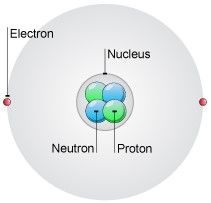
- The nucleus, the centre of the atom, contains both protons and neutrons . The protons and neutrons are held together in the nucleus by a strong force which balances the repulsive electrostatic force between the protons. The electrons are outside the nucleus.
- The nucleus makes up most off the mass of an atom but takes up virtually no space. This force is known as the 'strong' force and it has a very short range
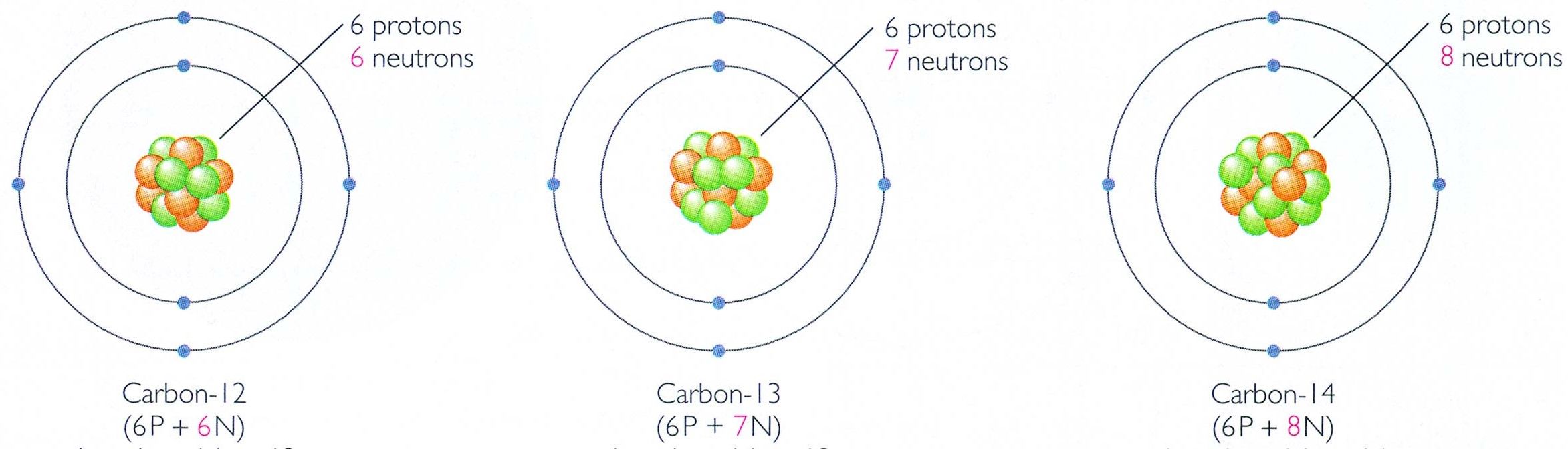
- The three isotopes have the same number of protons and thus the same atomic number of 6. Their atomic masses differ, however, due to the fact that they have different amounts of neutrons
- Carbon-12 is a stable isotope. Whereas Carbon 13 and 14 are unstable. Therefore, they decay in order to make themselves more stable and emit radiation
- When an atom decays it emits energetic radiation and the nucleus changes. Therefore when carbon 14 decays, it no longer becomes carbon as the number of proton changes. Therefore, it no longer has a proton number of 6 and can longer be classed as carbon.
- the behaviour of radioactive materials cannot be changed by chemical or physical processes
- Carbon-12 is a stable isotope. Whereas Carbon 13 and 14 are unstable. Therefore, they decay in order to make themselves more stable and emit radiation
- The three isotopes have the same number of protons and thus the same atomic number of 6. Their atomic masses differ, however, due to the fact that they have different amounts of neutrons
- The nucleus makes up most off the mass of an atom but takes up virtually no space. This force is known as the 'strong' force and it has a very short range
- Rutherford
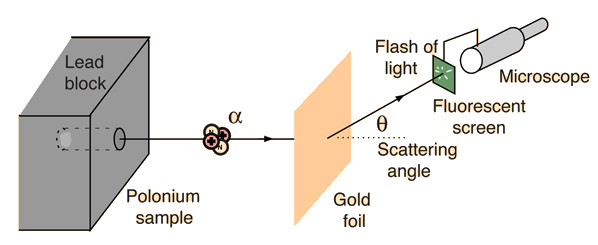
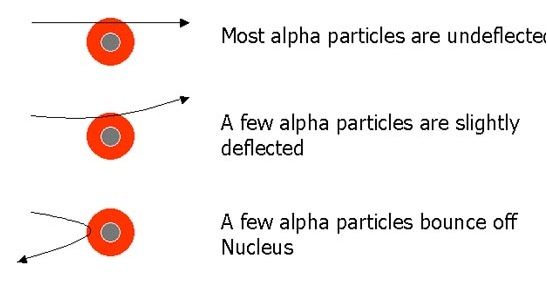
- In 1909, Rutherford, Geiger and Marsden fired alpha particles (positively charged) at gold foil (used because it can be rolled out to just a few atoms) in a vacuum.
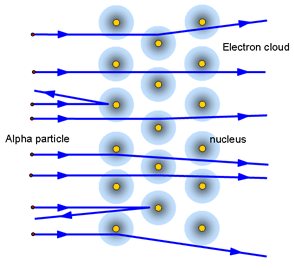
- Most of the alpha particles went straight through and were deflected by a few degrees.
- A small fraction were actually reflected back towards the direction from which they had come from
- In fact less than 1/8000 alpha particles were 'back-scattered' (deflected through an angle greater than 90 degrees).
- Rutherford realised that there must have been something with a positive charge that was repelling the positive alpha particles. Also, whatever was causing the backscatter had to have a lot of mass otherwise, the alpha particles would've simply moved it out of the way. This something was the nucleus
- He concluded that the nucleus must be tiny and concentrated at the centre and the rest must be empty space with some other subatomic particles (electrons) as most alpha particles went through and were slightly deflected
- A small fraction were actually reflected back towards the direction from which they had come from
- Most of the alpha particles went straight through and were deflected by a few degrees.
- In 1909, Rutherford, Geiger and Marsden fired alpha particles (positively charged) at gold foil (used because it can be rolled out to just a few atoms) in a vacuum.
- The nucleus, the centre of the atom, contains both protons and neutrons . The protons and neutrons are held together in the nucleus by a strong force which balances the repulsive electrostatic force between the protons. The electrons are outside the nucleus.
- Ionising Radiation
- The radiations from radioactive materials – alpha, beta and gamma radiation – are all ionising radiations which can damage living cells.
- This happens because ionising radiation can remove the electron of an atom creating ions. These ions can then take part in other chemical reactions in the living cells. This may result in the living cells dying, or becoming cancerous.
- Sterilisation
- Surgical instruments and some hygiene products, e.g. tampons, are sterilised using high doses of gamma radiation from radioactive cobalt. The products are first sealed from the air and then exposed to the radiation Food can also be sterilised by gamma radiation in the same way. The radiation kills microorganisms, preserving the food for longer. But in the UK only irradiated herbs, spices or vegetable seasonings, with the correct labels, are allowed. Major supermarkets say they will not stock irradiated foods because people are reluctant to buy them, even though the food itself is not radioactive.
- Radioactive tracers
- Radioactive atoms of a molecule can be used as radioactive tracers. These tracers emit gamma radiation that will almost all penetrate out of the body to be detected by a gamma camera. This camera traces where the radioactive molecule goes in the body. Images can then be formed to allow doctors to see areas of damage to assess what treatment is needed.
- Radioisotopes with short half-lives are chosen to make sure that the tracer does not stay radioactive in the body for long periods. by an injection or by ingestion (eating a solid with the tracer in it or drinking a liquid with the tracer in it). The tracer is given enough time to move around the body before a radiographer positions a radiation detector outside the body. This produces a picture showing where the tracer has accumulated.
- Radiotherapy
- Although ionising radiation can cause cancer, high doses can be directed at cancerous cells to kill them. This is called radiotherapy. About 40% of people with cancer undergo radiotherapy as part of their treatment. It is administered in two main ways: From outside the body using x-rays or the radiation from radioactive cobalt or from inside the body by putting radioactive materials into the tumour, or close to it. Some normal cells are also damaged by the radiation, but they can repair themselves better than the cancer cells are able to.
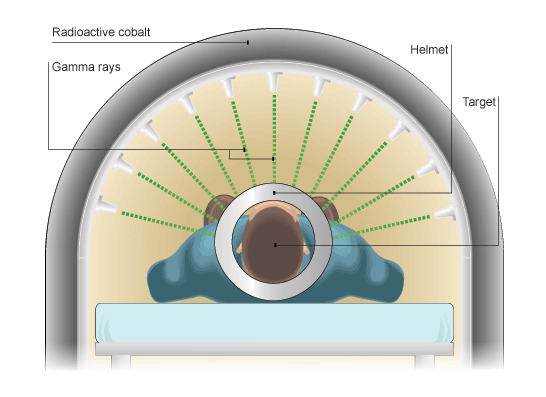
- Gamma rays damage cells whether they are normal or cancerous, so gamma rays must be focused on the tumour. One way of doing this is to use a wide beam of gamma rays, but to rotate the beam around the patient, keeping the tumour at the centre. This concentrates the gamma rays on the cells that need to be killed
- Although ionising radiation can cause cancer, high doses can be directed at cancerous cells to kill them. This is called radiotherapy. About 40% of people with cancer undergo radiotherapy as part of their treatment. It is administered in two main ways: From outside the body using x-rays or the radiation from radioactive cobalt or from inside the body by putting radioactive materials into the tumour, or close to it. Some normal cells are also damaged by the radiation, but they can repair themselves better than the cancer cells are able to.
- Radioactive atoms of a molecule can be used as radioactive tracers. These tracers emit gamma radiation that will almost all penetrate out of the body to be detected by a gamma camera. This camera traces where the radioactive molecule goes in the body. Images can then be formed to allow doctors to see areas of damage to assess what treatment is needed.
- The radiations from radioactive materials – alpha, beta and gamma radiation – are all ionising radiations which can damage living cells.
- Doseage
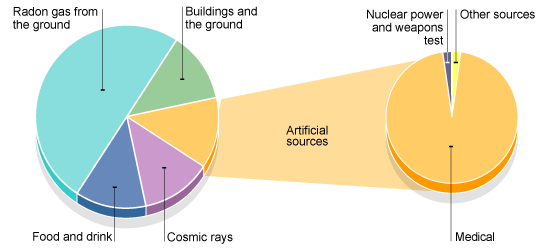
- Radiation dose measures the possible harm the radiation could do to the body. It is measured in millisieverts (mSv). It takes into account the type and amount of radiatio that youve been exposed to. The UK annual dose is 25 mSv.
- Uranium miners/processors, Miners(many rocks are naturally radioactive), Nuclear power plant workers, Airline staff (cosmic rays), Nuclear researchers & medical staff(researches)
- Type- Alpha is the most ionising so it causes the most cell damage.Alpha has a short range in air so its only hazardous if the source of radiation gets inside.
- Amount- the number of alpha particles, beta particles, or gamma photons reaching the body.
- Tissue- The damage to the body is affected by the type of tissue affected e.g. lung tissue is easily damaged. Radon gas is dangerous beause it emits alpha particles. If t is breather inbto the lungs then the alpha radiation is absorbed by the lung tissue.
- Amount- the number of alpha particles, beta particles, or gamma photons reaching the body.
- Radiation dose measures the possible harm the radiation could do to the body. It is measured in millisieverts (mSv). It takes into account the type and amount of radiatio that youve been exposed to. The UK annual dose is 25 mSv.
- Contamination & Irrdaiation
- Contamination- Having radioactive material inside the body, or having it on the skin or clothes. If you swallow or breath in any radioactive material, your vital organs will be exposed to continuos radiation from a long period of time. Alpha is the worst ue to their strong ionising ffect and gamma is the least as most pass straight out of the body.
- we are irradiated and contaminated by radioactive materials all the time and the main sources of this background radiation
- Irradiation- Being exposed to radiation from an external source.
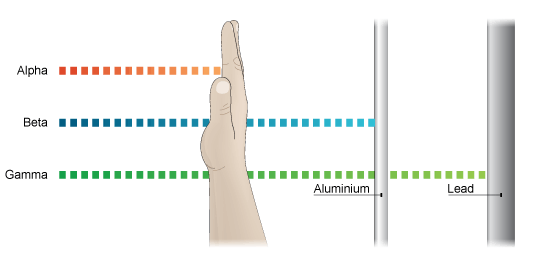
- Alpha irradiation present a very low risk s alpha particles only travel a few centimetres in air and are easily absorbed. Your clothes and the outer layers of dead cells on your skin.
- Beta irradiation is worse as beta particles can penetrate a few centimetres into the body.
- Gamma- Most gamma rays pass straight through the body but they have a high energy so if they are absorbed they are dangerous
- Beta irradiation is worse as beta particles can penetrate a few centimetres into the body.
- Alpha irradiation present a very low risk s alpha particles only travel a few centimetres in air and are easily absorbed. Your clothes and the outer layers of dead cells on your skin.
- Contamination- Having radioactive material inside the body, or having it on the skin or clothes. If you swallow or breath in any radioactive material, your vital organs will be exposed to continuos radiation from a long period of time. Alpha is the worst ue to their strong ionising ffect and gamma is the least as most pass straight out of the body.
- Protection
- Gloves- Barrier to prevent contamination, Barrier to alpha irradiation
- Tongs- Increase distance (to reduce irradiation), to avoid direct contact with/contamination by source and to direct the source away from observers
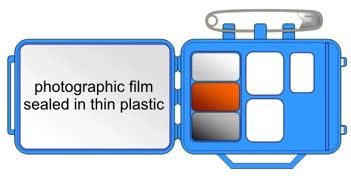
- Monitoring badge: Monitoring exposure over time, indicates when to avoid further exposure, indicates when a safe level of exposure has been reached
- Gloves- Barrier to prevent contamination, Barrier to alpha irradiation
- The Atom
Radioactive materials
- Some elements emit ionising radiation all the time. They are known as radioactive materials
- Radioactive elements are found naturally in the environment. The radiation they give off is called background radiation.
- Alpha Radiation
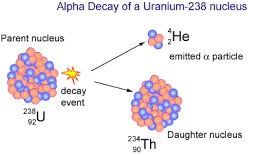
- Alpha particles are particles which are relatively big, slow moving and much heavier than beta particles. As a result, they're the least penetrating - they're stopped quickly. However, they are the most ionising of all three types of radiation.
- An alpha particle is a high speed helium nuclei as it is made up of 2 protons and 2 neutrons
- Mass of 4 and charge of 2
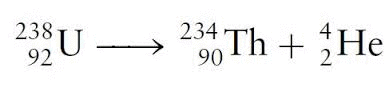
- Alpha decay always changes the element of an atom that's decaying, since its losing protons
- Alpha particles are released by very heavy nuclei e.g uranium
- Alpha decay always changes the element of an atom that's decaying, since its losing protons
- Mass of 4 and charge of 2
- An alpha particle is a high speed helium nuclei as it is made up of 2 protons and 2 neutrons
- Alpha particles are particles which are relatively big, slow moving and much heavier than beta particles. As a result, they're the least penetrating - they're stopped quickly. However, they are the most ionising of all three types of radiation.
- Beta Radiation
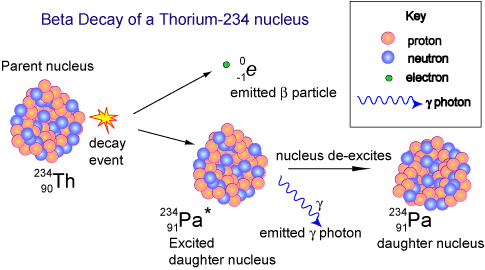
- Beta particles are fast moving electrons. They are much smaller that alpha particles (less likely to collide with other particles). This means they travel further in air and other materials and are less ionising. When they have slowed down, they are just like other electrons
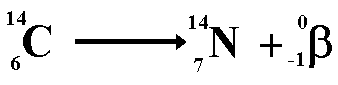
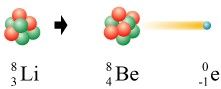
- Beta particles are released by nuclei that have too many neutrons. The proton stays in the nucleus and the electron leaves the atom with high energy (beta particle). When a beta particle is emitted from the nucleus, the nucleus has one more proton and one less neutron. This means the atomic mass remains unchanged and the atomic number increases by 1.
- They penetrate moderately before they are stopped
- beta particles have no mass and a charge of -1
- They penetrate moderately before they are stopped
- Beta particles are released by nuclei that have too many neutrons. The proton stays in the nucleus and the electron leaves the atom with high energy (beta particle). When a beta particle is emitted from the nucleus, the nucleus has one more proton and one less neutron. This means the atomic mass remains unchanged and the atomic number increases by 1.
- Beta particles are fast moving electrons. They are much smaller that alpha particles (less likely to collide with other particles). This means they travel further in air and other materials and are less ionising. When they have slowed down, they are just like other electrons
- Gamma Radiation
- Once a nucleus emits a beta particle, the remaining protons and neutrons arrange themselves into a lower energy state by emitting a photon of gamma ray.The photons have more energy than most X-ray photons and rarely collides with particles, so the radiation is very penetrating and has a weak ionising effect.
- Since gamma is just energy, the element remains the same.
- Once a nucleus emits a beta particle, the remaining protons and neutrons arrange themselves into a lower energy state by emitting a photon of gamma ray.The photons have more energy than most X-ray photons and rarely collides with particles, so the radiation is very penetrating and has a weak ionising effect.
- Some elements emit ionising radiation all the time. They are known as radioactive materials
Half-Lives
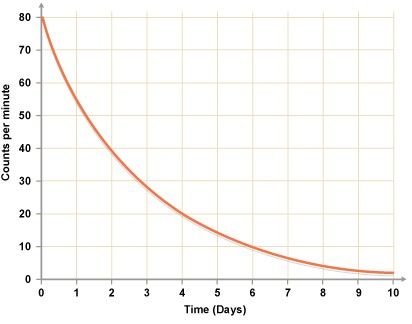
- Each time an unstable nucleus decays and emits radiation, there is one less radioactive nucleus to decay and so, over time, the activity of radioactive sources decrease.
- How quickly the activity decreases varies a lot and the problem with trying to measure is that the activity never reaches zero.
- A short half life means the activity falls quickly because lots of the nuclei decay in a short time
- A long half life means the activity falls more slowly because most of the nuclei don't decay for a long time
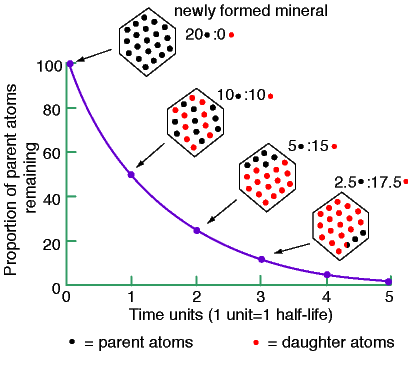
- The time taken for the amount of radioactive element/nuclei in a sample to fall to half
- Each time an unstable nucleus decays and emits radiation, there is one less radioactive nucleus to decay and so, over time, the activity of radioactive sources decrease.
Nuclear fusion & fission
- Fission
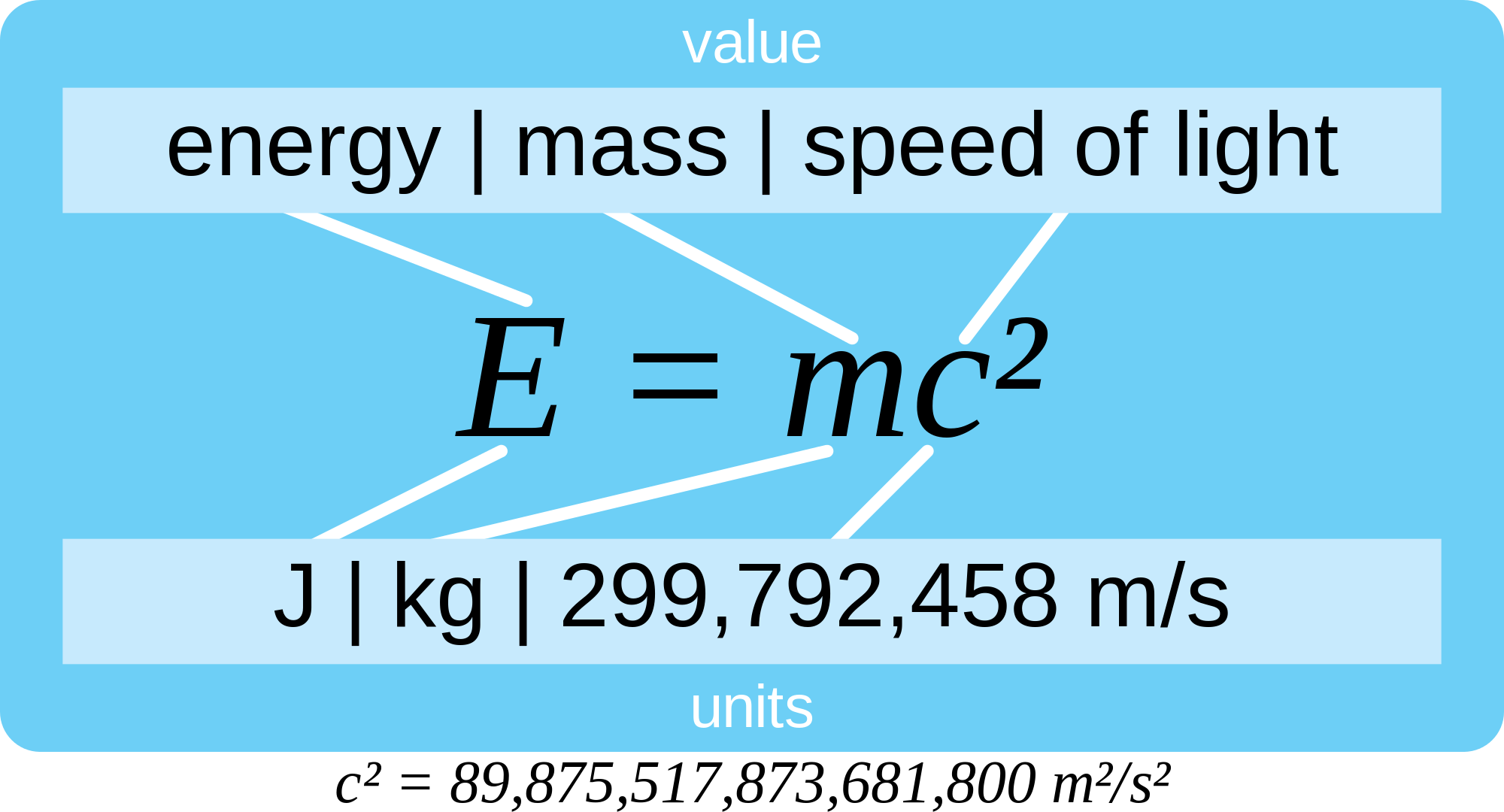
- E = mc2 is used to calculate the energy released during nuclear fusion and fission (where E is the energy produced, m is the mass lost and c is the speed of light in a vacuum)
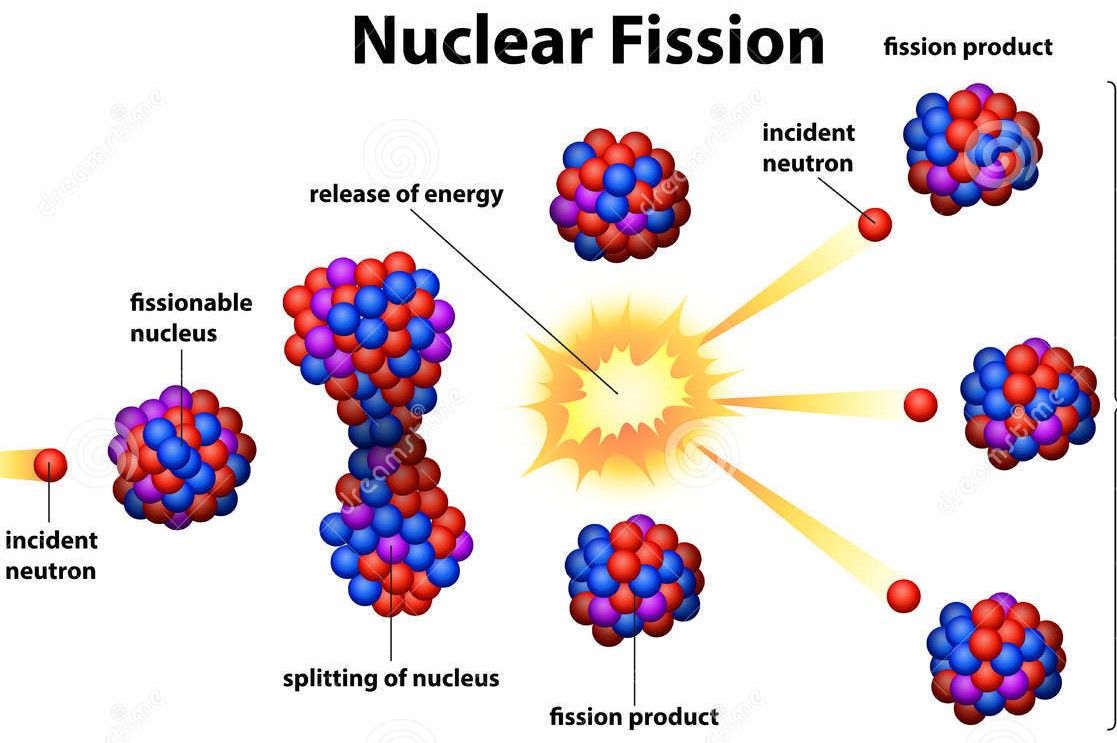
- When nuclei undergo fusion or fission, they lose mass and energy is released
- 1. neutrons are fired at the large and unstable uranium/plutonium nuclei
- 2. The neutron collides and the uranium/plutonium nucleus splits into two similar-sized smaller nuclei
- 3. More neutrons are released
- 4. These neutrons can then collide with more uranium nuclei. These processes are repeated continuously, forming a chain reaction.
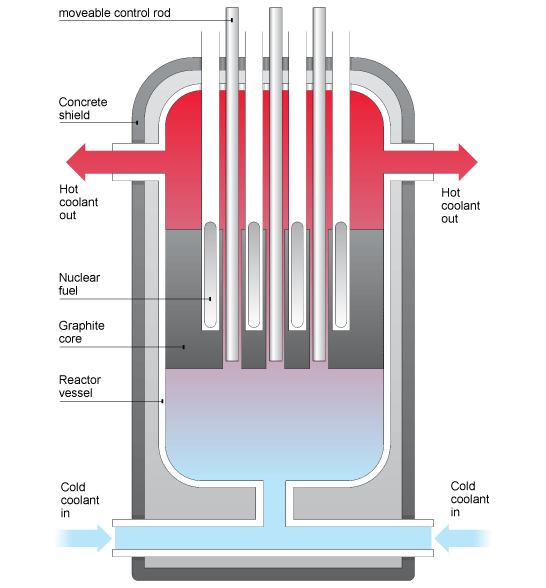
- This is controlled by control rods, containing boron, which absorb some of the neutrons, thus preventing them from continuing to react and slowing the reaction. They can be moved further in or out of the reactor to absorb more or less neutrons
- 4. These neutrons can then collide with more uranium nuclei. These processes are repeated continuously, forming a chain reaction.
- 3. More neutrons are released
- The coolant is pumped through the reactor. The hot fuel rods heat the coolant to 500 degrees. This then turns water to steam to drive a turbine. This can be used instead of fossil fuels.
- A nuclear fuel is one in which energy is released by changes in the nucleus. The uranium/plutonium fuel is contained in the fuel rods
- 2. The neutron collides and the uranium/plutonium nucleus splits into two similar-sized smaller nuclei
- No carbon dioxide is produced when the station is operating; There is a high power output ;A small amount of fuel is needed, when compared with coal or gas
- Hazardous radioactive waste is produced; Building the power stations is quite expensive; Decommissioning, ie taking apart, the power stations at the end of their lifetime is very costly
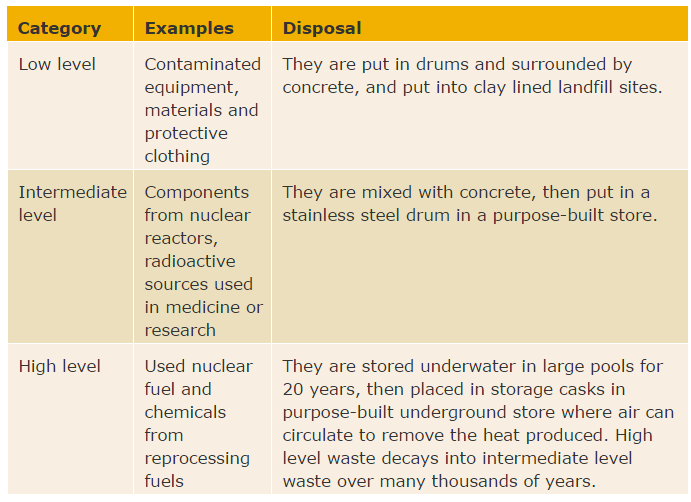
- We are all exposed to background radiation. When the nuclear waste only emits very low levels of radiation, it poses less risk. The longer the half life, the longer it'll take to become 'safe'
- The amount of this is increasing as HLW decays to ILW
- HLW gets hot because its so radioactive.
- Radioactive waste is hazardous because of contamination. If some were to leak into water supplies and be taken up by food, which we then eat, the radioactive material would remain in our stomach where it can irradiate our internal organs
- We are all exposed to background radiation. When the nuclear waste only emits very low levels of radiation, it poses less risk. The longer the half life, the longer it'll take to become 'safe'
- Hazardous radioactive waste is produced; Building the power stations is quite expensive; Decommissioning, ie taking apart, the power stations at the end of their lifetime is very costly
- E = mc2 is used to calculate the energy released during nuclear fusion and fission (where E is the energy produced, m is the mass lost and c is the speed of light in a vacuum)
- If two hydrogen nuclei are brought close enough together then they have the ability to fuse. This process is called nuclear fusion. It takes a lot of work to overcome the repulsive electrostatic forces and bring them close enough but if it does happen, a lot of energy is released when they fuse. To do this you need a great deal of energy, which means a high temperature.
- Fission
Images and files in the map



Information
- Description
- Mind Map on OCR 21st century P6, created by Pritesh Patel on 06/11/2016.
- Created by
- Pritesh Patel
- Views
- 8
- Rating