
Mind map
5. Understand the main accounting principles and practices (cont)
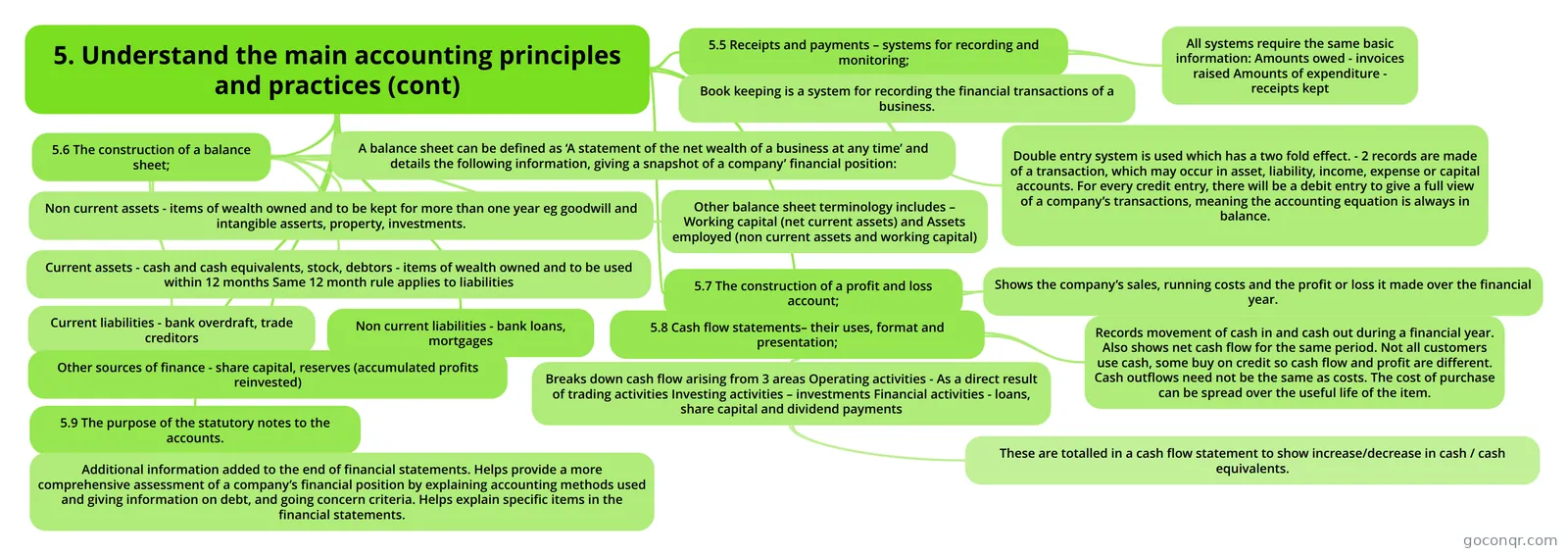
Mind map: accounting principles and practices
Map content
5. Understand the main accounting principles and practices (cont)
5.5 Receipts and payments – systems for recording and monitoring;
- Book keeping is a system for recording the financial transactions of a business.
- All systems require the same basic information: Amounts owed - invoices raised Amounts of expenditure - receipts kept
- Double entry system is used which has a two fold effect. - 2 records are made of a transaction, which may occur in asset, liability, income, expense or capital accounts. For every credit entry, there will be a debit entry to give a full view of a company’s transactions, meaning the accounting equation is always in balance.
5.6 The construction of a balance sheet;
- A balance sheet can be defined as ‘A statement of the net wealth of a business at any time’ and details the following information, giving a snapshot of a company’ financial position:
- Non current assets - items of wealth owned and to be kept for more than one year eg goodwill and intangible asserts, property, investments.
- Current assets - cash and cash equivalents, stock, debtors - items of wealth owned and to be used within 12 months Same 12 month rule applies to liabilities
- Current liabilities - bank overdraft, trade creditors
- Other balance sheet terminology includes – Working capital (net current assets) and Assets employed (non current assets and working capital)
Non current liabilities - bank loans, mortgages
Other sources of finance - share capital, reserves (accumulated profits reinvested)
5.7 The construction of a profit and loss account;
- Shows the company’s sales, running costs and the profit or loss it made over the financial year.
5.8 Cash flow statements– their uses, format and presentation;
- Records movement of cash in and cash out during a financial year. Also shows net cash flow for the same period. Not all customers use cash, some buy on credit so cash flow and profit are different. Cash outflows need not be the same as costs. The cost of purchase can be spread over the useful life of the item.
- Breaks down cash flow arising from 3 areas Operating activities - As a direct result of trading activities Investing activities – investments Financial activities - loans, share capital and dividend payments
- These are totalled in a cash flow statement to show increase/decrease in cash / cash equivalents.
5.9 The purpose of the statutory notes to the accounts.
- Additional information added to the end of financial statements. Helps provide a more comprehensive assessment of a company’s financial position by explaining accounting methods used and giving information on debt, and going concern criteria. Helps explain specific items in the financial statements.
Information
- Description
- Mind Map on 5. Understand the main accounting principles and practices (cont), created by Paul Cox on 05/03/2014.
- Created by
- Paul Cox
- Views
- 20
- Rating
More on Accounting Equation and Double-Entry Bookkeeping