
Mind map
SBU Business Strategy (Week 6)
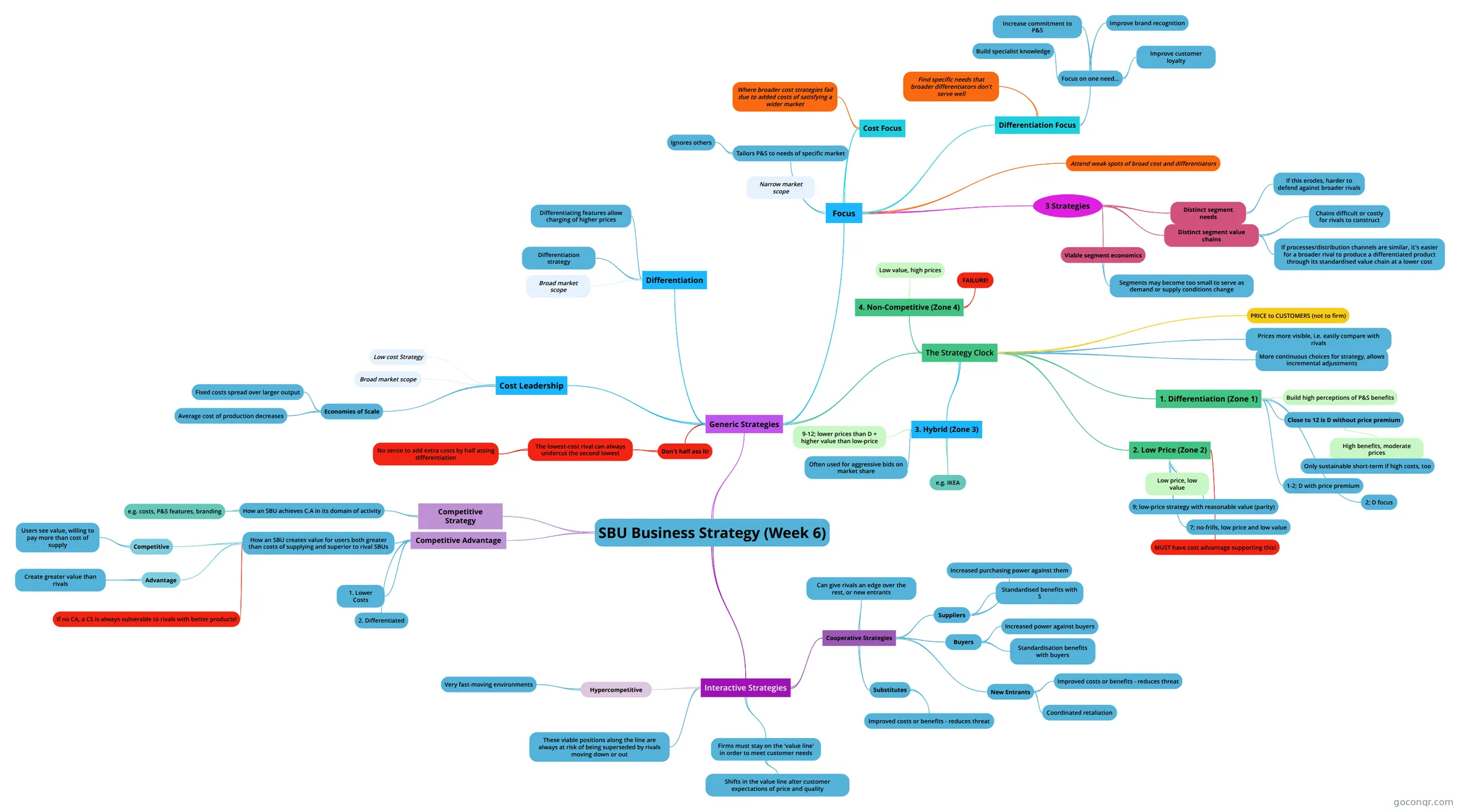
Mind map: SBU business strategy
Map content
SBU Business Strategy (Week 6)
Generic Strategies
- Cost Leadership
- Economies of Scale
- Fixed costs spread over larger output
- Average cost of production decreases
- Broad market scope
- Low cost Strategy
- Economies of Scale
- Differentiation
- Broad market scope
- Differentiation strategy
- Differentiating features allow charging of higher prices
- Focus
- Narrow market scope
- Cost Focus
- Where broader cost strategies fail due to added costs of satisfying a wider market
- Differentiation Focus
- Find specific needs that broader differentiators don't serve well
- Focus on one need...
- Build specialist knowledge
- Increase commitment to P&S
- Improve brand recognition
- Improve customer loyalty
- Tailors P&S to needs of specific market
- Ignores others
- Attend weak spots of broad cost and differentiators
- 3 Strategies
- Distinct segment needs
- If this erodes, harder to defend against broader rivals
- Distinct segment value chains
- Chains difficult or costly for rivals to construct
- If processes/distribution channels are similar, it's easier for a broader rival to produce a differentiated product through its standardised value chain at a lower cost
- Viable segment economics
- Segments may become too small to serve as demand or supply conditions change
- Distinct segment needs
- Don't half ass it!
- The lowest-cost rival can always undercut the second lowest
- No sense to add extra costs by half assing differentiation
- The lowest-cost rival can always undercut the second lowest
- The Strategy Clock
- 3. Hybrid (Zone 3)
- 9-12; lower prices than D + higher value than low-price
- Often used for aggressive bids on market share
- e.g. IKEA
- PRICE to CUSTOMERS (not to firm)
- Prices more visible, i.e. easily compare with rivals
- More continuous choices for strategy, allows incremental adjustments
- 1. Differentiation (Zone 1)
- Build high perceptions of P&S benefits
- Close to 12 is D without price premium
- High benefits, moderate prices
- Only sustainable short-term if high costs, too
- High benefits, moderate prices
- 1-2; D with price premium
- 2; D focus
- 2. Low Price (Zone 2)
- Low price, low value
- 9; low-price strategy with reasonable value (parity)
- 7; no-frills, low price and low value
- MUST have cost advantage supporting this!
- 4. Non-Competitive (Zone 4)
- Low value, high prices
- FAILURE!
- 3. Hybrid (Zone 3)
- Cost Leadership
Interactive Strategies
- Hypercompetitive
- Very fast-moving environments
- Cooperative Strategies
- Can give rivals an edge over the rest, or new entrants
- Suppliers
- Increased purchasing power against them
- Standardised benefits with S
- Buyers
- Increased power against buyers
- Standardisation benefits with buyers
- New Entrants
- Improved costs or benefits - reduces threat
- Coordinated retaliation
- Substitutes
- Improved costs or benefits - reduces threat
- Firms must stay on the 'value line' in order to meet customer needs
- Shifts in the value line alter customer expectations of price and quality
- These viable positions along the line are always at risk of being superseded by rivals moving down or out
- Hypercompetitive
Competitive Strategy
- How an SBU achieves C.A in its domain of activity
- e.g. costs, P&S features, branding
- How an SBU achieves C.A in its domain of activity
Competitive Advantage
- How an SBU creates value for users both greater than costs of supplying and superior to rival SBUs
- Competitive
- Users see value, willing to pay more than cost of supply
- Advantage
- Create greater value than rivals
- If no CA, a CS is always vulnerable to rivals with better products!
- Competitive
- 1. Lower Costs
- 2. Differentiated
- How an SBU creates value for users both greater than costs of supplying and superior to rival SBUs
Information
- Description
- Based on Chapter 5 of the same name, with attention to small business units rather than corporate strategy
- Created by
- T L
- Views
- 4
- Rating