
6323340
Description

Mind Map by Melissa Elsworth , updated more than 1 year ago
More


1_Ionic Bonding
- Transferring ectrons
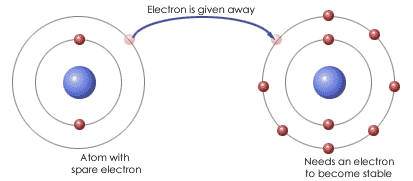
- In Ionic Bonding, atoms lose or gain electrons to form
charged particles (called ions) which are strongly attracted
to one another (because of the opposite changes + and -)
- A shell with just one electron is well keen to get
rid of it extra one electron to complete it shell
- Become a positive
change (E.g. Na+)
- Become a positive
change (E.g. Na+)
- A nearly full shell is well keen to get
that extra electron from another
atom that has an extra electron the
it ‘wants’ to get rid of, so it can have
an complete shell
- Become a
Negative change
- Become a
Negative change
- A shell with just one electron is well keen to get
rid of it extra one electron to complete it shell
- In Ionic Bonding, atoms lose or gain electrons to form
charged particles (called ions) which are strongly attracted
to one another (because of the opposite changes + and -)
- Ionic compound has a
regular lattice structure
- Ionic compound
always have giant
ionic lattices
- Ions form a closely packed
regular lattice arrangement
- Electrostatic forces of attraction
between oppositely charge ions, in
all directions.
- Ionic compound
always have giant
ionic lattices
- Ionic compounds all
have similar
properties
- Each have:
- High melting
point
- High boiling point due to strong
attraction between the ions
- Ions are free to
move
- Carry electric
current
- Dissolve easily in
water
- High melting
point
- Each have:
Media attachments
Want to create your own Mind Maps for free with GoConqr? Learn more.