
Mind map
LSM2101 ETC
Map content
LSM2101 ETC
Overview
- pH difference of 0.75 across the inner membrane
- Charge difference across the membrane = 0.168V
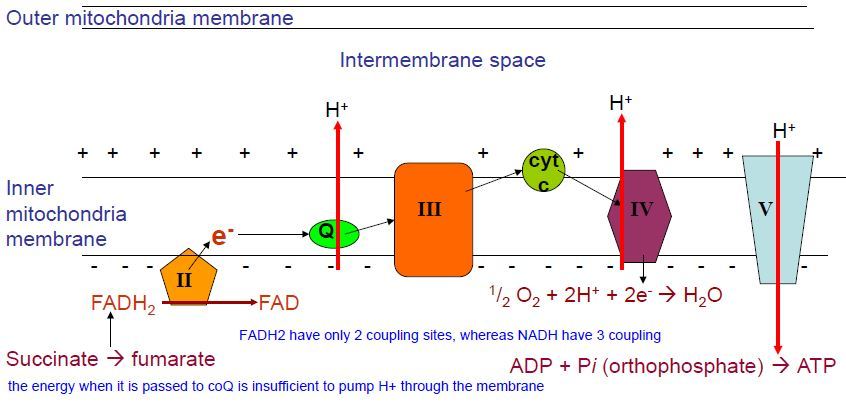
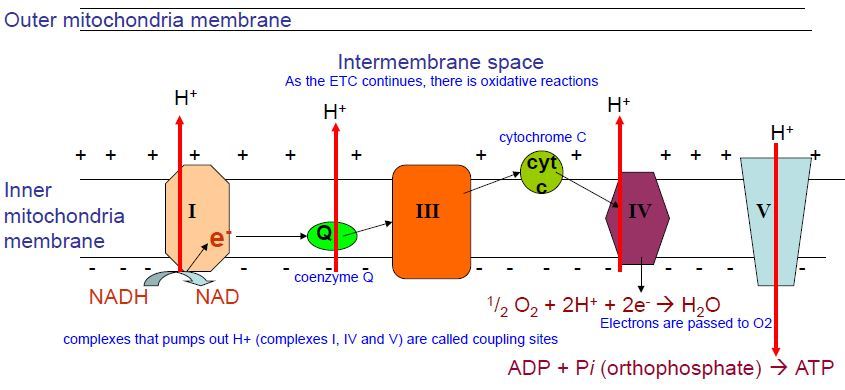
- complexes that pumps out H+ ions are coupling sites (Complex I, IV, V)
- FADH2 produces fewer ATP molecules than NADH because it bypassed complex I (which has the highest energy level as compared to all the complexes). Furthermore, complex I has a coupling site, which pumps proton across the membrane and thus allowing for more protons to pass through ATPase to form ATP. Thus, by the time it reached to complex IV, FADH2 would have pumped lesser electrons through the membrane as compared to NADH
- pH difference of 0.75 across the inner membrane
Components of ETC
- Complex I - NADH-Co Q reductase (PG: FMN; 2FeS)
- Complex II – Succinate-Co Q reductase (PG: Heme; FeS Clusters)
- Coenzyme Q - ubiquinone (PG: FeS; Cyt C1; Cyt bL; Cyt bH)
- Complex III – Co Q-cytochrome c reductase
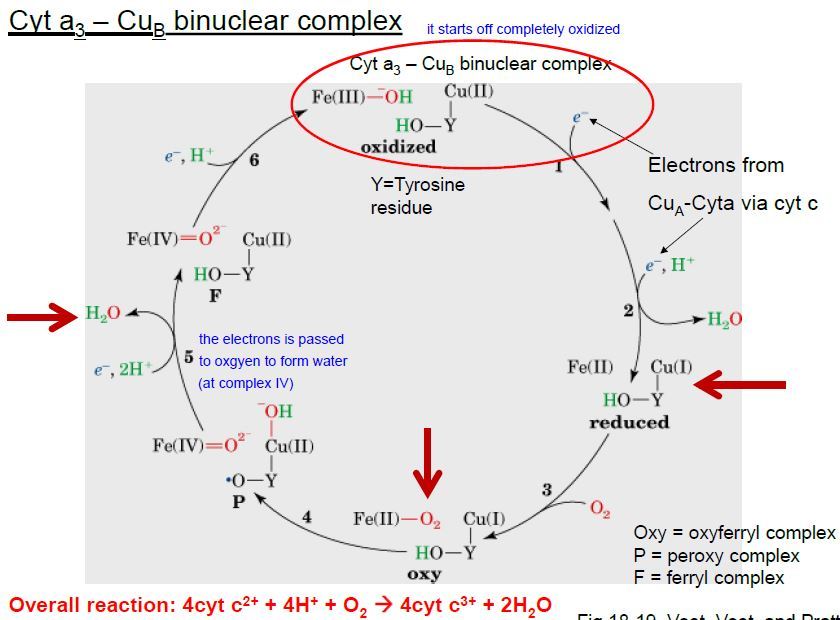
- Complex IV – cytochrome c oxidase (PG: CuA; Cyt a; Cyt a3-CuB)
- Cytochrome C
- The prosthetic groups(PG) within the complexes are essential for proper functioning of the complex
- The prosthetic groups plays a major role in transport of the electrons
- FMN and CoQ is similar to FAD, where it can accept 2H+ ions, or be partially reduced (radical form)
- Role of Heme
- Most cytochromes contains a heme group. The Fe within the heme is responsible for electron transfer
- Heme:porphyrin ring (4 pyrrole groups) and iron atom
- Iron atom in heme is octahedrally coordinated (6 bonds) Fe++ <--> Fe+++
- Most of the heme group have the same chemical and physical structure
- The differences in the heme groups can cause the cytochrome (heme) to have different absorption spectra
- Most absorption spectra would consist of three peaks - γ, β and α (Soret bands)
- The differences in the heme groups can cause the cytochrome (heme) to have different absorption spectra
- Heme:porphyrin ring (4 pyrrole groups) and iron atom
- Most cytochromes contains a heme group. The Fe within the heme is responsible for electron transfer
- Role of Fe-S Clusters
- In Complex I – two types of clusters exist [2Fe-2S] and [4Fe-4S]
- Fe++ <--> Fe+++
- In Complex I – two types of clusters exist [2Fe-2S] and [4Fe-4S]
- Role of Cu (in Complex IV)
- Requires cytochrome a and CuA and cytochrome a3 and CuB
- CuA is associated with cyt A, & CuB is associated with cyt a3 (forms a binuclear complex)
- CuA is associated with cyt A, & CuB is associated with cyt a3 (forms a binuclear complex)
- 8H+(matrix) + 4 cyt c2+ + O2 --> 4 cyt c3+ + 2H2O + 4H+
- Occurs in the inter membrane space
- Requires cytochrome a and CuA and cytochrome a3 and CuB
- The prosthetic groups plays a major role in transport of the electrons
- Complex I - NADH-Co Q reductase (PG: FMN; 2FeS)
Q Cycle
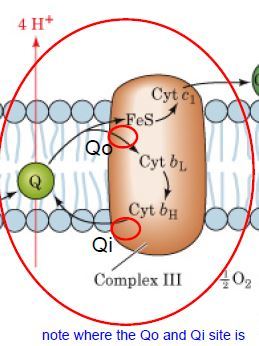
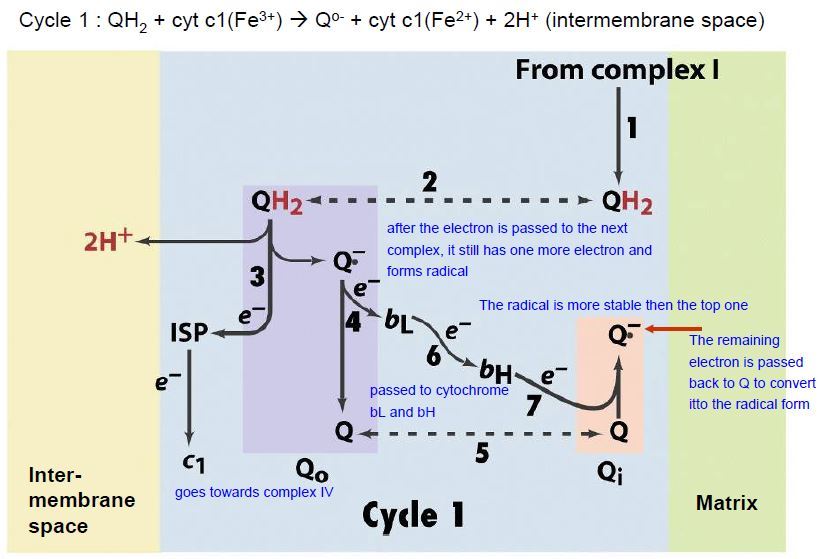
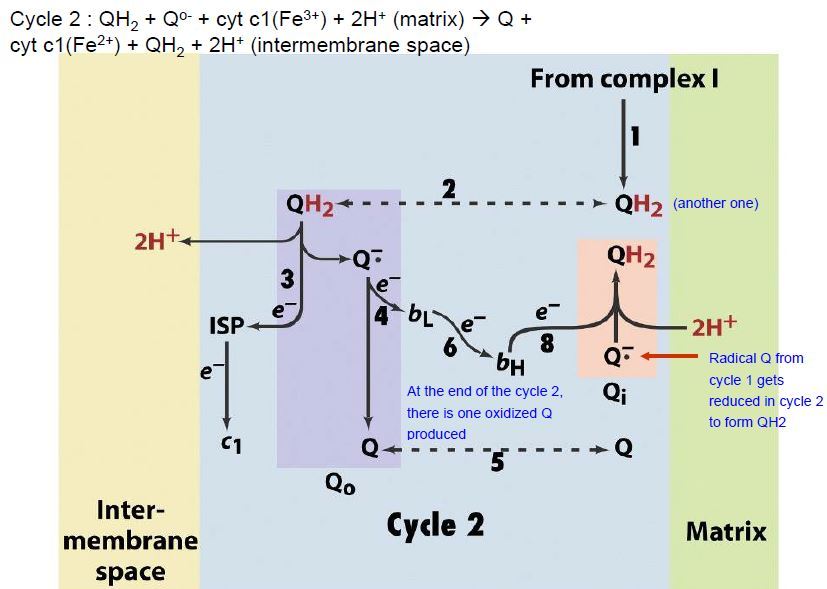
- Occurs in the complex III of ETC
- 2 sites on complex III: Q0 site & Qi site
- Cycle 1
- QH2 + cyt c1(Fe3+) --> Qo- + cyt c1(Fe2+) + 2H+ (intermembrane space)
- Cycle 2
- QH2 + Qo- + cyt c1(Fe3+) + 2H+ (matrix) --> Q + cyt c1(Fe2+) + QH2 + 2H+ (intermembrane space)
- Why donate then pick up the same electron?
- QH2 + Qo- + cyt c1(Fe3+) + 2H+ (matrix) --> Q + cyt c1(Fe2+) + QH2 + 2H+ (intermembrane space)
- Overall: QH2 + 2 cyt c1(Fe3+) + 2H+ --> Q + 2 cyt c1(Fe2+) + 4H+ (intermembrane space)
- There are usually several QH2 molecules being reduced and oxidized at the same time
- QH2 is the reduced form of coQ --> not only being reduced by complex I & II, but also other FAD containing mitochondrial enzymes
- Everytime Q get fully oxidized to QH2, it would also pump 2 protons across the membrane
- QH2 is the reduced form of coQ --> not only being reduced by complex I & II, but also other FAD containing mitochondrial enzymes
Oxidative phosphorylation
- Involves 2 processes
- Oxidation of NADH or FADH2
- Phosphorylation of ADP
- Electron transfer potential of NADH or FADH2 is converted into the phosphoryl transfer potential (phosphoryl potential - E(node))
- Reduction potential
- Strong reducing agent (eg NADH)
- Poised to donate electron
- -ve E
- Poised to donate electron
- Strong oxidizing agent (eg O2)
- Poised to receive electron
- +ve E
- Poised to receive electron
- Down the complexes from I to IV, there is an increasing E vale (increasing oxidation strength) --> To ensure that the electron can be easily transferred from one complex to another
- Strong reducing agent (eg NADH)
- ΔGo - Free energy change
- =0: at eqilibrium
- -ve: spontaneous reaction
- +ve: reaction cannot occur spontaneously
- -ve: spontaneous reaction
- ΔGo’ = -nFΔ εο’
- =0: at eqilibrium
- Reduction potential
- Involves 2 processes
Chemiosmotic Model
- Chemiosmotic coupling
- Generation of proton (H+) gradient
- NADH - 2.5ATP FADH2 - 1.5ATP
- Generation of proton (H+) gradient
- Proton-motive force
- Consists of 2 components: Electrical potential & Chemical potential
- Electrical potential is the difference in charge across the inter membrane (0.168V)
- Chemical potential is the difference in pH across the membrane (0.75)
- Electrical potential is the difference in charge across the inter membrane (0.168V)
- Consists of 2 components: Electrical potential & Chemical potential
- Requires an intact inner mitochondrial membrane to help maintain a proton gradient
- Compounds that increase the permeability of the inner mitochondria membrane allow electron transport but inhibit ATP synthesis (uncoupling)
- Inner mitochondrial membrane is also impermeable to ions to help generate the gradient
- Chemiosmotic coupling
Experimental Analysis
- Oxygen electrode
- Comprises of a chamber with electrodes to measure O2 concentrations
- 1. Place a suspension of intact mitochondria into the chamber
- 2. Add appropriate substrates
- 3. Measure O2 Consumption
- ATP synthesis: O2 Consumption (P/O ratio) --> For every 2.5 ATP molecule synthsized, 1 O atom is reduced
- O atom consumption : NADH consumption --> 1:1
- 1 NADH : 2.5ATP
- O atom consumption : NADH consumption --> 1:1
- ATP synthesis: O2 Consumption (P/O ratio) --> For every 2.5 ATP molecule synthsized, 1 O atom is reduced
- 3. Measure O2 Consumption
- 2. Add appropriate substrates
- 1. Place a suspension of intact mitochondria into the chamber
- Comprises of a chamber with electrodes to measure O2 concentrations
- Oxygen electrode
ATP synthesis
- Occurs in the mitochondria
- However, since ATP utilization occurs in the cytosol, there is a need for transporter to transport ADP and Pi into mitochondria
- Pi-H+ symport
- Carry both ions in together. Driven by the proton gradient.
- Thus, both substrate have to be present for the transporter to work
- Carry both ions in together. Driven by the proton gradient.
- ATP-ADP translocase
- export ATP and import ADP.
- Pi-H+ symport
- Complex V - FoF1 ATPase
- Step 1: Rotation of the C-Ring
- Passage of protons from the inter-membrane space through the Fo component to the matrix drive the rotation of the c-ring assembly
- 3 rotation of the c-ring assembly would generate enough energy for the synthesize of ATP
- One proton enters the complex, and one leaves and enter the matrix
- Passage of protons from the inter-membrane space through the Fo component to the matrix drive the rotation of the c-ring assembly
- Step 2: ATP synthesis
- This rotation mechanically induces conformational changes in the α3β3 assembly that synthesizes ATP from ADP and Pi.
- Step 1: Rotation of the C-Ring
Inhibitors of oxidative phosphorylation
- Antimycin A
- (inhibitor of complex III)
- (inhibitor of complex III)
- Cyanide
- (Inhibitor of complex IV)
- No ETC can occur. Thus no oxygen consumption
- (Inhibitor of complex IV)
- Oligomycin
- (inhibitor of complex V)
- oxygen consumption would rapidly decline to 0. The proton gradient is required to dissipate the proton gradient by ATPase. However, since ATPase is inhibited, no ATP produced, thus are is no favourable energetics to pump the proton out
- (inhibitor of complex V)
- Antimycin A
Uncoupling of electron transport and ATP synthesis
- Thermogenin
- forms channels in the inner mitochondria membrane to conduct protons (does not have a lot of complex V, but it expresses thermogenin)
- found in brown adipose tissues and allows for non-shivering thermogenesis (heat generation) to occur in hibernating animals and in non-furry newborn mammals.
- Respiratory chain would would pump the proton back into the matrix, and the energy harnessed would be released as heat
- found in brown adipose tissues and allows for non-shivering thermogenesis (heat generation) to occur in hibernating animals and in non-furry newborn mammals.
- forms channels in the inner mitochondria membrane to conduct protons (does not have a lot of complex V, but it expresses thermogenin)
- 2,4-dinitrophenol (DNP)
- dissipated proton gradient
- ETC would still occur, and oxygen would be still reduced to water. However, there is no ATP synthesis
- dissipated proton gradient
- Thermogenin
Mitochondria Disease
- Mitochondria proteins are encoded by genes located on the mitochondria DNA and the chromosomal DNA
- Mitochondria Disease can be a result of a mutation in the mtDNA
- Leigh syndrome – neurodegeration
- MELAS – mitochondrial encephalopathy, lactic acidosis and stroke-like episodes
- CPEO – progressive paralysis of the eye muscles
- LHON – central visual loss due to degeneration of the optic nerve
- NARP – neuropathy, developmental delay, sizeures
- MERRF – myoclonic epilepsy and ragged red fibers (muscle wasting), optic atrophy
- Mitochondria Disease can be a result of a mutation in the mtDNA
- Mitochondria proteins are encoded by genes located on the mitochondria DNA and the chromosomal DNA
Images and files in the map
Information
- Description
- Science (LSM2101) Mind Map on LSM2101 ETC, created by Vivien Tan on 23/09/2016.
- Created by
- Vivien Tan
- Views
- 0
- Rating