
Mind map
LECTURE 5: ELECTIONS, REFERENDUMS AND DIRECT DEMOCRACY
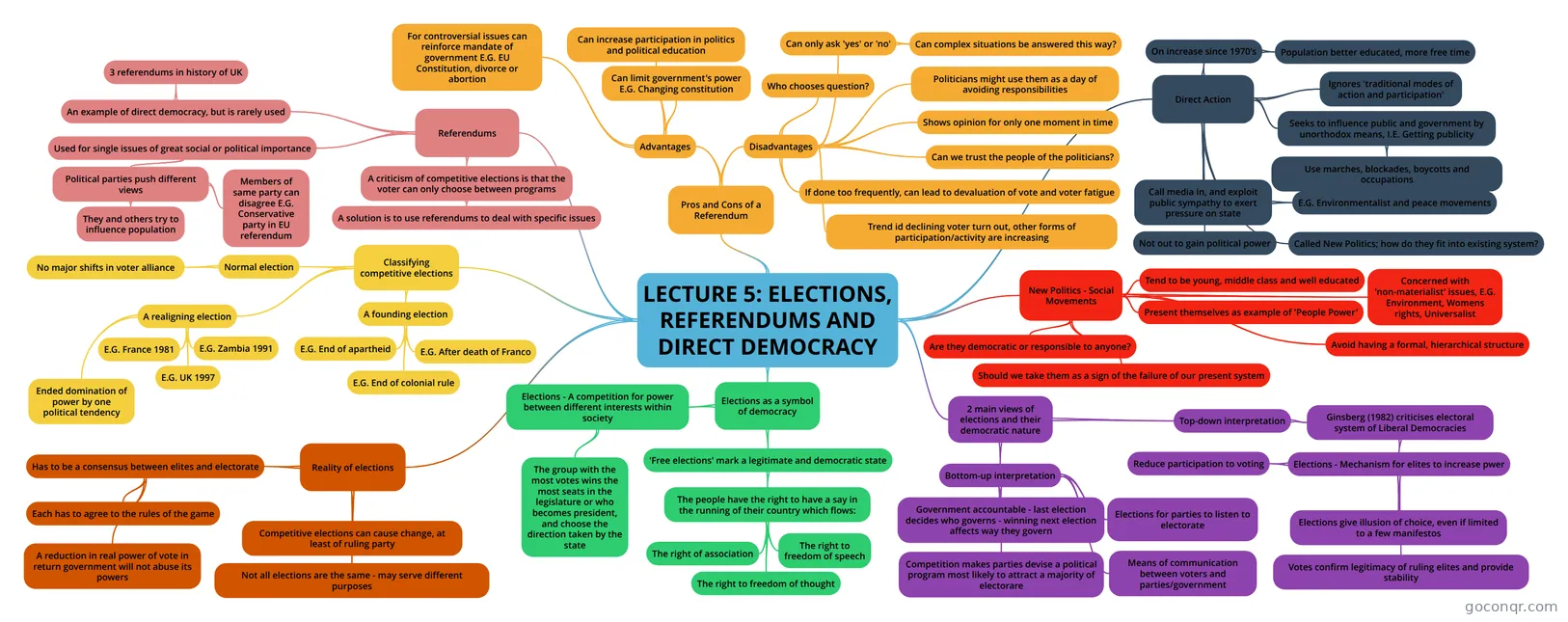
Mind map: Elections, referendums and direct democracy
Map content
LECTURE 5: ELECTIONS, REFERENDUMS AND DIRECT DEMOCRACY
Elections as a symbol of democracy
- 'Free elections' mark a legitimate and democratic state
- The people have the right to have a say in the running of their country which flows:
- The right to freedom of thought
- The right to freedom of speech
- The right of association
- The people have the right to have a say in the running of their country which flows:
- Elections - A competition for power between different interests within society
- The group with the most votes wins the most seats in the legislature or who becomes president, and choose the direction taken by the state
- 'Free elections' mark a legitimate and democratic state
2 main views of elections and their democratic nature
- Bottom-up interpretation
- Government accountable - last election decides who governs - winning next election affects way they govern
- Competition makes parties devise a political program most likely to attract a majority of electorare
- Elections for parties to listen to electorate
- Means of communication between voters and parties/government
- Top-down interpretation
- Ginsberg (1982) criticises electoral system of Liberal Democracies
- Elections - Mechanism for elites to increase pwer
- Reduce participation to voting
- Elections give illusion of choice, even if limited to a few manifestos
- Votes confirm legitimacy of ruling elites and provide stability
- Elections - Mechanism for elites to increase pwer
- Ginsberg (1982) criticises electoral system of Liberal Democracies
- Bottom-up interpretation
Reality of elections
- Has to be a consensus between elites and electorate
- Each has to agree to the rules of the game
- A reduction in real power of vote in return government will not abuse its powers
- Competitive elections can cause change, at least of ruling party
- Not all elections are the same - may serve different purposes
- Has to be a consensus between elites and electorate
Classifying competitive elections
- A founding election
- E.G. After death of Franco
- E.G. End of apartheid
- E.G. End of colonial rule
- A realigning election
- E.G. UK 1997
- E.G. France 1981
- E.G. Zambia 1991
- Ended domination of power by one political tendency
- Normal election
- No major shifts in voter alliance
- A founding election
Referendums
- A criticism of competitive elections is that the voter can only choose between programs
- A solution is to use referendums to deal with specific issues
- Used for single issues of great social or political importance
- Political parties push different views
- Members of same party can disagree E.G. Conservative party in EU referendum
- They and others try to influence population
- Political parties push different views
- An example of direct democracy, but is rarely used
- 3 referendums in history of UK
- A criticism of competitive elections is that the voter can only choose between programs
Pros and Cons of a Referendum
- Advantages
- Can limit government's power E.G. Changing constitution
- Can increase participation in politics and political education
- For controversial issues can reinforce mandate of government E.G. EU Constitution, divorce or abortion
- Disadvantages
- Who chooses question?
- Can only ask 'yes' or 'no'
- Can complex situations be answered this way?
- Politicians might use them as a day of avoiding responsibilities
- Shows opinion for only one moment in time
- Can we trust the people of the politicians?
- If done too frequently, can lead to devaluation of vote and voter fatigue
- Trend id declining voter turn out, other forms of participation/activity are increasing
- Advantages
Direct Action
- On increase since 1970's
- Population better educated, more free time
- Ignores 'traditional modes of action and participation'
- Seeks to influence public and government by unorthodox means, I.E. Getting publicity
- Use marches, blockades, boycotts and occupations
- Call media in, and exploit public sympathy to exert pressure on state
- E.G. Environmentalist and peace movements
- Not out to gain political power
- Called New Politics; how do they fit into existing system?
- On increase since 1970's
New Politics - Social Movements
- Tend to be young, middle class and well educated
- Present themselves as example of 'People Power'
- Concerned with 'non-materialist' issues, E.G. Environment, Womens rights, Universalist
- Avoid having a formal, hierarchical structure
- Are they democratic or responsible to anyone?
- Should we take them as a sign of the failure of our present system
Information
- Description
- Mind Map on LECTURE 5: ELECTIONS, REFERENDUMS AND DIRECT DEMOCRACY, created by Luigi Botrugno on 17/10/2016.
- Created by
- Luigi Botrugno
- Views
- 3
- Rating
More on Elections and electoral systems