
Mind map
THE NECKLACE BY SHANYISA
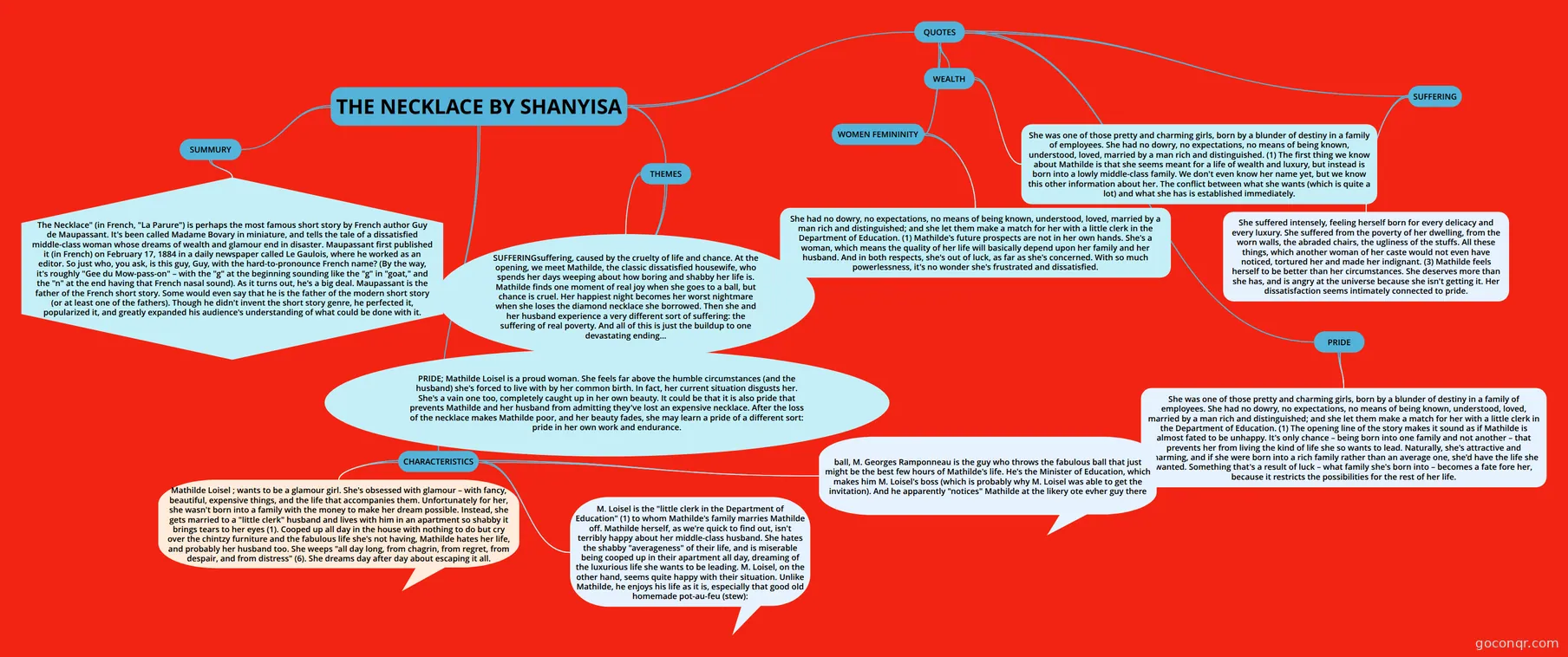
Mind map: The Necklace by Guy de Maupassant
Map content
THE NECKLACE BY SHANYISA
THEMES
- PRIDE; Mathilde Loisel is a proud woman. She feels far above the humble circumstances (and the husband) she's forced to live with by her common birth. In fact, her current situation disgusts her. She's a vain one too, completely caught up in her own beauty. It could be that it is also pride that prevents Mathilde and her husband from admitting they've lost an expensive necklace. After the loss of the necklace makes Mathilde poor, and her beauty fades, she may learn a pride of a different sort: pride in her own work and endurance.
- SUFFERINGsuffering, caused by the cruelty of life and chance. At the opening, we meet Mathilde, the classic dissatisfied housewife, who spends her days weeping about how boring and shabby her life is. Mathilde finds one moment of real joy when she goes to a ball, but chance is cruel. Her happiest night becomes her worst nightmare when she loses the diamond necklace she borrowed. Then she and her husband experience a very different sort of suffering: the suffering of real poverty. And all of this is just the buildup to one devastating ending…
SUMMURY
- The Necklace" (in French, "La Parure") is perhaps the most famous short story by French author Guy de Maupassant. It's been called Madame Bovary in miniature, and tells the tale of a dissatisfied middle-class woman whose dreams of wealth and glamour end in disaster. Maupassant first published it (in French) on February 17, 1884 in a daily newspaper called Le Gaulois, where he worked as an editor. So just who, you ask, is this guy, Guy, with the hard-to-pronounce French name? (By the way, it's roughly "Gee du Mow-pass-on" – with the "g" at the beginning sounding like the "g" in "goat," and the "n" at the end having that French nasal sound). As it turns out, he's a big deal. Maupassant is the father of the French short story. Some would even say that he is the father of the modern short story (or at least one of the fathers). Though he didn't invent the short story genre, he perfected it, popularized it, and greatly expanded his audience's understanding of what could be done with it.
QUOTES
- WEALTH
- She was one of those pretty and charming girls, born by a blunder of destiny in a family of employees. She had no dowry, no expectations, no means of being known, understood, loved, married by a man rich and distinguished. (1) The first thing we know about Mathilde is that she seems meant for a life of wealth and luxury, but instead is born into a lowly middle-class family. We don't even know her name yet, but we know this other information about her. The conflict between what she wants (which is quite a lot) and what she has is established immediately.
- WOMEN FEMININITY
- She had no dowry, no expectations, no means of being known, understood, loved, married by a man rich and distinguished; and she let them make a match for her with a little clerk in the Department of Education. (1) Mathilde's future prospects are not in her own hands. She's a woman, which means the quality of her life will basically depend upon her family and her husband. And in both respects, she's out of luck, as far as she's concerned. With so much powerlessness, it's no wonder she's frustrated and dissatisfied.
- SUFFERING
- She suffered intensely, feeling herself born for every delicacy and every luxury. She suffered from the poverty of her dwelling, from the worn walls, the abraded chairs, the ugliness of the stuffs. All these things, which another woman of her caste would not even have noticed, tortured her and made her indignant. (3) Mathilde feels herself to be better than her circumstances. She deserves more than she has, and is angry at the universe because she isn't getting it. Her dissatisfaction seems intimately connected to pride.
- PRIDE
- She was one of those pretty and charming girls, born by a blunder of destiny in a family of employees. She had no dowry, no expectations, no means of being known, understood, loved, married by a man rich and distinguished; and she let them make a match for her with a little clerk in the Department of Education. (1) The opening line of the story makes it sound as if Mathilde is almost fated to be unhappy. It's only chance – being born into one family and not another – that prevents her from living the kind of life she so wants to lead. Naturally, she's attractive and charming, and if she were born into a rich family rather than an average one, she'd have the life she wanted. Something that's a result of luck – what family she's born into – becomes a fate fore her, because it restricts the possibilities for the rest of her life.
- WEALTH
CHARACTERISTICS
- Mathilde Loisel ; wants to be a glamour girl. She's obsessed with glamour – with fancy, beautiful, expensive things, and the life that accompanies them. Unfortunately for her, she wasn't born into a family with the money to make her dream possible. Instead, she gets married to a "little clerk" husband and lives with him in an apartment so shabby it brings tears to her eyes (1). Cooped up all day in the house with nothing to do but cry over the chintzy furniture and the fabulous life she's not having, Mathilde hates her life, and probably her husband too. She weeps "all day long, from chagrin, from regret, from despair, and from distress" (6). She dreams day after day about escaping it all.
- M. Loisel is the "little clerk in the Department of Education" (1) to whom Mathilde's family marries Mathilde off. Mathilde herself, as we're quick to find out, isn't terribly happy about her middle-class husband. She hates the shabby "averageness" of their life, and is miserable being cooped up in their apartment all day, dreaming of the luxurious life she wants to be leading. M. Loisel, on the other hand, seems quite happy with their situation. Unlike Mathilde, he enjoys his life as it is, especially that good old homemade pot-au-feu (stew):
- ball, M. Georges Ramponneau is the guy who throws the fabulous ball that just might be the best few hours of Mathilde's life. He's the Minister of Education, which makes him M. Loisel's boss (which is probably why M. Loisel was able to get the invitation). And he apparently "notices" Mathilde at the likery ote evher guy there
Information
- Description
- Mind Map on THE NECKLACE BY SHANYISA, created by Nikita Gyssler on 01/11/2016.
- Created by
- Nikita Gyssler
- Views
- 21
- Rating