
Mind map
Caregiver- infant ineractions
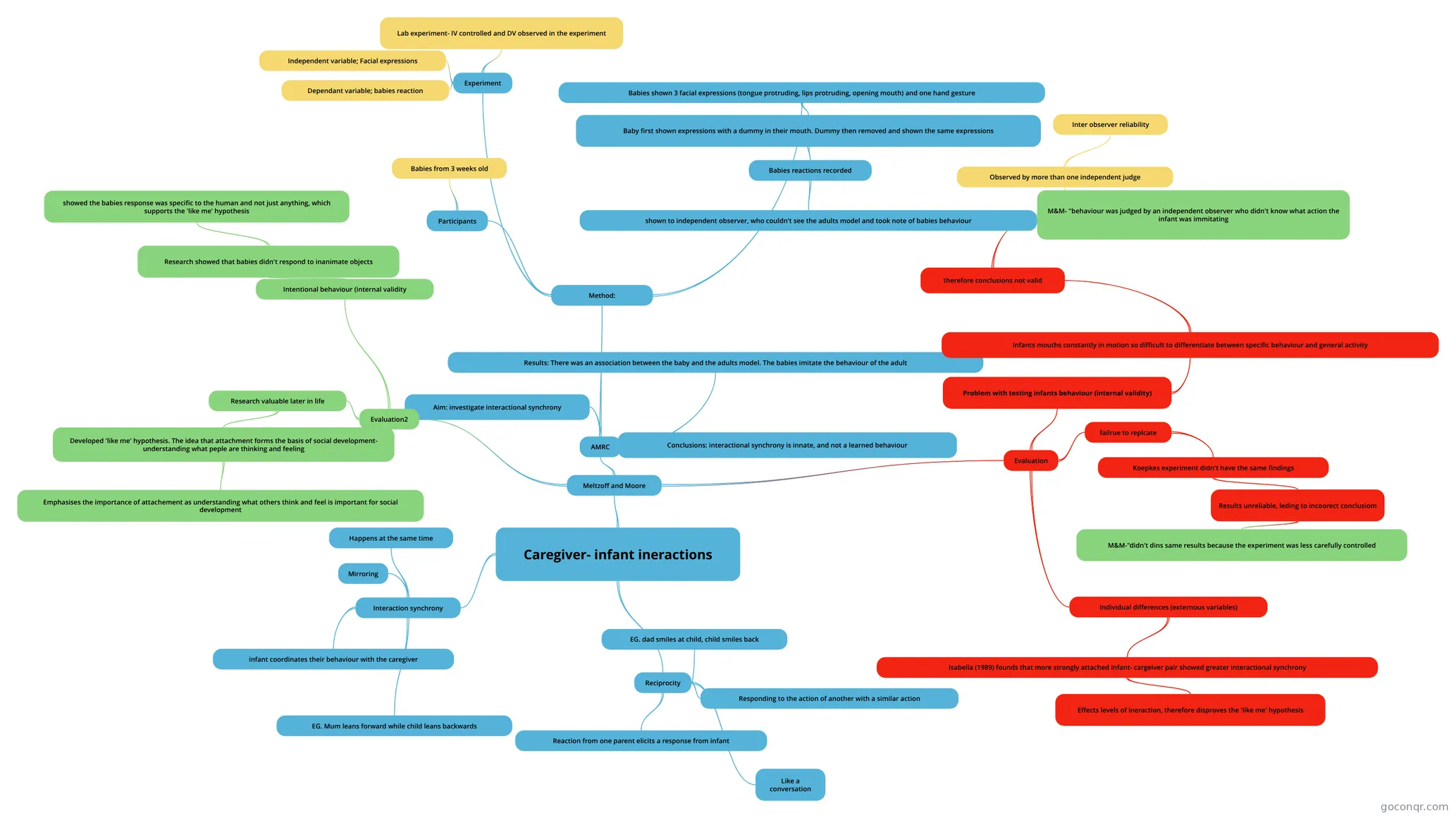
Mind map: Caregiver-infant interactions
Map content
Caregiver- infant ineractions
Reciprocity
- Responding to the action of another with a similar action
- Reaction from one parent elicits a response from infant
- EG. dad smiles at child, child smiles back
- Like a conversation
Interaction synchrony
- infant coordinates their behaviour with the caregiver
- Mirroring
- EG. Mum leans forward while child leans backwards
- Happens at the same time
Meltzoff and Moore
- AMRC
- Aim: investigate interactional synchrony
- Results: There was an association between the baby and the adults model. The babies imitate the behaviour of the adult
- Conclusions: interactional synchrony is innate, and not a learned behaviour
- Method:
- Babies shown 3 facial expressions (tongue protruding, lips protruding, opening mouth) and one hand gesture
- Baby first shown expressions with a dummy in their mouth. Dummy then removed and shown the same expressions
- Babies reactions recorded
- shown to independent observer, who couldn't see the adults model and took note of babies behaviour
- Observed by more than one independent judge
- Inter observer reliability
- Observed by more than one independent judge
- shown to independent observer, who couldn't see the adults model and took note of babies behaviour
- Babies reactions recorded
- Baby first shown expressions with a dummy in their mouth. Dummy then removed and shown the same expressions
- Experiment
- Lab experiment- IV controlled and DV observed in the experiment
- Independent variable; Facial expressions
- Dependant variable; babies reaction
- Participants
- Babies from 3 weeks old
- Babies shown 3 facial expressions (tongue protruding, lips protruding, opening mouth) and one hand gesture
- Evaluation
- Problem with testing infants behaviour (internal validity)
- Infants mouths constantly in motion so difficult to differentiate between specific behaviour and general activity
- therefore conclusions not valid
- M&M- "behaviour was judged by an independent observer who didn't know what action the infant was immitating
- therefore conclusions not valid
- Infants mouths constantly in motion so difficult to differentiate between specific behaviour and general activity
- failrue to replcate
- Koepkes experiment didn't have the same findings
- Results unreliable, leding to incoorect conclusiom
- M&M-"didn't dins same results because the experiment was less carefully controlled
- Results unreliable, leding to incoorect conclusiom
- Koepkes experiment didn't have the same findings
- Individual differences (externous variables)
- Isabella (1989) founds that more strongly attached infant- cargeiver pair showed greater interactional synchrony
- Effects levels of ineraction, therefore disproves the 'like me' hypothesis
- Isabella (1989) founds that more strongly attached infant- cargeiver pair showed greater interactional synchrony
- Problem with testing infants behaviour (internal validity)
- Evaluation2
- Intentional behaviour (internal validity
- Research showed that babies didn't respond to inanimate objects
- showed the babies response was specific to the human and not just anything, which supports the 'like me' hypothesis
- Research showed that babies didn't respond to inanimate objects
- Research valuable later in life
- Developed 'like me' hypothesis. The idea that attachment forms the basis of social development- understanding what peple are thinking and feeling
- Emphasises the importance of attachement as understanding what others think and feel is important for social development
- Developed 'like me' hypothesis. The idea that attachment forms the basis of social development- understanding what peple are thinking and feeling
- Intentional behaviour (internal validity
- AMRC
Information
- Description
- Mind Map on Caregiver- infant ineractions, created by sarah Miller on 11/16/2016.
- Created by
- sarah Miller
- Views
- 0
- Rating
More on Caregiver-infant interactions