
704881
Description

Mind Map by danny-hudson97, updated more than 1 year ago

|
Created by danny-hudson97
almost 12 years ago
|
|
Multi-store Model
of Memory
- Atkinson &
Shiffrin (1968)
- Components
- 1) Sensory
Memory
- Stores the incoming information from the senses. The model
assumes that these are modality specific, that is there is a
separate store for each of the five senses. The store is very brief
and the vast majority of information is lost here. Only information
that is relevant or important is attended to and passed on to STM.
Forgetting from the sensory store is by decay.
- Stores the incoming information from the senses. The model
assumes that these are modality specific, that is there is a
separate store for each of the five senses. The store is very brief
and the vast majority of information is lost here. Only information
that is relevant or important is attended to and passed on to STM.
Forgetting from the sensory store is by decay.
- 2) Short Term
Memory
- Atkinson & Shiffrin believed the store to be fragile and
retains information for about 30 seconds. Compare this
to the 18 seconds of the Brown–Peterson technique.
Material that is rehearsed is passed on to LTM.
Forgetting from STM is by displacement or decay.
- Atkinson & Shiffrin believed the store to be fragile and
retains information for about 30 seconds. Compare this
to the 18 seconds of the Brown–Peterson technique.
Material that is rehearsed is passed on to LTM.
Forgetting from STM is by displacement or decay.
- 3) Long
Term Memory
- Can store this information for a lifetime.
Forgetting from LTM is by decay or interference
- Can store this information for a lifetime.
Forgetting from LTM is by decay or interference
- 1) Sensory
Memory
- Processes
- 1) Attention
- Needed to transfer information from the
senses to STM. Most stimuli that reach
the senses are ignored because they
aren’t seen as important. Only relevant or
interesting information, or material that we
choose to concentrate on is passed to the
STM. 99% is lost at this stage.
- Needed to transfer information from the
senses to STM. Most stimuli that reach
the senses are ignored because they
aren’t seen as important. Only relevant or
interesting information, or material that we
choose to concentrate on is passed to the
STM. 99% is lost at this stage.
- 2) Rehersal
- Needed to transfer information from STM to LTM. We can rehearse
information out loud as a child would do learning times tables by rote. iI is
seen as crucial and is one of the main criticisms of the theory. Elaborative
rehearsal links the information with existing material or elaborates it in
some other way, again as an aid to longer term storage.
- Needed to transfer information from STM to LTM. We can rehearse
information out loud as a child would do learning times tables by rote. iI is
seen as crucial and is one of the main criticisms of the theory. Elaborative
rehearsal links the information with existing material or elaborates it in
some other way, again as an aid to longer term storage.
- 1) Attention
- Evaluation
- +++++
- The model has
simplistic appeal and
has been influential in
stimulating research
- Various studies that suggest the existence of two separate stores support
the theory. For example Murdoch (1962) found evidence for a primacy and
recency effect. As already mentioned primacy effect due to information
heard first being rehearsed and passed to LTM and recency effect
because recently heard or seen information is still present in the STM.
- The model has
simplistic appeal and
has been influential in
stimulating research
- - - - - -
- Flow of information is assumed to be
one way, but it seems likely that our
LTM is able to assist our STM
suggesting a ‘reverse flow.’
- When considered more closely case
studies of amnesiacs suggest that
both STM and LTM are far more
complex than the multi-store model
suggests
- Flow of information is assumed to be
one way, but it seems likely that our
LTM is able to assist our STM
suggesting a ‘reverse flow.’
- +++++
- Components
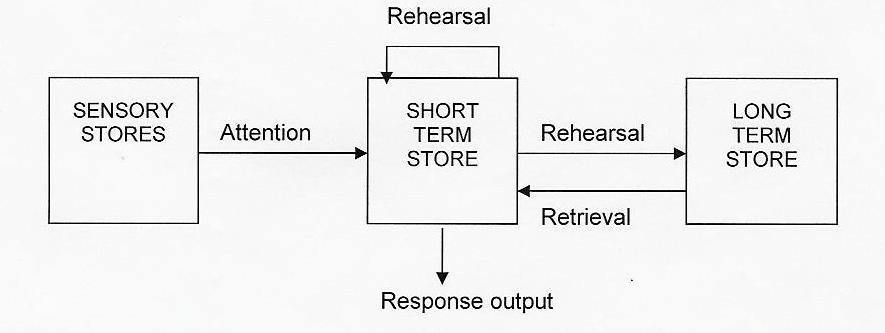
- This model builds on the idea of three memory stores and
tries to explain how they work together. The model sees
memory as a flow of information through a system. The
model takes an information processing approach and as
such it is usually represented in the form of a flow diagram.
Media attachments
Want to create your own Mind Maps for free with GoConqr? Learn more.