
Mind map
Physics 1a – Energy
Map content
Physics 1a – Energy
Heat Radiation
- Infrared radiation can be emitted by solids, liquids and gases
- Any object can both absorb and emit infrared radiation, whether or not conduction or convection are also taking place
- The transfer of heat energy by infrared (IR) Radiation
- All objects are continually emitting and absorbing infrared radiation. Infrared radiation is emitted from the surface of an object
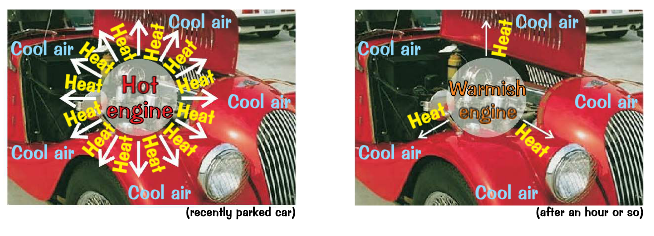
- An object that's hotter than its surroundings emit more radiation than it absorbs (as it cools down). And an object that's cooler than its surroundings absorbs more radiation than it emits (as it warms up).
- The hotter an object is, the more radiation it radiates at a given time
- You can feel this infrared tadiation if you stand near something hot like a fire or if you put your hand just above the bonnet of a recently parked car
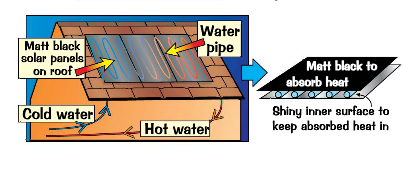
- Dark, matt surfaces absorb infrared radiation falling on them much better than light, shiny surfaces, such as gloss white or silver. They also emit much more infrared radiation (at any given temperature)
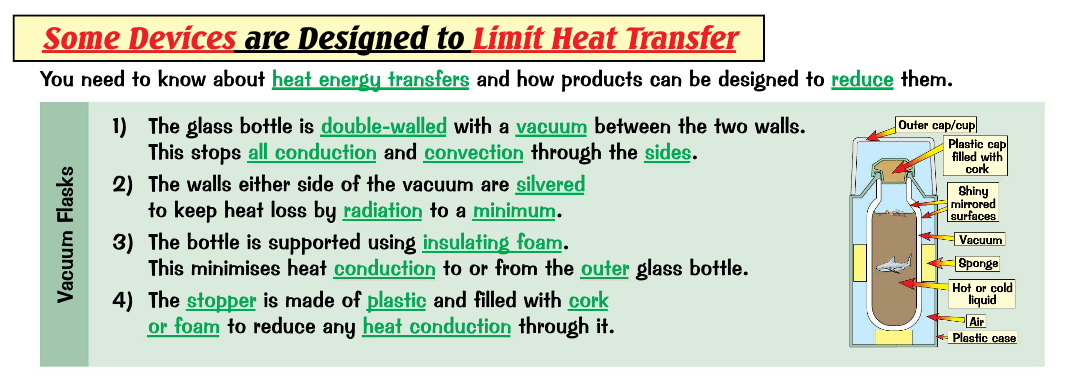
- Light, shiny surfaces reflect a lot of the infrared radiation falling on them. E.g. vacuum flasks have silver inner surfaces to keep heat in or out ,depending on whether it's storing hot or cold liquid
- Solar hot water panels contain water pipes under a black surface (or black painted pipes under glass)
- Radiation from the Sun is absorbed by the black surface to heat the water in the pipes
- The water can be used for washing or pumped to radiators to heat the building
- Infrared radiation can be emitted by solids, liquids and gases
Heat is transferred in three different ways
- Conduction
- Main form of heat transfer in solids
- Transfer of energy by particles
- Convection
- Main form of heat transfer in liquids and gases
- Transfer of energy by particles
- The bigger the temperature difference between a body and its surroundings, the faster energy is transferred by heating
- Radiation
- Conduction
Kinetic Theory and Conduction
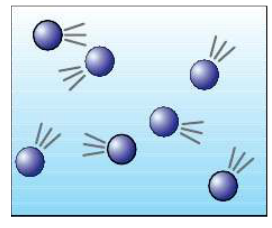
- Kinetic Theory can explain the three states of matter
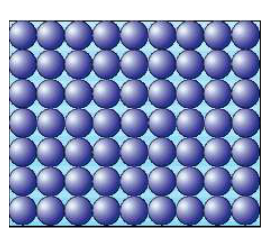
- Solid
- Strong forces of attraction hold the particles close together in a fixed, regular arrangement. The particles don't have much energy so they can only vibrate about their fixed positions
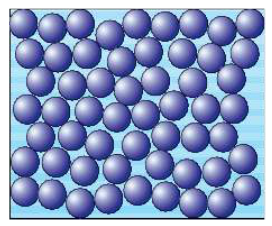
- Liquid
- Weaker forces of attraction between the particles. The particles are close together, but can move past each other, and form irregular arrangements. They have more energy than particles in a solid – they can move in random directions at low speeds
- Gas
- There are almost no forces of attraction between the particles. The particles have more energy than those in liquids and solids – they are free to move, and travel in random directions at high speeds
- Solid
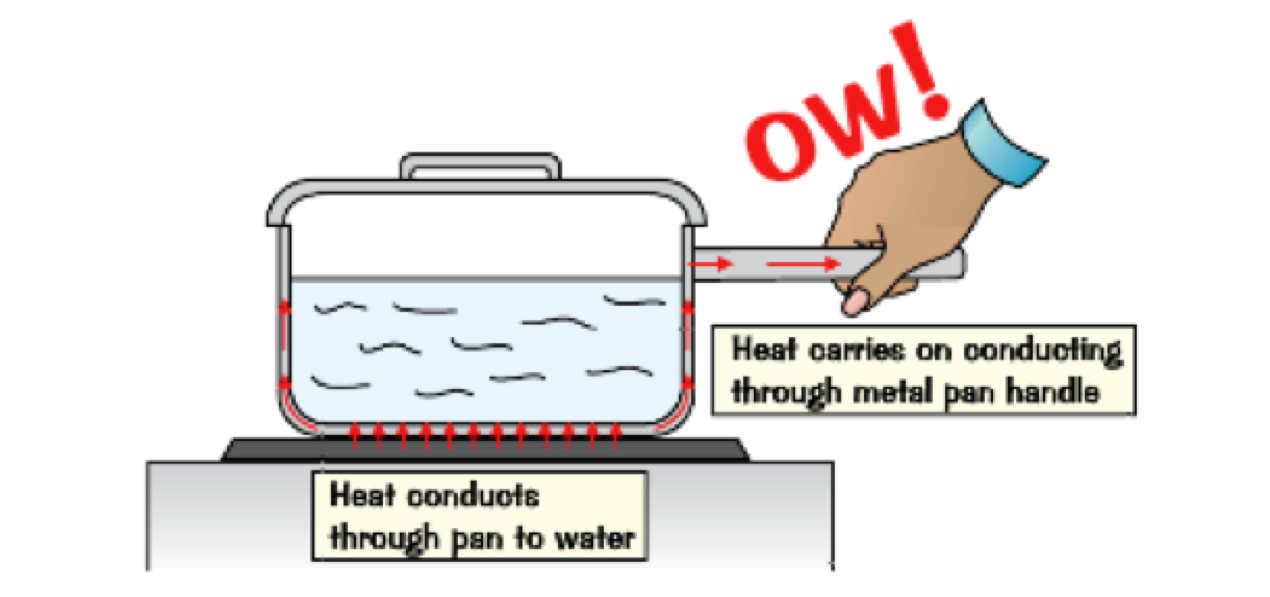
- Conduction of Heat – occurs mainly in Solids
- Conduction of heat energy is the process where vibrating particles pass on their extra kinetic energy to neighbouring particles
- This process continues throughout the solid and gradually some of the extra kinetic energy (or heat) is passed all the way through the solid, causing a rise in temperature at the other side of the solid. And hence an increase in the heat radiating from its surface
- Usually conduction is faster in denser solids, because the particles are closer together and so will collide more often and pass energy between them. Materials that have larger spaces between their particles conduct heat energy much more slowly – these materials are insulators
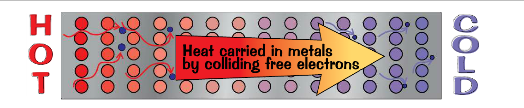
- Metals are good conductors because of their free electrons
- Metals "conduct" so well because the electrons are free to move inside the metal
- At the hot end the electrons move faster and collide with other free electrons, transferring energy. These other electrons then pass on their extra energy to other electrons, etc.
- Because the electrons can move freely, this is obviously a much faster way of transferring the energy through the metal than slowly passing it by jostling neighbouring atoms
- This is why heat energy travels so fast through metals
- Conduction is more efficient through a short, fat rod than through a long thin rod. It all comes down to how fat the electrons have to transfer the energy
- Kinetic Theory can explain the three states of matter
Convection
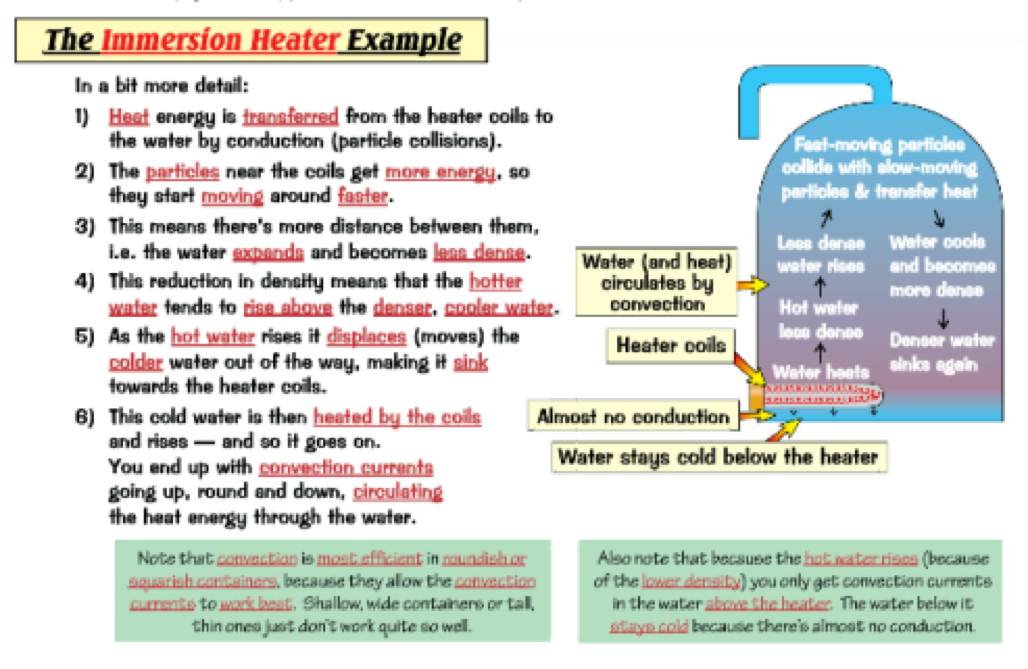
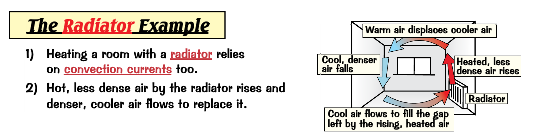
- Convection of Heat – Liquids and Gases Only
- Convection occurs when the more energetic particles move from the hotter region to the cooler region – and take their heat energy with them
- Convection currents are all about changes in density
- Convection of Heat – Liquids and Gases Only
Condensation
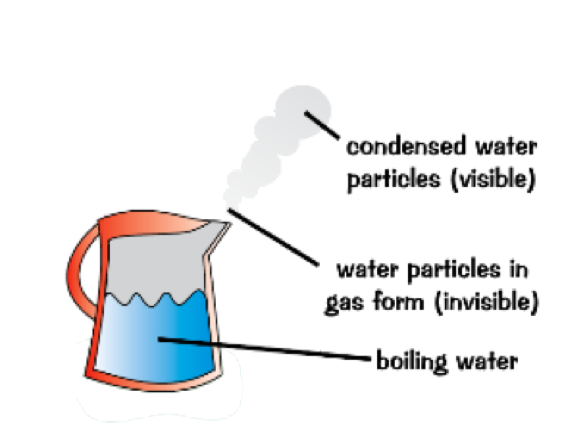
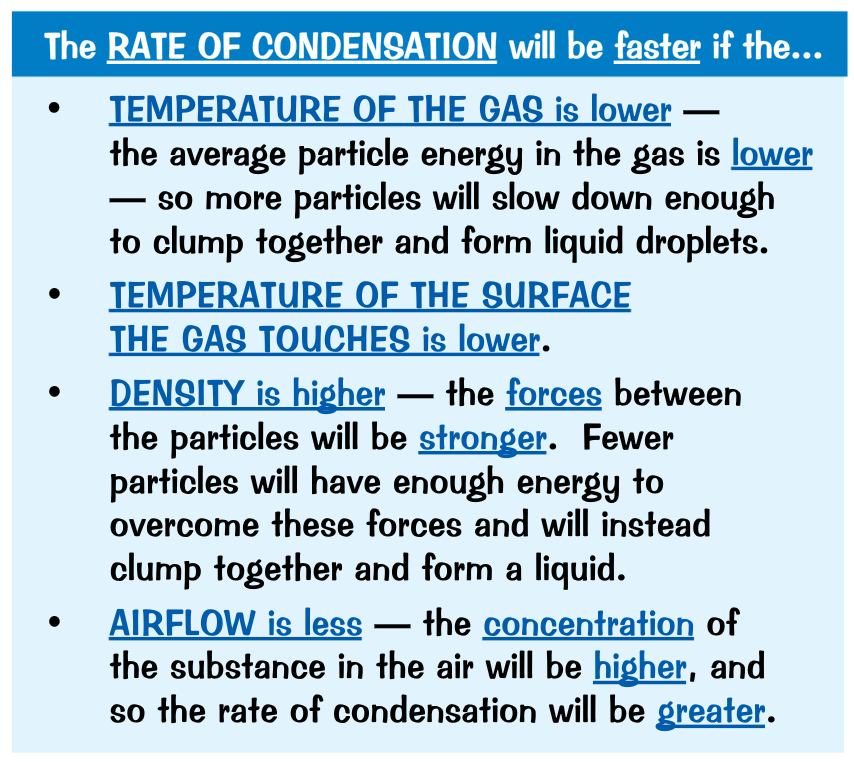
- Condensation is when gas turns to liquid
- When a gas cools, the particles in the gas slow down and lose kinetic energy. The attractive forces between the particles pull them closer together
- If the temperature gets cold enough and the gas particles get close enough together that condensation can take place, the gas becomes a liquid
- Water vapour in the air condenses when it comes into contact with cold surfaces
- The steam rising from a boiling kettle is actually invisible water vapour condensing to form tiny water droplets as it spreads into cooler air
Evaporation
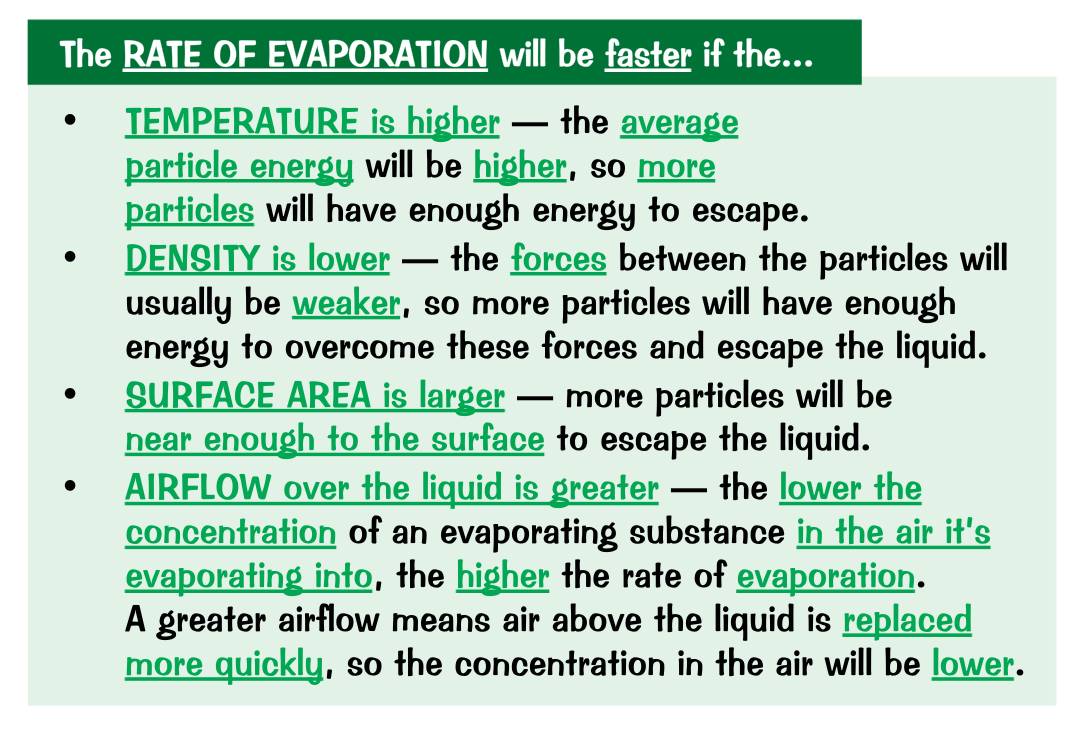
- Evaporation is when liquid turns to gas
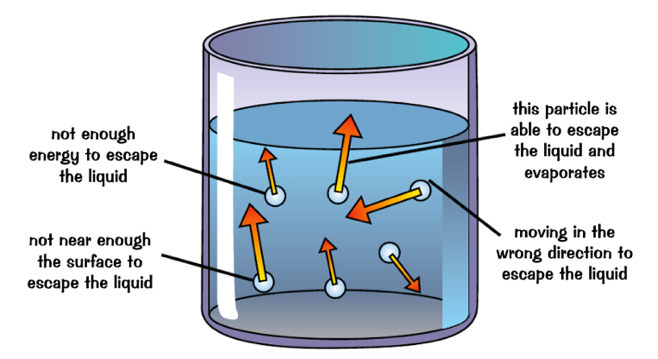
- Evaporation is when particles escape from liquid
- Particles can evaporate from a liquid at temperatures that are much lower than the liquid's boiling point
- Particles neat the surface of a liquid can escape and become gas particles if:
- The particles are travelling in the right direction to escape the liquid
- The particles are travelling fast enough (they gave enough kinetic energy) to overcome the attractive forces of the other particles in the liquid
- The fastest particles are most likely to evaporate from the liquid – so when the do, the average speed and kinetic energy of the remaining particles decreases
- This decrease in average particle energy means the temperature of the remaining liquid falls – the liquid cools
- This cooling effect can be really useful. For example, you sweat when you exercise or get got. As the water from the sweat on your skin evaporates, it cools you down
Rate of Heat Transfer
- The rate of heat energy transfer depends on many things
- Heat energy is radiated from the surface if an object
- The bigger the surface area, the more infrared waves that can be emitted from (or absorbed by) the surface – so the quicker the transfer of heat. E.g. radiators have large surface areas to maximise the amount of heat they transfer
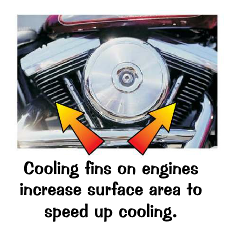
- This is why car and motorbike engines often have 'fins' – they increase the surface area so heat is radiated away quicker. So the engine cools quicker
- Heat sinks are devices designed to transfer heat away from objects they're in contact with, e.g. computer components. They have fins and a large surface area so they can emit heat as quickly as possible
- If two objects at the same temperature have the same surface area but different volumes, the object with the smaller volume will cool more quickly – as a higher proportion of the object will be in contact with its surroundings
- Other factors, like the type of material, affect the rate too. Objects made from good conductors transfer heat away more quickly than insulating materials. It also matters whether the materials in contact with it are insulators or conductors. If an object is in contact with a conductor, the heat will be conducted away much faster that if it is in contact with a good insulator
- Humans and animals have ways of controlling heat transfer too
- In the cold, the hairs on skin 'stand up' to trap a thicker layer of insulating air around the body. This limits the amount of heat loss by convection. Some animals do the same using fur
- When the body's too warm, it diverts more blood to flow near the surface of the skin so that more heat can be lost by radiation – that's why some people go pink when they get hot
- Generally, animals in warm climates gave larger ears than those in cold climates to help control heat transfer
- The rate of heat energy transfer depends on many things
Energy Efficiency in the Home
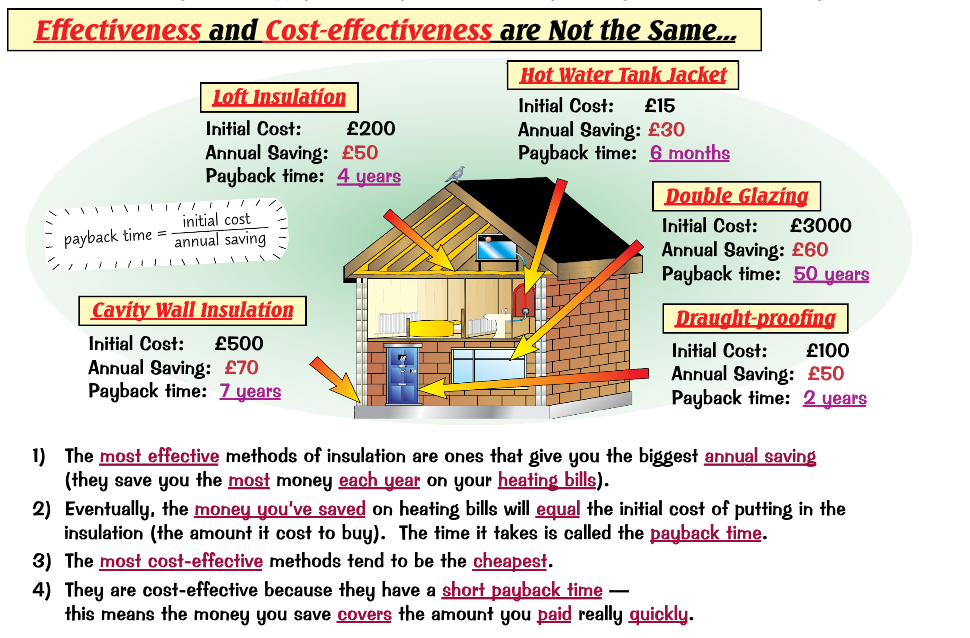
- Cavity Wall Insulation- foam squirted into the gap between the bricks stops convection currents being set up in the gap and radiation across the gap. The insulating foam and the air pockets trapped in it (air is an insulator) also helps reduce heat loss by conduction
- Loft Insulation- a thick layer of fibreglass wool laid out across the loft floor and ceiling reduces heat loss from the house by conduction and convection
- Draught-proofing- strips of foam and plastic around doors and windows stop draughts of cold air blowing in, i.e. they reduce heat loss due to convection
- Hot water tank jacket- lagging such as fibreglass wool reduces conduction and radiation
- Thick curtains- prevents hot air reaching the window by convection, and reduces conduction
- U-values show how fast heat can transfer through a material
- Heat transfers faster through materials with higher-U-values than through materials with low-U-values
- So the better the insulator the lower the U-value
Specific Heat Capacity
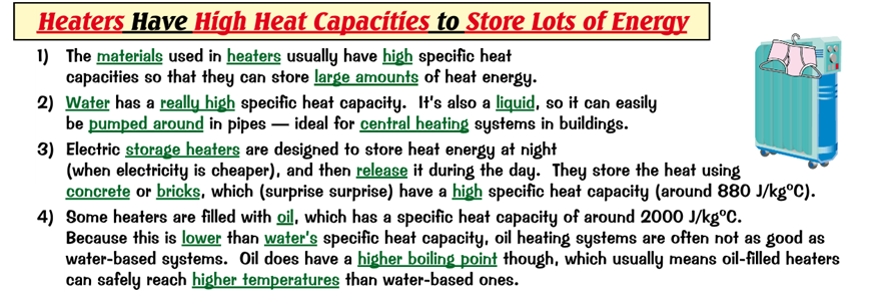
- It takes more heat to increase the temperature of some materials than others
- Materials which need to gain lots of energy to warm up also release loads of energy when they cool down again. They can 'store' a lot of heat.
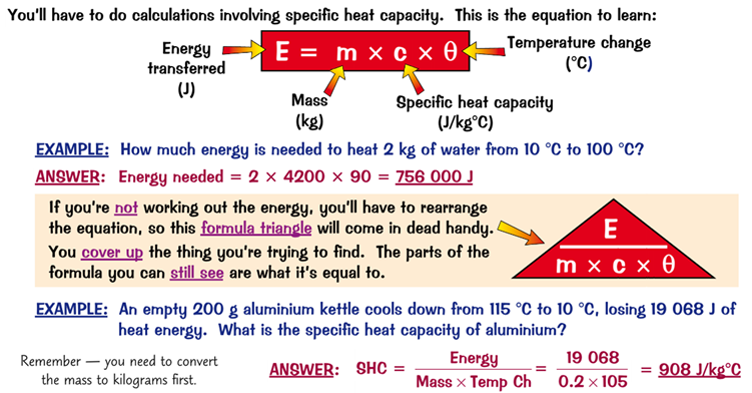
- The measure of how much energy a substance can store is called its specific heat capacity
- Specific heat capacity is the amount if energy needed to raise the temperature of 1Kg of a substance by 1oC
Images and files in the map


Information
- Description
- GCSE Physics Mind Map on Physics 1a – Energy, created by Oliver Walton on 04/12/2016.
- Created by
- Oliver Walton
- Views
- 0
- Rating