
Mind map
Unit 1
Map content
Unit 1
Constituents of the atom
- The nuclear model
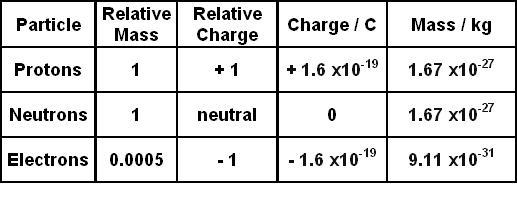
- We know that the atom consists of positively charged protons and neutral neutrons inside the nucleus. The nucleus sits in the middle of the atom and is surrounded by negative electrons.
- Notation
- You can represent an atom by using two numbers, the proton number which is the number of protons in the nucleus. In an uncharged atom the number of electrons in its orbital shell is equal to the number of protons. The other number is the nucleon number, the total number of nucleons in the nucleus is worked out by adding the number of protons and neutrons.
- Isotopes
- Isotopes are different forms of an element. An isotope has the number of protons but have a different number neutrons. Since they have the same number of protons (and electrons ) they behave in the same way.
- Specific Charge
- Specific charge is another title for the charge-mass ratio. This is a measure of the charge per unit mass and is simply worked out by dividing the charge of a particle by the charge of a particle by its mass.
- Ions
- An atom may gain or loose electrons. When this happens the atoms becomes electrically charged.
- If the atom gains an electron there are more negative charges than positive, so the atom is a negative ion.
- If the atom looses an electron there are more positive charges than negative, so the atom is a positive ion.
- An atom may gain or loose electrons. When this happens the atoms becomes electrically charged.
- The nuclear model
Particles and Antiparticles
- Antimatter
- Every particle has its own antiparticle. An antiparticle has the same mass as the particle version but has opposite charge. An antiproton has a negative charge, an anti electron has a has a positive charge but an antineutron is also uncharged like the particle version.
- Annihilation
- Whenever a particle and its antiparticle meet they annihilate each other. Annihilation is the process by which mass is converted into energy, particle and antiparticle are transformed into two photons of energy.
- Photon
- Max Planck had the idea that light could be released in 'chunks' or packets of energy. Einstein named these wave-packets photons.
- Photon
- Whenever a particle and its antiparticle meet they annihilate each other. Annihilation is the process by which mass is converted into energy, particle and antiparticle are transformed into two photons of energy.
- Pair Production
- Pair production is the opposite to annihilation, energy is converted into mass. A single photon of energy is converted into a particle-antiparticle pair. This can only happen if the photon has enough mass energy to "pay for the mass".
- Pair production in a magnetic field
- If pair production occurs in a magnetic field the particle and antiparticle will move in circles of opposite direction but only if they are charged.
- Antimatter
Quarks
- Rutherford
- Rutherford fired a beam of alpha particles at a thin piece of gold foil. If the atom had no inner structure the alpha particles would only be deflected by very small angles. Some of the alpha particles were scattered at large angles by the nuclei of the atoms. From this Rutherford deduced that the atom was mostly empty space with the majority of the mass situated in the centre.
- Quarks
- These smaller particles were named quarks and are thought to be fundamental particles, meaning that they are not made of anything smaller. There are six different quarks and each one has its own antiparticle.
- Particle classification
- Quarks are the smallest building blocks of particles, we can break these down into to two groups. Those made from quarks and those not made from quarks. These are hadrons, which are heavy and made from smaller particles. The other group are the leptons which are light and not made from smaller particles.
- Rutherford
Images and files in the map
Information
- Description
- AS level Physics Mind Map on Unit 1, created by harrison cutler on 02/01/2017.
- Created by
- harrison cutler
- Views
- 0
- Rating