
Mind map
Conditions That Promote Trade
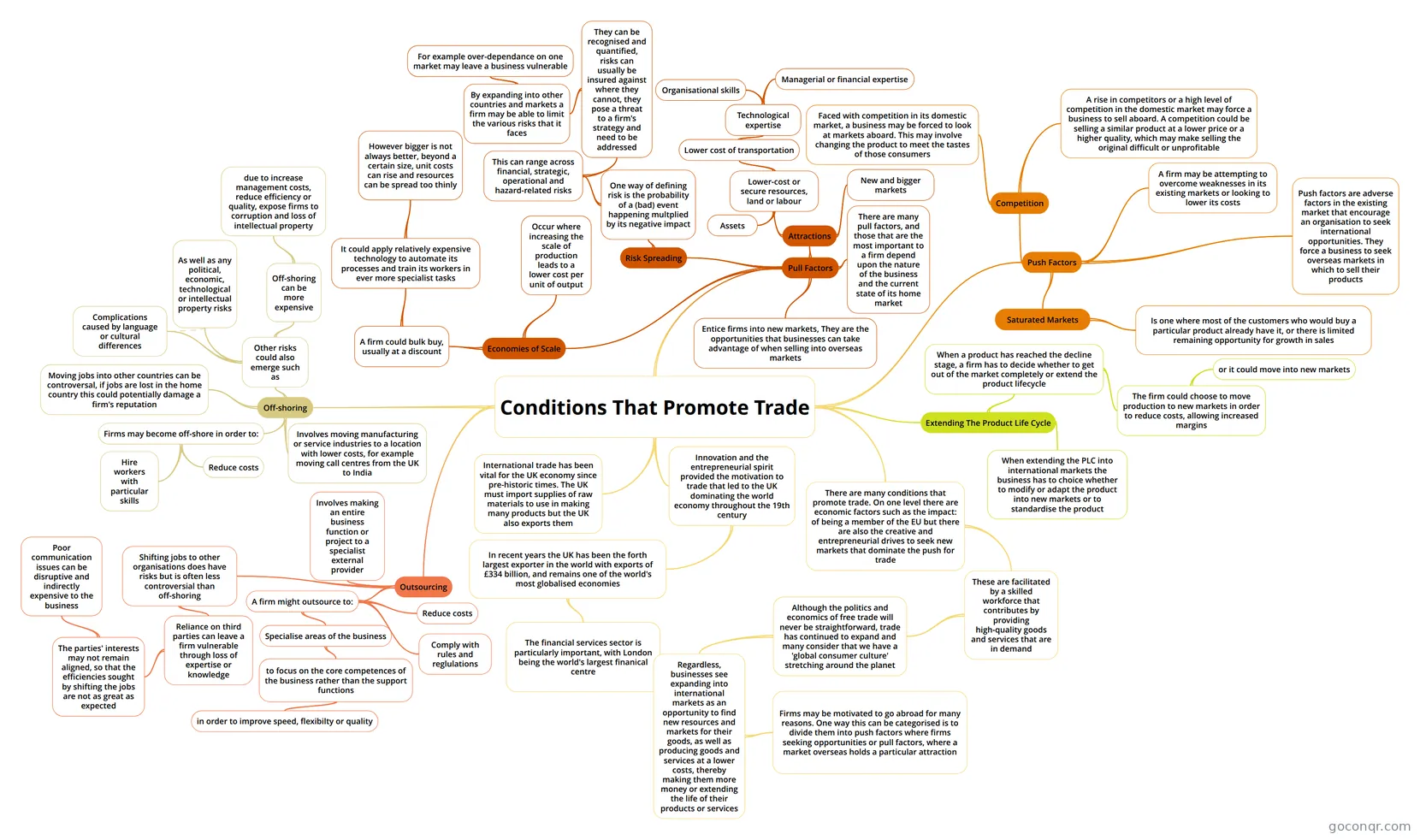
Mind map: Conditions That Promote Trade
Map content
Conditions That Promote Trade
International trade has been vital for the UK economy since pre-historic times. The UK must import supplies of raw materials to use in making many products but the UK also exports them
Innovation and the entrepreneurial spirit provided the motivation to trade that led to the UK dominating the world economy throughout the 19th century
- In recent years the UK has been the forth largest exporter in the world with exports of £334 billion, and remains one of the world's most globalised economies
- The financial services sector is particularly important, with London being the world's largest finanical centre
- In recent years the UK has been the forth largest exporter in the world with exports of £334 billion, and remains one of the world's most globalised economies
There are many conditions that promote trade. On one level there are economic factors such as the impact: of being a member of the EU but there are also the creative and entrepreneurial drives to seek new markets that dominate the push for trade
- These are facilitated by a skilled workforce that contributes by providing high-quality goods and services that are in demand
- Although the politics and economics of free trade will never be straightforward, trade has continued to expand and many consider that we have a 'global consumer culture' stretching around the planet
- Regardless, businesses see expanding into international markets as an opportunity to find new resources and markets for their goods, as well as producing goods and services at a lower costs, thereby making them more money or extending the life of their products or services
- Firms may be motivated to go abroad for many reasons. One way this can be categorised is to divide them into push factors where firms seeking opportunities or pull factors, where a market overseas holds a particular attraction
- Regardless, businesses see expanding into international markets as an opportunity to find new resources and markets for their goods, as well as producing goods and services at a lower costs, thereby making them more money or extending the life of their products or services
- Although the politics and economics of free trade will never be straightforward, trade has continued to expand and many consider that we have a 'global consumer culture' stretching around the planet
- These are facilitated by a skilled workforce that contributes by providing high-quality goods and services that are in demand
Push Factors
- Push factors are adverse factors in the existing market that encourage an organisation to seek international opportunities. They force a business to seek overseas markets in which to sell their products
- A firm may be attempting to overcome weaknesses in its existing markets or looking to lower its costs
- Saturated Markets
- Is one where most of the customers who would buy a particular product already have it, or there is limited remaining opportunity for growth in sales
- Competition
- A rise in competitors or a high level of competition in the domestic market may force a business to sell aboard. A competition could be selling a similar product at a lower price or a higher quality, which may make selling the original difficult or unprofitable
- Faced with competition in its domestic market, a business may be forced to look at markets aboard. This may involve changing the product to meet the tastes of those consumers
Pull Factors
- Entice firms into new markets, They are the opportunities that businesses can take advantage of when selling into overseas markets
- There are many pull factors, and those that are the most important to a firm depend upon the nature of the business and the current state of its home market
- Attractions
- New and bigger markets
- Lower-cost or secure resources, land or labour
- Lower cost of transportation
- Technological expertise
- Managerial or financial expertise
- Organisational skills
- Technological expertise
- Assets
- Lower cost of transportation
- Economies of Scale
- Occur where increasing the scale of production leads to a lower cost per unit of output
- A firm could bulk buy, usually at a discount
- It could apply relatively expensive technology to automate its processes and train its workers in ever more specialist tasks
- However bigger is not always better, beyond a certain size, unit costs can rise and resources can be spread too thinly
- It could apply relatively expensive technology to automate its processes and train its workers in ever more specialist tasks
- Risk Spreading
- One way of defining risk is the probability of a (bad) event happening multplied by its negative impact
- This can range across financial, strategic, operational and hazard-related risks
- They can be recognised and quantified, risks can usually be insured against where they cannot, they pose a threat to a firm's strategy and need to be addressed
- By expanding into other countries and markets a firm may be able to limit the various risks that it faces
- For example over-dependance on one market may leave a business vulnerable
- By expanding into other countries and markets a firm may be able to limit the various risks that it faces
- They can be recognised and quantified, risks can usually be insured against where they cannot, they pose a threat to a firm's strategy and need to be addressed
- This can range across financial, strategic, operational and hazard-related risks
- One way of defining risk is the probability of a (bad) event happening multplied by its negative impact
Off-shoring
- Involves moving manufacturing or service industries to a location with lower costs, for example moving call centres from the UK to India
- Firms may become off-shore in order to:
- Reduce costs
- Hire workers with particular skills
- Moving jobs into other countries can be controversal, if jobs are lost in the home country this could potentially damage a firm's reputation
- Other risks could also emerge such as
- Complications caused by language or cultural differences
- As well as any political, economic, technological or intellectual property risks
- Off-shoring can be more expensive
- due to increase management costs, reduce efficiency or quality, expose firms to corruption and loss of intellectual property
Outsourcing
- Involves making an entire business function or project to a specialist external provider
- A firm might outsource to:
- Reduce costs
- Specialise areas of the business
- to focus on the core competences of the business rather than the support functions
- in order to improve speed, flexibilty or quality
- to focus on the core competences of the business rather than the support functions
- Comply with rules and reglulations
- Shifting jobs to other organisations does have risks but is often less controversial than off-shoring
- Reliance on third parties can leave a firm vulnerable through loss of expertise or knowledge
- The parties' interests may not remain aligned, so that the efficiencies sought by shifting the jobs are not as great as expected
- Poor communication issues can be disruptive and indirectly expensive to the business
- The parties' interests may not remain aligned, so that the efficiencies sought by shifting the jobs are not as great as expected
- Reliance on third parties can leave a firm vulnerable through loss of expertise or knowledge
Extending The Product Life Cycle
- When a product has reached the decline stage, a firm has to decide whether to get out of the market completely or extend the product lifecycle
- The firm could choose to move production to new markets in order to reduce costs, allowing increased margins
- or it could move into new markets
- The firm could choose to move production to new markets in order to reduce costs, allowing increased margins
- When extending the PLC into international markets the business has to choice whether to modify or adapt the product into new markets or to standardise the product
- When a product has reached the decline stage, a firm has to decide whether to get out of the market completely or extend the product lifecycle
Information
- Description
- Business A-Level (Theme 4 - Globalisation) Mind Map on Conditions That Promote Trade, created by Chloe Pilkington on 21/01/2017.
- Created by
- Chloe Pilkington
- Views
- 1
- Rating
More on Reasons for Trade and Gains from Trade