
Mind map
The learning theory of attachment
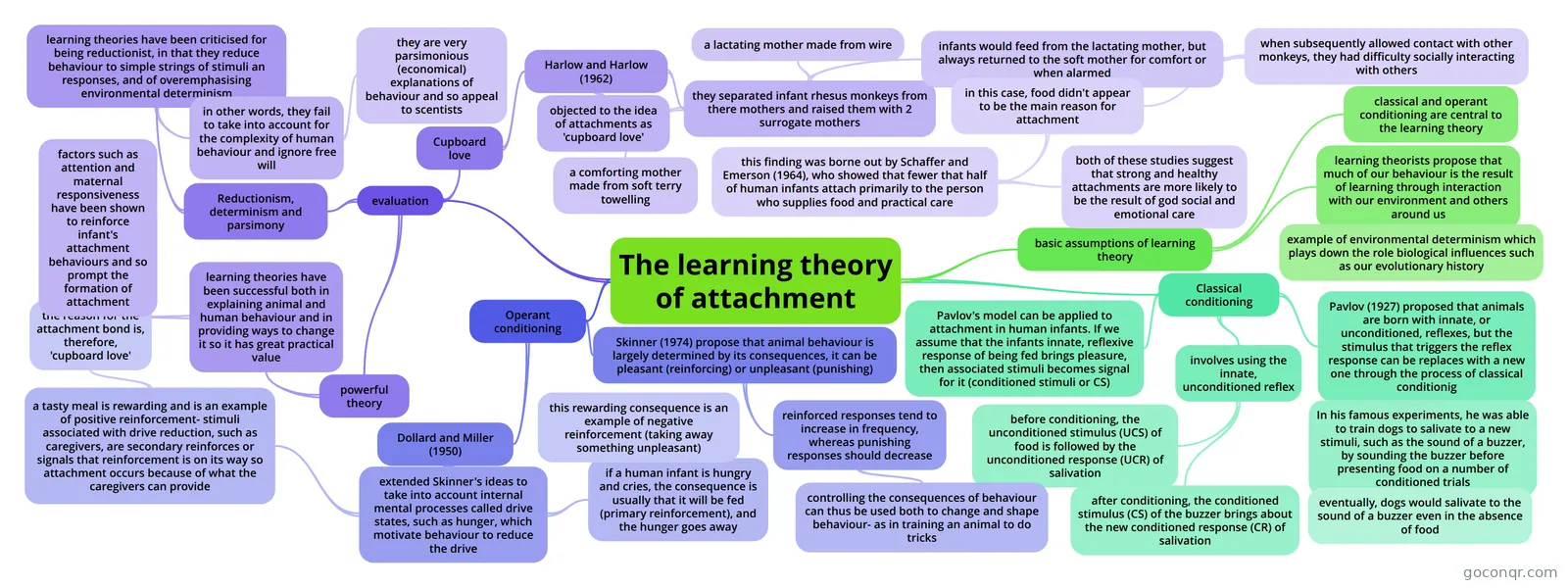
Mind map: Learning theory of attachment
Map content
The learning theory of attachment
basic assumptions of learning theory
- learning theorists propose that much of our behaviour is the result of learning through interaction with our environment and others around us
- example of environmental determinism which plays down the role biological influences such as our evolutionary history
- classical and operant conditioning are central to the learning theory
- learning theorists propose that much of our behaviour is the result of learning through interaction with our environment and others around us
Classical conditioning
- Pavlov (1927) proposed that animals are born with innate, or unconditioned, reflexes, but the stimulus that triggers the reflex response can be replaces with a new one through the process of classical conditionig
- In his famous experiments, he was able to train dogs to salivate to a new stimuli, such as the sound of a buzzer, by sounding the buzzer before presenting food on a number of conditioned trials
- eventually, dogs would salivate to the sound of a buzzer even in the absence of food
- In his famous experiments, he was able to train dogs to salivate to a new stimuli, such as the sound of a buzzer, by sounding the buzzer before presenting food on a number of conditioned trials
- involves using the innate, unconditioned reflex
- before conditioning, the unconditioned stimulus (UCS) of food is followed by the unconditioned response (UCR) of salivation
- after conditioning, the conditioned stimulus (CS) of the buzzer brings about the new conditioned response (CR) of salivation
- Pavlov's model can be applied to attachment in human infants. If we assume that the infants innate, reflexive response of being fed brings pleasure, then associated stimuli becomes signal for it (conditioned stimuli or CS)
- Pavlov (1927) proposed that animals are born with innate, or unconditioned, reflexes, but the stimulus that triggers the reflex response can be replaces with a new one through the process of classical conditionig
Operant conditioning
- Skinner (1974) propose that animal behaviour is largely determined by its consequences, it can be pleasant (reinforcing) or unpleasant (punishing)
- reinforced responses tend to increase in frequency, whereas punishing responses should decrease
- controlling the consequences of behaviour can thus be used both to change and shape behaviour- as in training an animal to do tricks
- reinforced responses tend to increase in frequency, whereas punishing responses should decrease
- Dollard and Miller (1950)
- extended Skinner's ideas to take into account internal mental processes called drive states, such as hunger, which motivate behaviour to reduce the drive
- if a human infant is hungry and cries, the consequence is usually that it will be fed (primary reinforcement), and the hunger goes away
- this rewarding consequence is an example of negative reinforcement (taking away something unpleasant)
- a tasty meal is rewarding and is an example of positive reinforcement- stimuli associated with drive reduction, such as caregivers, are secondary reinforces or signals that reinforcement is on its way so attachment occurs because of what the caregivers can provide
- the reason for the attachment bond is, therefore, 'cupboard love'
- if a human infant is hungry and cries, the consequence is usually that it will be fed (primary reinforcement), and the hunger goes away
- extended Skinner's ideas to take into account internal mental processes called drive states, such as hunger, which motivate behaviour to reduce the drive
- Skinner (1974) propose that animal behaviour is largely determined by its consequences, it can be pleasant (reinforcing) or unpleasant (punishing)
evaluation
- powerful theory
- learning theories have been successful both in explaining animal and human behaviour and in providing ways to change it so it has great practical value
- factors such as attention and maternal responsiveness have been shown to reinforce infant's attachment behaviours and so prompt the formation of attachment
- learning theories have been successful both in explaining animal and human behaviour and in providing ways to change it so it has great practical value
- Reductionism, determinism and parsimony
- learning theories have been criticised for being reductionist, in that they reduce behaviour to simple strings of stimuli an responses, and of overemphasising environmental determinism
- in other words, they fail to take into account for the complexity of human behaviour and ignore free will
- they are very parsimonious (economical) explanations of behaviour and so appeal to scentists
- in other words, they fail to take into account for the complexity of human behaviour and ignore free will
- learning theories have been criticised for being reductionist, in that they reduce behaviour to simple strings of stimuli an responses, and of overemphasising environmental determinism
- Cupboard love
- Harlow and Harlow (1962)
- objected to the idea of attachments as 'cupboard love'
- they separated infant rhesus monkeys from there mothers and raised them with 2 surrogate mothers
- a lactating mother made from wire
- a comforting mother made from soft terry towelling
- infants would feed from the lactating mother, but always returned to the soft mother for comfort or when alarmed
- when subsequently allowed contact with other monkeys, they had difficulty socially interacting with others
- in this case, food didn't appear to be the main reason for attachment
- this finding was borne out by Schaffer and Emerson (1964), who showed that fewer that half of human infants attach primarily to the person who supplies food and practical care
- both of these studies suggest that strong and healthy attachments are more likely to be the result of god social and emotional care
- this finding was borne out by Schaffer and Emerson (1964), who showed that fewer that half of human infants attach primarily to the person who supplies food and practical care
- in this case, food didn't appear to be the main reason for attachment
- when subsequently allowed contact with other monkeys, they had difficulty socially interacting with others
- Harlow and Harlow (1962)
- powerful theory
Information
- Description
- Mind Map on The learning theory of attachment, created by Bethan Stevenson on 20/04/2014.
- Created by
- Bethan Stevenson
- Views
- 20
- Rating
More on Learning theory of attachment