
Mind map
Beethoven symphony no 1 (1st movement)- Introduction
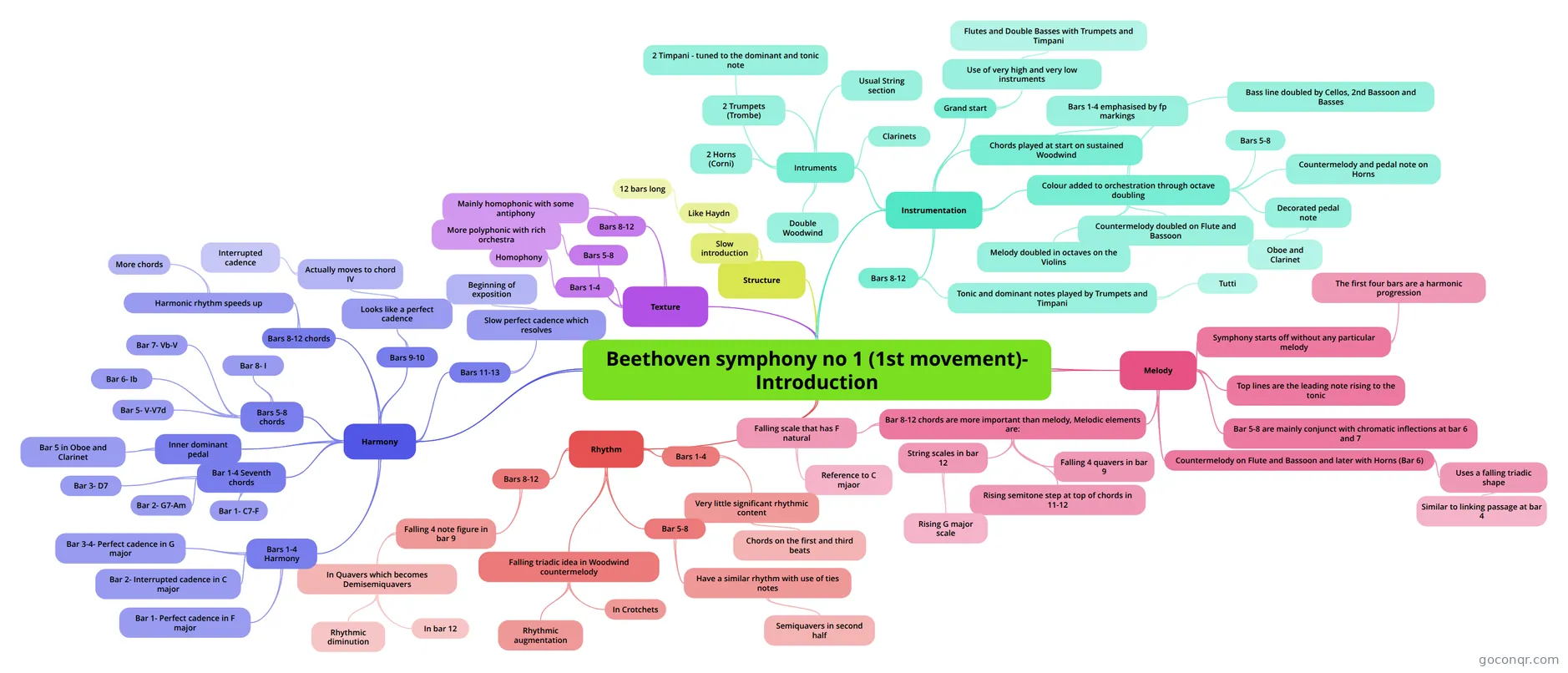
Mind map: Beethoven symphony no 1 first movement introduction
Map content
Beethoven symphony no 1 (1st movement)- Introduction
Instrumentation
- Intruments
- Double Woodwind
- 2 Horns (Corni)
- 2 Trumpets (Trombe)
- 2 Timpani - tuned to the dominant and tonic note
- Usual String section
- Clarinets
- Grand start
- Use of very high and very low instruments
- Flutes and Double Basses with Trumpets and Timpani
- Use of very high and very low instruments
- Chords played at start on sustained Woodwind
- Bars 1-4 emphasised by fp markings
- Colour added to orchestration through octave doubling
- Bars 5-8
- Melody doubled in octaves on the Violins
- Countermelody doubled on Flute and Bassoon
- Decorated pedal note
- Oboe and Clarinet
- Countermelody and pedal note on Horns
- Bass line doubled by Cellos, 2nd Bassoon and Basses
- Bars 8-12
- Tonic and dominant notes played by Trumpets and Timpani
- Tutti
- Tonic and dominant notes played by Trumpets and Timpani
- Intruments
Melody
- Symphony starts off without any particular melody
- The first four bars are a harmonic progression
- Top lines are the leading note rising to the tonic
- Bar 5-8 are mainly conjunct with chromatic inflections at bar 6 and 7
- Countermelody on Flute and Bassoon and later with Horns (Bar 6)
- Uses a falling triadic shape
- Similar to linking passage at bar 4
- Uses a falling triadic shape
- Bar 8-12 chords are more important than melody, Melodic elements are:
- Falling 4 quavers in bar 9
- Rising semitone step at top of chords in 11-12
- String scales in bar 12
- Rising G major scale
- Falling scale that has F natural
- Reference to C mjaor
- Symphony starts off without any particular melody
Rhythm
- Bars 1-4
- Very little significant rhythmic content
- Chords on the first and third beats
- Very little significant rhythmic content
- Bar 5-8
- Have a similar rhythm with use of ties notes
- Semiquavers in second half
- Have a similar rhythm with use of ties notes
- Falling triadic idea in Woodwind countermelody
- In Crotchets
- Rhythmic augmentation
- Bars 8-12
- Falling 4 note figure in bar 9
- In Quavers which becomes Demisemiquavers
- In bar 12
- Rhythmic diminution
- In Quavers which becomes Demisemiquavers
- Falling 4 note figure in bar 9
- Bars 1-4
Harmony
- Bars 1-4 Harmony
- Bar 1- Perfect cadence in F major
- Bar 2- Interrupted cadence in C major
- Bar 3-4- Perfect cadence in G major
- Bar 1-4 Seventh chords
- Bar 1- C7-F
- Bar 2- G7-Am
- Bar 3- D7
- Inner dominant pedal
- Bar 5 in Oboe and Clarinet
- Bars 5-8 chords
- Bar 5- V-V7d
- Bar 6- Ib
- Bar 7- Vb-V
- Bar 8- I
- Bars 8-12 chords
- Harmonic rhythm speeds up
- More chords
- Harmonic rhythm speeds up
- Bars 9-10
- Looks like a perfect cadence
- Actually moves to chord IV
- Interrupted cadence
- Actually moves to chord IV
- Looks like a perfect cadence
- Bars 11-13
- Slow perfect cadence which resolves
- Beginning of exposition
- Slow perfect cadence which resolves
- Bars 1-4 Harmony
Texture
- Bars 1-4
- Homophony
- Bars 5-8
- More polyphonic with rich orchestra
- Bars 8-12
- Mainly homophonic with some antiphony
- Bars 1-4
Structure
- Slow introduction
- Like Haydn
- 12 bars long
- Like Haydn
- Slow introduction
Information
- Description
- Mind Map on Beethoven symphony no 1 (1st movement)- Introduction, created by JammyCornflake on 24/04/2014.
- Created by
- JammyCornflake
- Views
- 24
- Rating