
The Classical Period
214 resources created by 179 users
This Music page on GoConqr gathers community-made quizzes, mind maps, flashcards, slides and notes on The Classical Period, from Haydn's string quartets and Mozart's Symphony No. 40 to Beethoven's symphonies and concertos. It's built for school students revising a topic and teachers after ready-made material. There are over 200 resources here, including more than 20 quizzes, over 100 mind maps and more than 60 flashcard decks, mostly at secondary level. Pick a composer, try a quiz to find your gaps, then make your own set.
Select topic
- Characteristics of Classical Music12
- Classical Composers10
- Classical Music Forms12
- The Concerto12
- Haydn: Life and Works13
- Haydn: String Quartet Op. 33 No. 25
- Mozart: Life and Works15
- Mozart: Symphony No. 4051
- Mozart: Horn Concerto12
- Classical Sacred Music5
- Beethoven: Life and Works6
- Beethoven: Piano Sonatas9
- Beethoven: Symphonies13
Top The Classical Period resources
-
12 cardsSyntax # Comments #
-
42 questionsClassical Era Advanced Music Theory
-
13 questionsMusic - Mozart Symphony No.40 in G Minor Welcome to this quiz based on Mozart's Symphony No.40 in G Minor. To begin with you may need to write his n...
-
10 questionsSymphony No. 40 in G Minor (First Movement) and the Classical Period The Classical peroid started in which year?
-
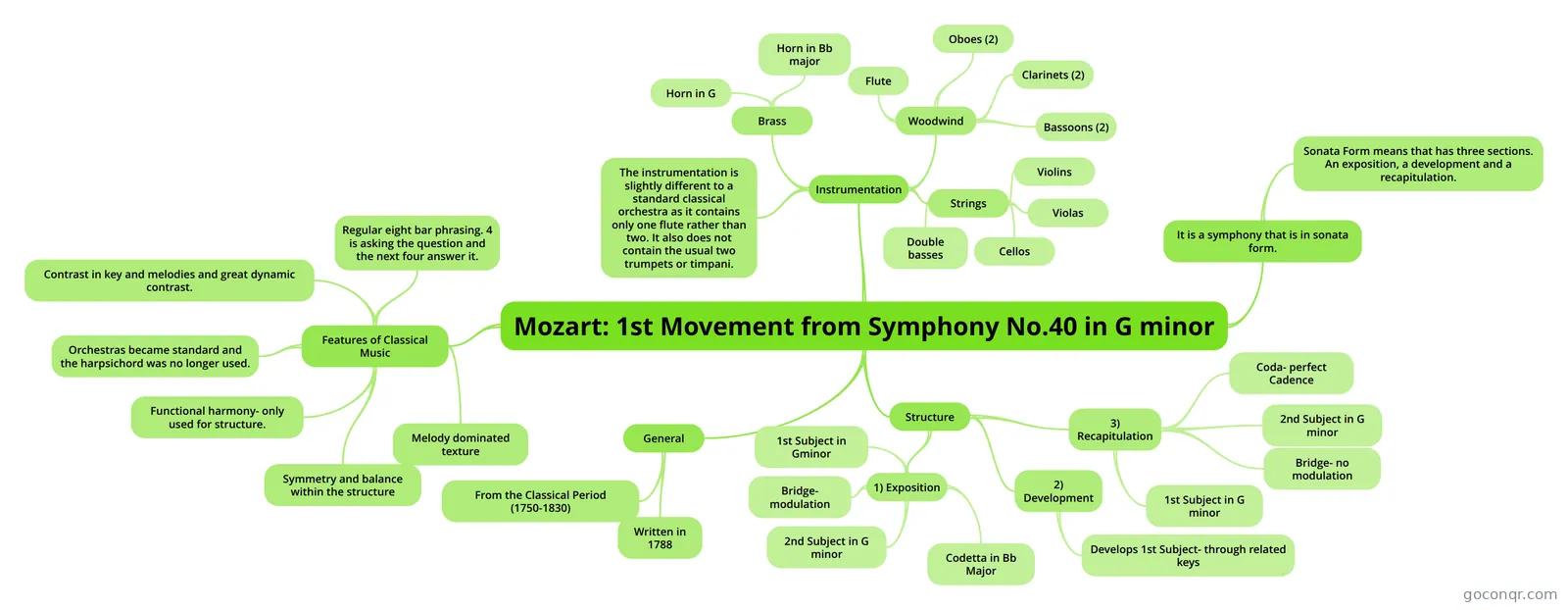 Mind map Mozart: 1st Movement from Symphony No.40 in G minor
-
57 cardsMusic History — Classical
-
Mind map Haydn - String Quartet in E flat Op.33 No.2 'The Joke' movement IV._1
-
Mind map Mozart Symphony 40 k550 in G minor
Quizzes
See all 26 quizzes-
42 questionsClassical Era Advanced Music Theory
-
13 questionsMusic - Mozart Symphony No.40 in G Minor Welcome to this quiz based on Mozart's Symphony No.40 in G Minor. To begin with you may need to write his n...
-
10 questionsSymphony No. 40 in G Minor (First Movement) and the Classical Period The Classical peroid started in which year?
-
40 questionsUntitled True/false: Melodies in the classical period consisted of long phrases that were more elaborate than those ...
-
32 questionsUntitled "three-part (A-B-A) form based on a statement (A), contrast or departure (B), and repetition (A). Also thre...
-
24 questionsBeethoven Sonata in C minor What is the tempo in the introduction?
-
20 questions1_MUS 220A Unit One Listening Questions
-
6 questionsClassical Period-Music What were some features of an orchestra in the Classical period?
Mind maps
See all 116 mind maps-
Mozart: 1st Movement from Symphony No.40 in G minor
-
Haydn - String Quartet in E flat Op.33 No.2 'The Joke' movement IV._1
-
Mozart Symphony 40 k550 in G minor
-
Mozart - Symphony No. 40
-
Beethoven
-
Haydn - String Quartet in E flat Op.33 No.2 'The Joke' movement IV.
-
Beethoven - Sonata Pathetic
-
Classical Era
Flashcards
See all 66 flashcards-
12 cardsSyntax # Comments #
-
57 cardsMusic History — Classical
-
79 cardsUntitled Johann Stamitz was the first composer to consistently write four-movement symphonies. In his symphonies, wh...
-
38 cardsClassical Era Study Guide Music with no literary basis is referred to as a. program music b. incidental music c. absolute music d. th...
-
84 cardsMusic 121 - EXAM
-
29 cardsSymphony No.40 in G Minor by Mozart
-
19 cardsConcerto Cards Early Baroque Concerto
-
12 cardsMozart setwork notes Bars 1-37 A1 Section (Rondo Theme)
Notes
-
Mozart: Die Zauberflöte Mozart profile Wolfgang Amadeus Mozart (1756 –1791), baptised as Johannes Chrysostomus Wolfgangus Theophilus Mozart, was a prolific and influential composer of the classical era. He composed over 6...
-
Classical Chamber MusicSetting: Intimate, room or palaceSize: 2 to 9 ppl, 1 player to a partString Quartet : Fast, Slow, Scherzo, Fast Lighter in sound than orchestral Fashionable for aristocrats to play or hire Musicians have ...
-
Concerto Through Time - created from Mind Map Baroque Concerto The concerto Concertos have three movements – fast, slow, fast. The concerto in the Baroque period (roughly 1600-1750) Baroque composers who wrote concertos include Vivaldi, Bach and Handel. Vivaldi w...
Slides
Topics in The Classical Period
More Music topics
About The Classical Period
GoConqr OriginalWhat this unit covers
The page is built around three composers: Haydn, Mozart and Beethoven. Most of the material is aimed at set-work study for GCSE Music and A-level Music, with a small share at university level. You will find mind maps, flashcard decks, quizzes, slide sets and notes, all made by GoConqr users.
Mozart's Symphony No. 40 in G minor is the most heavily covered work. Beethoven appears through Symphony No. 5, Symphony No. 1, the Eroica slides, the Violin Concerto and the Septet. Haydn is covered through the string quartet known as The Joke and several quizzes on his life.
Where to start
Begin with the broad overviews. The mind maps Classical 1750 - 1820 and Classical set out the period, and the flashcard deck Classical Era Study Guide gives you the key terms, such as sonata form, Viennese School and absolute music.
- Skim an overview map or deck to get the vocabulary.
- Move to one composer and one work.
- Test yourself with a quiz on that work.
Working on Mozart's Symphony No. 40
The mind map Mozart: 1st Movement from Symphony No.40 in G minor walks through the exposition, development and recapitulation, including the first subject, bridge, second subject and codetta. Read it, then try the quiz Symphony No. 40 in G Minor (First Movement) and the Classical Period, which asks about the order of sonata form sections and which composers belong to the era.
Flashcard decks such as Mozart Cards and Mozarts Symphony No. 40 help you memorise details between sessions.
Using maps and quizzes together
Read a mind map first, then close it and take a quiz. Wrong answers show you which branch to revisit. The quiz Classical Era checks facts about Haydn's early life and career, while the mind map on Haydn's String Quartet in E flat Op.33 No.2 covers texture and the roles of the four players. Teachers can set a map as a starter and a quiz as a quick check.
Where it fits
This unit sits in the Western Classical Music History strand of Music. Choose a composer, open a resource and see how much you can recall, then build your own maps or flashcards for anything you find missing.
Frequently asked questions
Which resource should I open first?
Start with an overview such as the mind map Classical 1750 - 1820 or the flashcard deck Classical Era Study Guide. They give you the period's key terms. Then pick a composer and work through one of his set works before testing yourself with a quiz.
What do the Mozart Symphony No. 40 mind maps cover?
They cover structure, instrumentation, harmony and tonality, melody, texture, dynamics, rhythm and mood. Several break the first movement into exposition, development and recapitulation, so you can revise one section at a time. Different authors have made them, so compare a few.
Are the resources free to use?
Yes. Every resource listed here is free to open, study and take, with no account needed. They were made by GoConqr users, not by GoConqr itself. If you sign up for a free account, you can also save quiz scores and make your own quizzes, maps, flashcards and notes.
Which exams are these resources suitable for?
The listed resources mention GCSE Music and A-level Music, and most of the material is at secondary level. A smaller share is more advanced. Check each title, such as the GCSE-labelled Mozart flashcards, to see whether it matches your course.
Does the page cover composers other than Mozart?
Yes. There are resources on Haydn, including quizzes and a string quartet map, and on Beethoven, including Symphony No. 5, the Violin Concerto and the Septet. You will also find concerto maps, plus flashcards on Haydn's Nelson Mass.
What if the topic I need is missing?
Try a different title for the same work, as several users have covered the same piece in their own way. If nothing fits, you can make your own mind map, quiz or flashcards once you have a free account.