
Mind map
Ancient Philosophical Influences
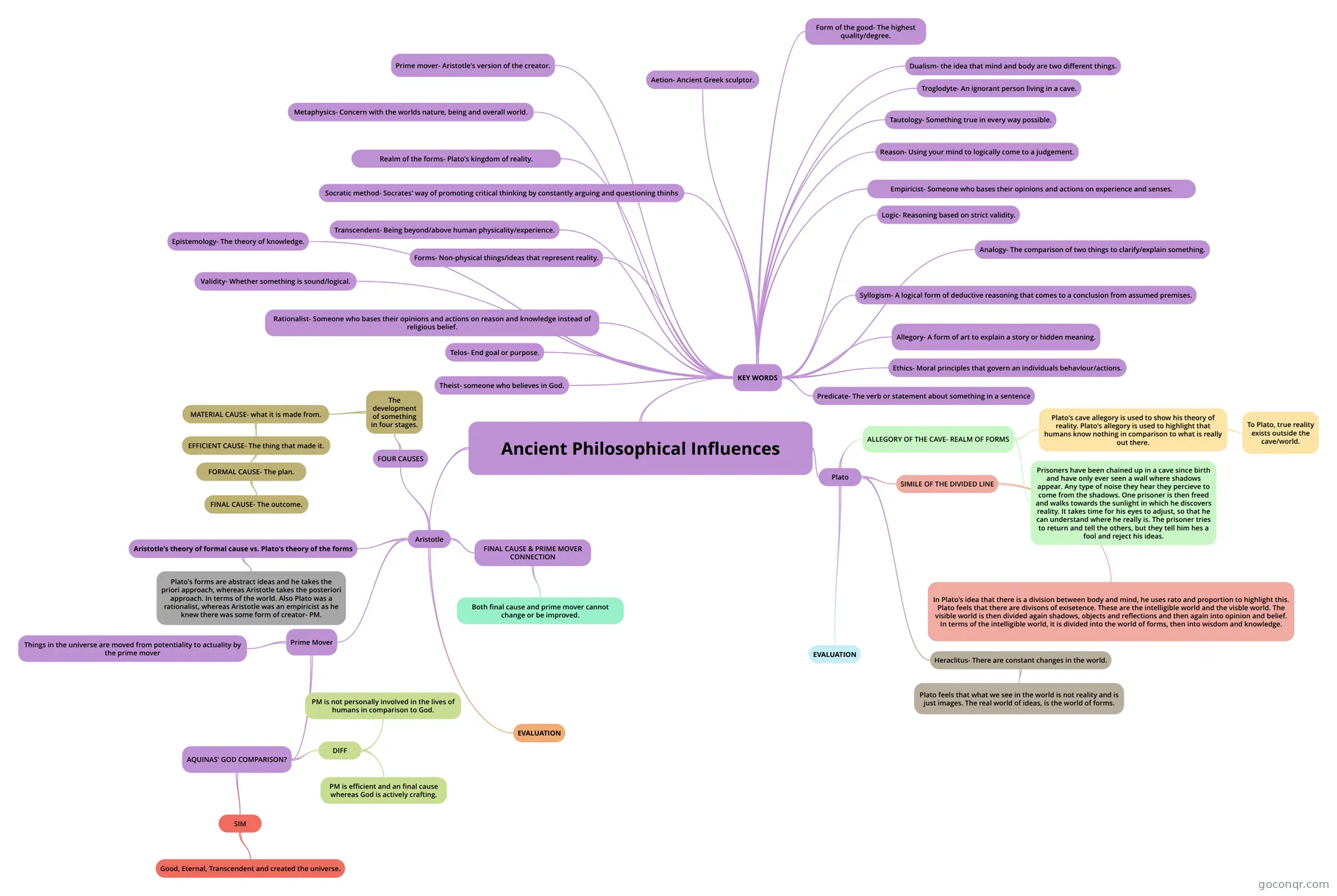
Mind map: Ancient philosophical influences
Map content
Ancient Philosophical Influences
Aristotle
- Aristotle's theory of formal cause vs. Plato's theory of the forms
- Plato's forms are abstract ideas and he takes the priori approach, whereas Aristotle takes the posteriori approach. In terms of the world. Also Plato was a rationalist, whereas Aristotle was an empiricist as he knew there was some form of creator- PM.
- FINAL CAUSE & PRIME MOVER CONNECTION
- Both final cause and prime mover cannot change or be improved.
- FOUR CAUSES
- The development of something in four stages.
- MATERIAL CAUSE- what it is made from.
- EFFICIENT CAUSE- The thing that made it.
- FORMAL CAUSE- The plan.
- FINAL CAUSE- The outcome.
- FORMAL CAUSE- The plan.
- EFFICIENT CAUSE- The thing that made it.
- MATERIAL CAUSE- what it is made from.
- The development of something in four stages.
- EVALUATION
- Prime Mover
- AQUINAS' GOD COMPARISON?
- SIM
- Good, Eternal, Transcendent and created the universe.
- DIFF
- PM is efficient and an final cause whereas God is actively crafting.
- PM is not personally involved in the lives of humans in comparison to God.
- SIM
- Things in the universe are moved from potentiality to actuality by the prime mover
- AQUINAS' GOD COMPARISON?
- Aristotle's theory of formal cause vs. Plato's theory of the forms
KEY WORDS
- Logic- Reasoning based on strict validity.
- Epistemology- The theory of knowledge.
- Metaphysics- Concern with the worlds nature, being and overall world.
- Ethics- Moral principles that govern an individuals behaviour/actions.
- Validity- Whether something is sound/logical.
- Syllogism- A logical form of deductive reasoning that comes to a conclusion from assumed premises.
- Predicate- The verb or statement about something in a sentence
- Tautology- Something true in every way possible.
- Forms- Non-physical things/ideas that represent reality.
- Reason- Using your mind to logically come to a judgement.
- Empiricist- Someone who bases their opinions and actions on experience and senses.
- Rationalist- Someone who bases their opinions and actions on reason and knowledge instead of religious belief.
- Prime mover- Aristotle's version of the creator.
- Socratic method- Socrates' way of promoting critical thinking by constantly arguing and questioning thinhs
- Analogy- The comparison of two things to clarify/explain something.
- Transcendent- Being beyond/above human physicality/experience.
- Dualism- the idea that mind and body are two different things.
- Aetion- Ancient Greek sculptor.
- Telos- End goal or purpose.
- Theist- someone who believes in God.
- Form of the good- The highest quality/degree.
- Realm of the forms- Plato's kingdom of reality.
- Allegory- A form of art to explain a story or hidden meaning.
- Troglodyte- An ignorant person living in a cave.
Plato
- Heraclitus- There are constant changes in the world.
- Plato feels that what we see in the world is not reality and is just images. The real world of ideas, is the world of forms.
- ALLEGORY OF THE CAVE- REALM OF FORMS
- Plato's cave allegory is used to show his theory of reality. Plato's allegory is used to highlight that humans know nothing in comparison to what is really out there.
- To Plato, true reality exists outside the cave/world.
- Prisoners have been chained up in a cave since birth and have only ever seen a wall where shadows appear. Any type of noise they hear they percieve to come from the shadows. One prisoner is then freed and walks towards the sunlight in which he discovers reality. It takes time for his eyes to adjust, so that he can understand where he really is. The prisoner tries to return and tell the others, but they tell him hes a fool and reject his ideas.
- Plato's cave allegory is used to show his theory of reality. Plato's allegory is used to highlight that humans know nothing in comparison to what is really out there.
- SIMILE OF THE DIVIDED LINE
- In Plato's idea that there is a division between body and mind, he uses rato and proportion to highlight this. Plato feels that there are divisons of exisetence. These are the intelligible world and the visble world. The visible world is then divided again shadows, objects and reflections and then again into opinion and belief. In terms of the intelligible world, it is divided into the world of forms, then into wisdom and knowledge.
- EVALUATION
- Heraclitus- There are constant changes in the world.
Information
- Description
- A2 Religious Studies YR1 (Philosophy) Mind Map on Ancient Philosophical Influences, created by Rosa Minani on 27/02/2017.
- Created by
- Rosa Minani
- Views
- 115
- Tags
- Rating