
Mind map
Are couples becoming more equal?
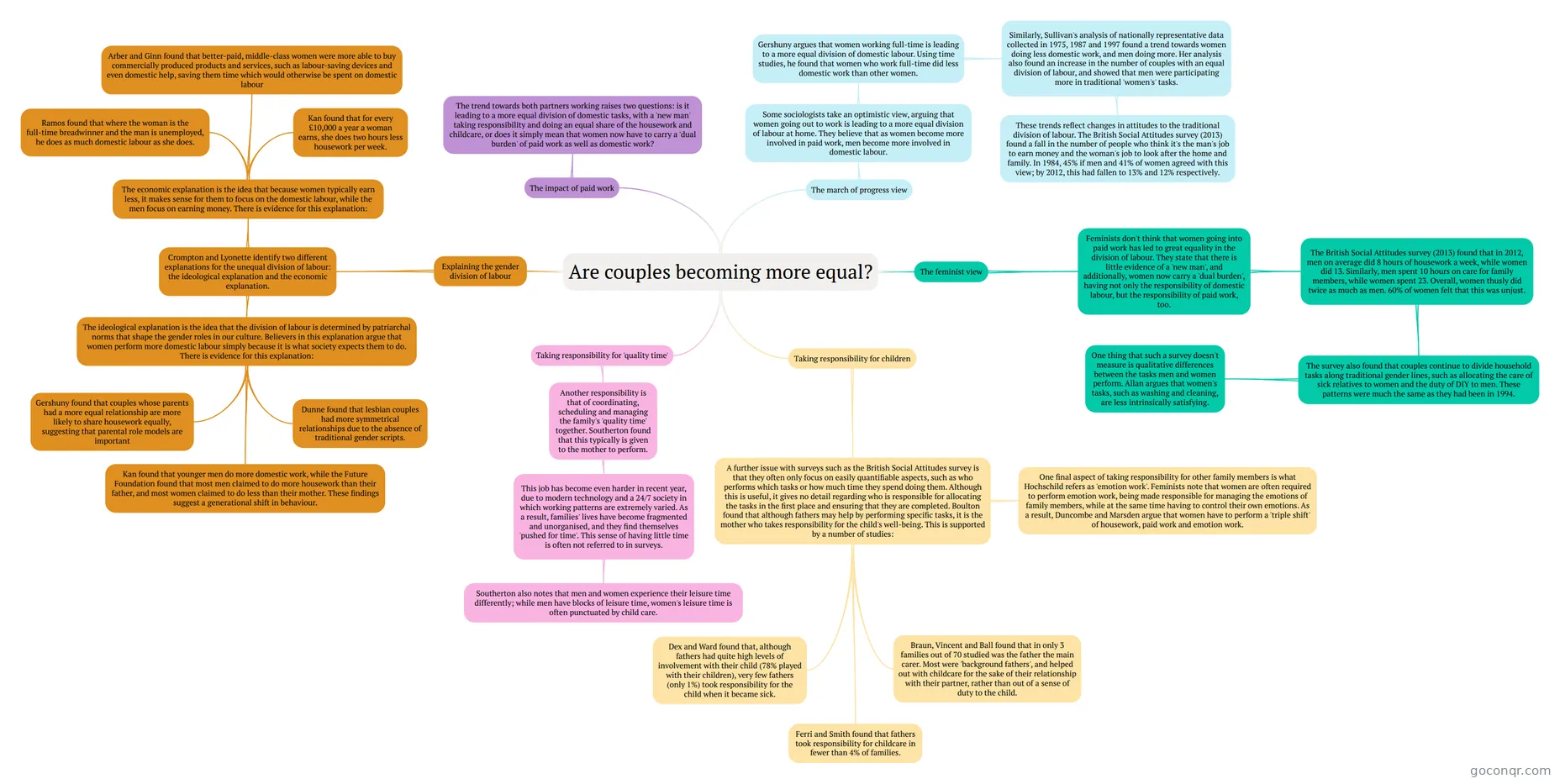
Mind map: Are couples becoming more equal
Map content
Are couples becoming more equal?
The impact of paid work
- The trend towards both partners working raises two questions: is it leading to a more equal division of domestic tasks, with a 'new man' taking responsibility and doing an equal share of the housework and childcare, or does it simply mean that women now have to carry a 'dual burden' of paid work as well as domestic work?
The march of progress view
- Some sociologists take an optimistic view, arguing that women going out to work is leading to a more equal division of labour at home. They believe that as women become more involved in paid work, men become more involved in domestic labour.
- Gershuny argues that women working full-time is leading to a more equal division of domestic labour. Using time studies, he found that women who work full-time did less domestic work than other women.
- Similarly, Sullivan's analysis of nationally representative data collected in 1975, 1987 and 1997 found a trend towards women doing less domestic work, and men doing more. Her analysis also found an increase in the number of couples with an equal division of labour, and showed that men were participating more in traditional 'women's' tasks.
- These trends reflect changes in attitudes to the traditional division of labour. The British Social Attitudes survey (2013) found a fall in the number of people who think it's the man's job to earn money and the woman's job to look after the home and family. In 1984, 45% if men and 41% of women agreed with this view; by 2012, this had fallen to 13% and 12% respectively.
- Similarly, Sullivan's analysis of nationally representative data collected in 1975, 1987 and 1997 found a trend towards women doing less domestic work, and men doing more. Her analysis also found an increase in the number of couples with an equal division of labour, and showed that men were participating more in traditional 'women's' tasks.
- Gershuny argues that women working full-time is leading to a more equal division of domestic labour. Using time studies, he found that women who work full-time did less domestic work than other women.
- Some sociologists take an optimistic view, arguing that women going out to work is leading to a more equal division of labour at home. They believe that as women become more involved in paid work, men become more involved in domestic labour.
The feminist view
- Feminists don't think that women going into paid work has led to great equality in the division of labour. They state that there is little evidence of a 'new man', and additionally, women now carry a 'dual burden', having not only the responsibility of domestic labour, but the responsibility of paid work, too.
- The British Social Attitudes survey (2013) found that in 2012, men on average did 8 hours of housework a week, while women did 13. Similarly, men spent 10 hours on care for family members, while women spent 23. Overall, women thusly did twice as much as men. 60% of women felt that this was unjust.
- The survey also found that couples continue to divide household tasks along traditional gender lines, such as allocating the care of sick relatives to women and the duty of DIY to men. These patterns were much the same as they had been in 1994.
- One thing that such a survey doesn't measure is qualitative differences between the tasks men and women perform. Allan argues that women's tasks, such as washing and cleaning, are less intrinsically satisfying.
- The survey also found that couples continue to divide household tasks along traditional gender lines, such as allocating the care of sick relatives to women and the duty of DIY to men. These patterns were much the same as they had been in 1994.
- The British Social Attitudes survey (2013) found that in 2012, men on average did 8 hours of housework a week, while women did 13. Similarly, men spent 10 hours on care for family members, while women spent 23. Overall, women thusly did twice as much as men. 60% of women felt that this was unjust.
- Feminists don't think that women going into paid work has led to great equality in the division of labour. They state that there is little evidence of a 'new man', and additionally, women now carry a 'dual burden', having not only the responsibility of domestic labour, but the responsibility of paid work, too.
Taking responsibility for children
- A further issue with surveys such as the British Social Attitudes survey is that they often only focus on easily quantifiable aspects, such as who performs which tasks or how much time they spend doing them. Although this is useful, it gives no detail regarding who is responsible for allocating the tasks in the first place and ensuring that they are completed. Boulton found that although fathers may help by performing specific tasks, it is the mother who takes responsibility for the child's well-being. This is supported by a number of studies:
- Ferri and Smith found that fathers took responsibility for childcare in fewer than 4% of families.
- Dex and Ward found that, although fathers had quite high levels of involvement with their child (78% played with their children), very few fathers (only 1%) took responsibility for the child when it became sick.
- Braun, Vincent and Ball found that in only 3 families out of 70 studied was the father the main carer. Most were 'background fathers', and helped out with childcare for the sake of their relationship with their partner, rather than out of a sense of duty to the child.
- One final aspect of taking responsibility for other family members is what Hochschild refers as 'emotion work'. Feminists note that women are often required to perform emotion work, being made responsible for managing the emotions of family members, while at the same time having to control their own emotions. As a result, Duncombe and Marsden argue that women have to perform a 'triple shift' of housework, paid work and emotion work.
- A further issue with surveys such as the British Social Attitudes survey is that they often only focus on easily quantifiable aspects, such as who performs which tasks or how much time they spend doing them. Although this is useful, it gives no detail regarding who is responsible for allocating the tasks in the first place and ensuring that they are completed. Boulton found that although fathers may help by performing specific tasks, it is the mother who takes responsibility for the child's well-being. This is supported by a number of studies:
Taking responsibility for 'quality time'
- Another responsibility is that of coordinating, scheduling and managing the family's 'quality time' together. Southerton found that this typically is given to the mother to perform.
- This job has become even harder in recent year, due to modern technology and a 24/7 society in which working patterns are extremely varied. As a result, families' lives have become fragmented and unorganised, and they find themselves 'pushed for time'. This sense of having little time is often not referred to in surveys.
- Southerton also notes that men and women experience their leisure time differently; while men have blocks of leisure time, women's leisure time is often punctuated by child care.
- This job has become even harder in recent year, due to modern technology and a 24/7 society in which working patterns are extremely varied. As a result, families' lives have become fragmented and unorganised, and they find themselves 'pushed for time'. This sense of having little time is often not referred to in surveys.
- Another responsibility is that of coordinating, scheduling and managing the family's 'quality time' together. Southerton found that this typically is given to the mother to perform.
Explaining the gender division of labour
- Crompton and Lyonette identify two different explanations for the unequal division of labour: the ideological explanation and the economic explanation.
- The ideological explanation is the idea that the division of labour is determined by patriarchal norms that shape the gender roles in our culture. Believers in this explanation argue that women perform more domestic labour simply because it is what society expects them to do. There is evidence for this explanation:
- Gershuny found that couples whose parents had a more equal relationship are more likely to share housework equally, suggesting that parental role models are important
- Kan found that younger men do more domestic work, while the Future Foundation found that most men claimed to do more housework than their father, and most women claimed to do less than their mother. These findings suggest a generational shift in behaviour.
- Dunne found that lesbian couples had more symmetrical relationships due to the absence of traditional gender scripts.
- The economic explanation is the idea that because women typically earn less, it makes sense for them to focus on the domestic labour, while the men focus on earning money. There is evidence for this explanation:
- Kan found that for every £10,000 a year a woman earns, she does two hours less housework per week.
- Arber and Ginn found that better-paid, middle-class women were more able to buy commercially produced products and services, such as labour-saving devices and even domestic help, saving them time which would otherwise be spent on domestic labour
- Ramos found that where the woman is the full-time breadwinner and the man is unemployed, he does as much domestic labour as she does.
- The ideological explanation is the idea that the division of labour is determined by patriarchal norms that shape the gender roles in our culture. Believers in this explanation argue that women perform more domestic labour simply because it is what society expects them to do. There is evidence for this explanation:
- Crompton and Lyonette identify two different explanations for the unequal division of labour: the ideological explanation and the economic explanation.
Information
- Description
- AS level Sociology AS - Families and Households (Couples) Mind Map on Are couples becoming more equal?, created by Em Maskrey on 02/03/2017.
- Created by
- Em Maskrey
- Views
- 7
- Rating