
Mind map
Ch.25 Radioactivity
Map content
Ch.25 Radioactivity
Radioactivity
- Alpha, Beta and Gamma are Ionising radiations because they can ionise atoms by removing some electrons, leaving positive ions
- These types of radiation can be detected using a cloud chamber
- Due to Alpha particles having a larger mass and charge, they produce stronger ionisation but do not travel very far before they are absorbed
- Beta particles have a small mass and charge so are less ionising, but have a longer range
- Gamma rays do not have mass or charge and therefore make them much less ionising, but have a much longer range
- Beta particles have a small mass and charge so are less ionising, but have a longer range
- Alpha radiation emits alpha particles, which consist of two protons and two neutrons (a helium nucleus) with charge +2e
- Beta+ radiation emits fast moving positrons, whereas Beta- radiation emits fast moving electrons
- Gamma radiation consists of high energy photons with a small wavelength
- Beta+ radiation emits fast moving positrons, whereas Beta- radiation emits fast moving electrons
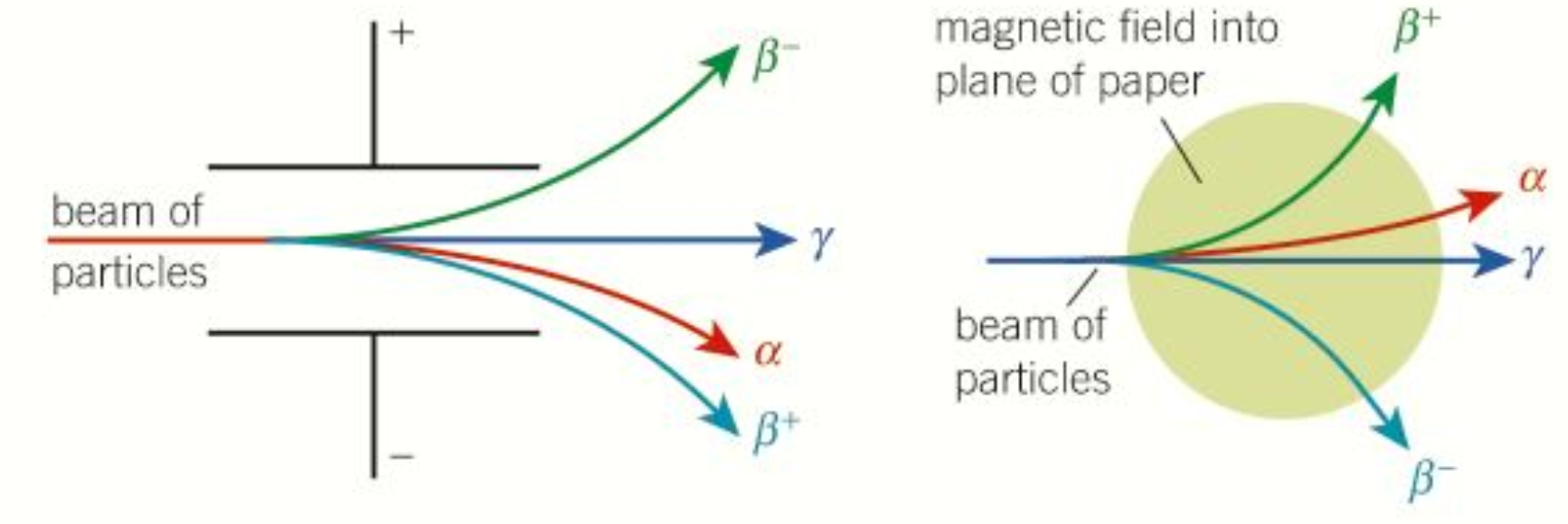
- Different types of radiation can be distinguished through a uniform electric field
- Beta- particles (electrons) are deflected towards the positive plate whereas Beta+ (positrons) and Alpha (helium nuclei) particles are deflected towards the negative plate
- Alpha particles are deflected less than Beta+ due to their larger mass
- Beta- particles (electrons) are deflected towards the positive plate whereas Beta+ (positrons) and Alpha (helium nuclei) particles are deflected towards the negative plate
- In both cases, direction of Gamma rays are unchanged because they have no charge
- Different types of radiation can be distinguished through a uniform magnetic field
- Direction of the force on each particle can be determined using Fleming's left-hand rule
- Alpha, Beta and Gamma are Ionising radiations because they can ionise atoms by removing some electrons, leaving positive ions
Nuclear Decay Equations
- The product of a 'parent nucleus' decay is a 'daughter nucleus' and the relevant radiation particle
- The net Atomic number and Atomic mass is conserved and therefore must be equal on either side of the equation
- A nucleus will decay until it is stable, which may mean it goes through many different elements / isotopes, and different forms of decay
- Decay chains show a complete and detailed 'chain' of what decay will occur from an original radioactive nucleus until it becomes stable
- The product of a 'parent nucleus' decay is a 'daughter nucleus' and the relevant radiation particle
Half Life and Activity
- Decay is random because we cannot predict when a particular nucleus in a sample will decay or which will decay next and each nucleus within a sample has equal chance of decaying per unit time
- Decay is spontaneous because the decay of nuclei is not affected by the presence of other nuclei in the sample or external factors such as pressure
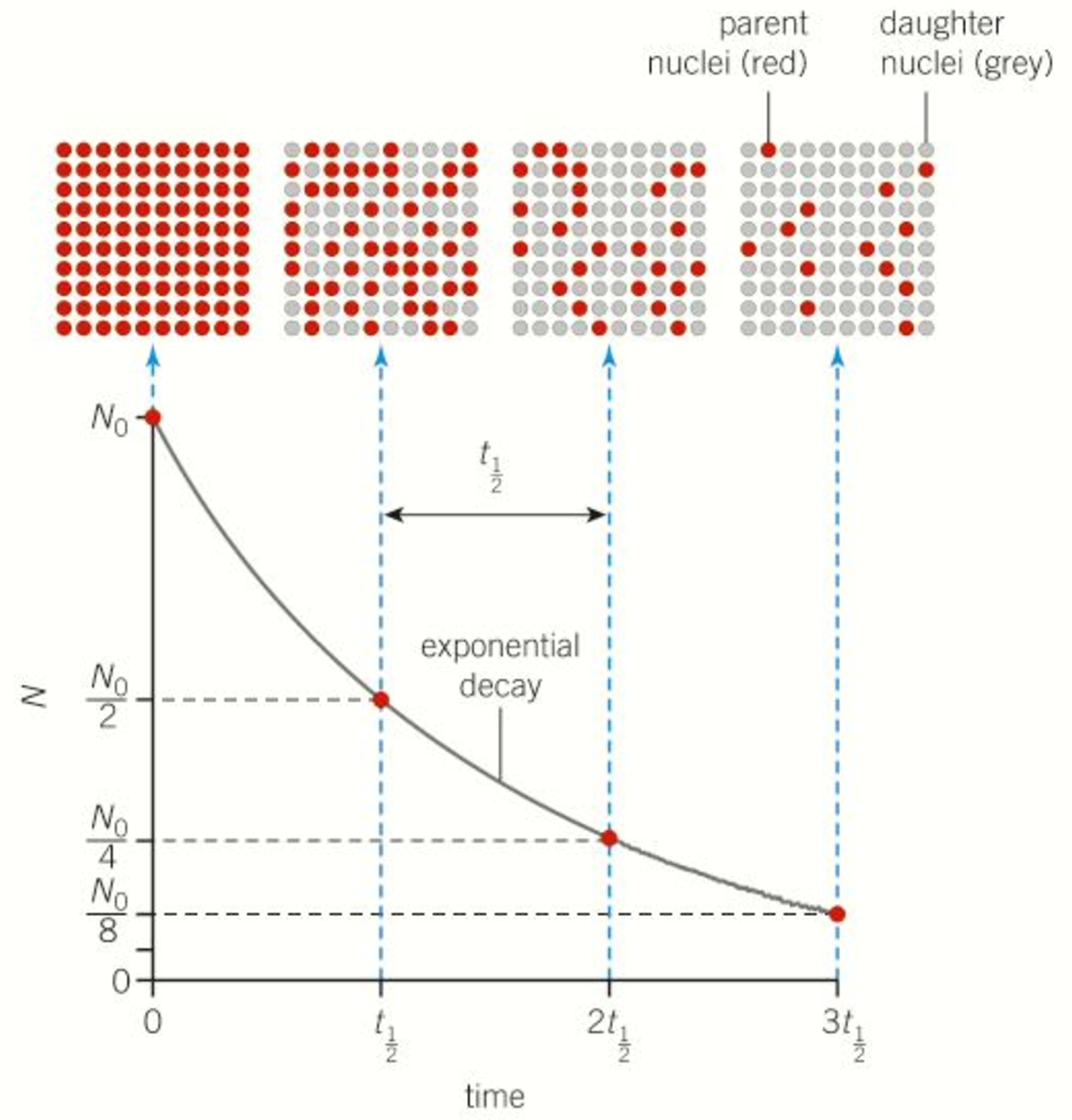
- The half-life of an isotope is the average time it takes for half the number of active nuclei in the sample to decay
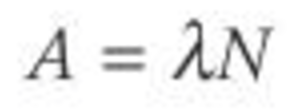
- The activity of a source A is the rate at which nuclei decay or disintergate
- Activity is measured in Becquerels (Bq)
- The decay constant of an isotope is the probability of decay of an individual nucleus per unit time
Radioactive Decay Equations
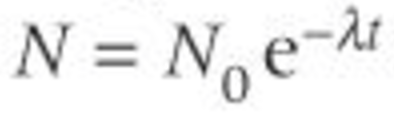
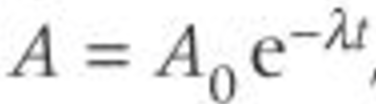
- Where N. is the number of undecayed nuclei at time t=0 and N is the number of undecayed nuclei in the sample at time t
- Because A is directly proportional to N
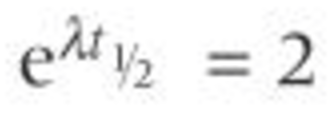
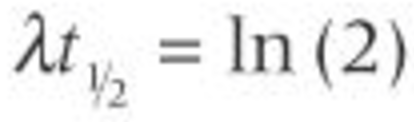
- The decay constant is related to its half life
Modelling Radioactive Decay
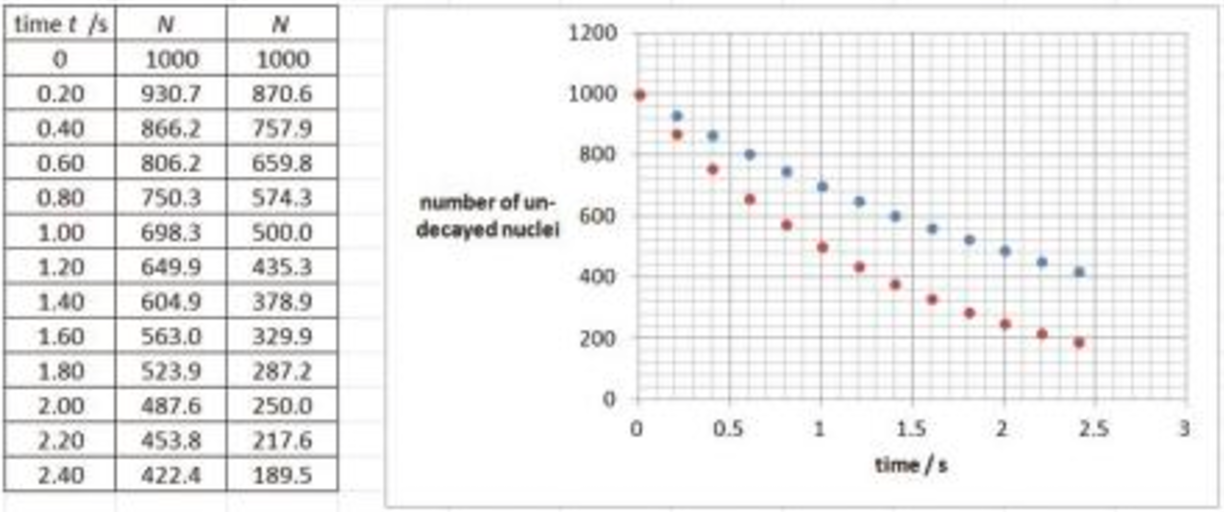
- 1) Start with a given number N. of undecayed nuclei in the sample
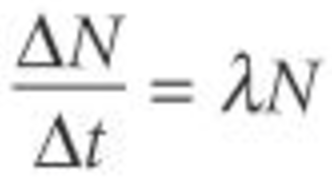
- 2) Choose a small interval of time. the value of this must be very small compared to the half life of the isotope so that you can assume the activity of the source does not change significantly
- 3) Calculate the number of nuclei decaying using equation:
- 4) Calculate the number of undecayed nuclei in the source at the end of the period by subtracting change in N from N
- 5) Repeat (4) for subsequent multiples of the time interval
- 4) Calculate the number of undecayed nuclei in the source at the end of the period by subtracting change in N from N
- 3) Calculate the number of nuclei decaying using equation:
- 2) Choose a small interval of time. the value of this must be very small compared to the half life of the isotope so that you can assume the activity of the source does not change significantly
- 1) Start with a given number N. of undecayed nuclei in the sample
Radioactive Dating
- All living things on Earth contain carbon atoms
- Atmospheric carbon is mainly carbon-12 but also a tiny amount of the radioactive carbon-14, which has a half life of about 5700 years
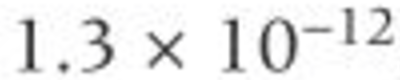
- The ratio of carbon-14 to carbon-12 in atmospheric carbon is almost constant at:
- The ratio is the same in all living things but once an organism dies, it stops takin in carbon
- This means that the carbon-12 remains constant but the carbon-14 decays and the ratio between the two changes
- We can use this to date organisms in Carbon-dating
- This means that the carbon-12 remains constant but the carbon-14 decays and the ratio between the two changes
- The ratio is the same in all living things but once an organism dies, it stops takin in carbon
- The ratio of carbon-14 to carbon-12 in atmospheric carbon is almost constant at:
- Atmospheric carbon is mainly carbon-12 but also a tiny amount of the radioactive carbon-14, which has a half life of about 5700 years
- All living things on Earth contain carbon atoms
Images and files in the map
Information
- Description
- A2 Physics Mind Map on Ch.25 Radioactivity, created by Will Pratt on 03/03/2017.
- Created by
- Will Pratt
- Views
- 0
- Rating