
Mind map
The English School
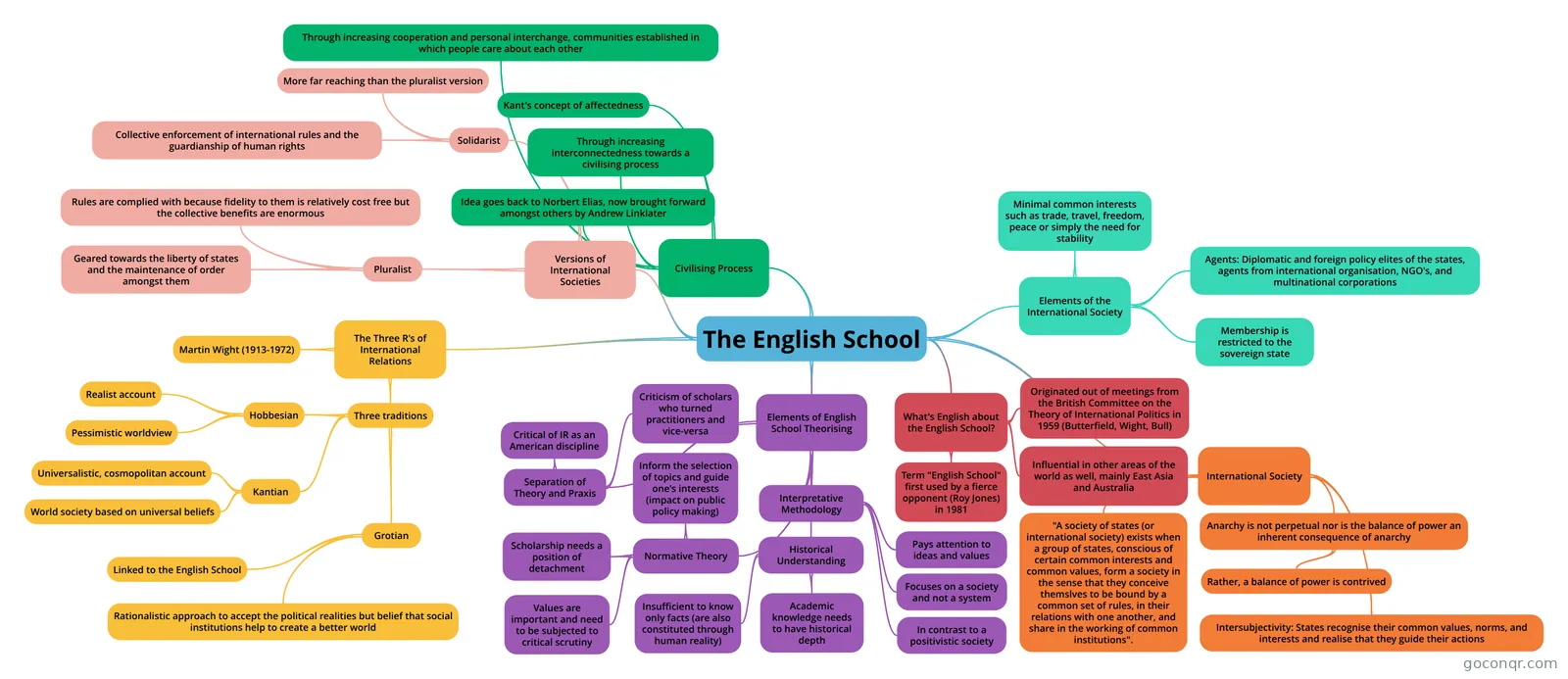
Mind map: The English School
Map content
The English School
What's English about the English School?
- Term "English School" first used by a fierce opponent (Roy Jones) in 1981
- Originated out of meetings from the British Committee on the Theory of International Politics in 1959 (Butterfield, Wight, Bull)
- Influential in other areas of the world as well, mainly East Asia and Australia
Elements of English School Theorising
- Interpretative Methodology
- Pays attention to ideas and values
- Focuses on a society and not a system
- In contrast to a positivistic society
- Historical Understanding
- Academic knowledge needs to have historical depth
- Insufficient to know only facts (are also constituted through human reality)
- Normative Theory
- Values are important and need to be subjected to critical scrutiny
- Inform the selection of topics and guide one's interests (impact on public policy making)
- Scholarship needs a position of detachment
- Separation of Theory and Praxis
- Critical of IR as an American discipline
- Criticism of scholars who turned practitioners and vice-versa
- Interpretative Methodology
The Three R's of International Relations
- Martin Wight (1913-1972)
- Three traditions
- Hobbesian
- Realist account
- Pessimistic worldview
- Kantian
- Universalistic, cosmopolitan account
- World society based on universal beliefs
- Grotian
- Linked to the English School
- Rationalistic approach to accept the political realities but belief that social institutions help to create a better world
- Hobbesian
International Society
- "A society of states (or international society) exists when a group of states, conscious of certain common interests and common values, form a society in the sense that they conceive themslves to be bound by a common set of rules, in their relations with one another, and share in the working of common institutions".
- Anarchy is not perpetual nor is the balance of power an inherent consequence of anarchy
- Rather, a balance of power is contrived
- Intersubjectivity: States recognise their common values, norms, and interests and realise that they guide their actions
Elements of the International Society
- Membership is restricted to the sovereign state
- Agents: Diplomatic and foreign policy elites of the states, agents from international organisation, NGO's, and multinational corporations
- Minimal common interests such as trade, travel, freedom, peace or simply the need for stability
Versions of International Societies
- Pluralist
- Geared towards the liberty of states and the maintenance of order amongst them
- Rules are complied with because fidelity to them is relatively cost free but the collective benefits are enormous
- Solidarist
- Collective enforcement of international rules and the guardianship of human rights
- More far reaching than the pluralist version
- Pluralist
Civilising Process
- Idea goes back to Norbert Elias, now brought forward amongst others by Andrew Linklater
- Through increasing interconnectedness towards a civilising process
- Kant's concept of affectedness
- Through increasing cooperation and personal interchange, communities established in which people care about each other
Information
- Description
- Mind Map on The English School, created by Luigi Botrugno on 03/03/2017.
- Created by
- Luigi Botrugno
- Views
- 4
- Rating