
Mind map
1d Pentose Phosphate Pathway (Slides 94-111)
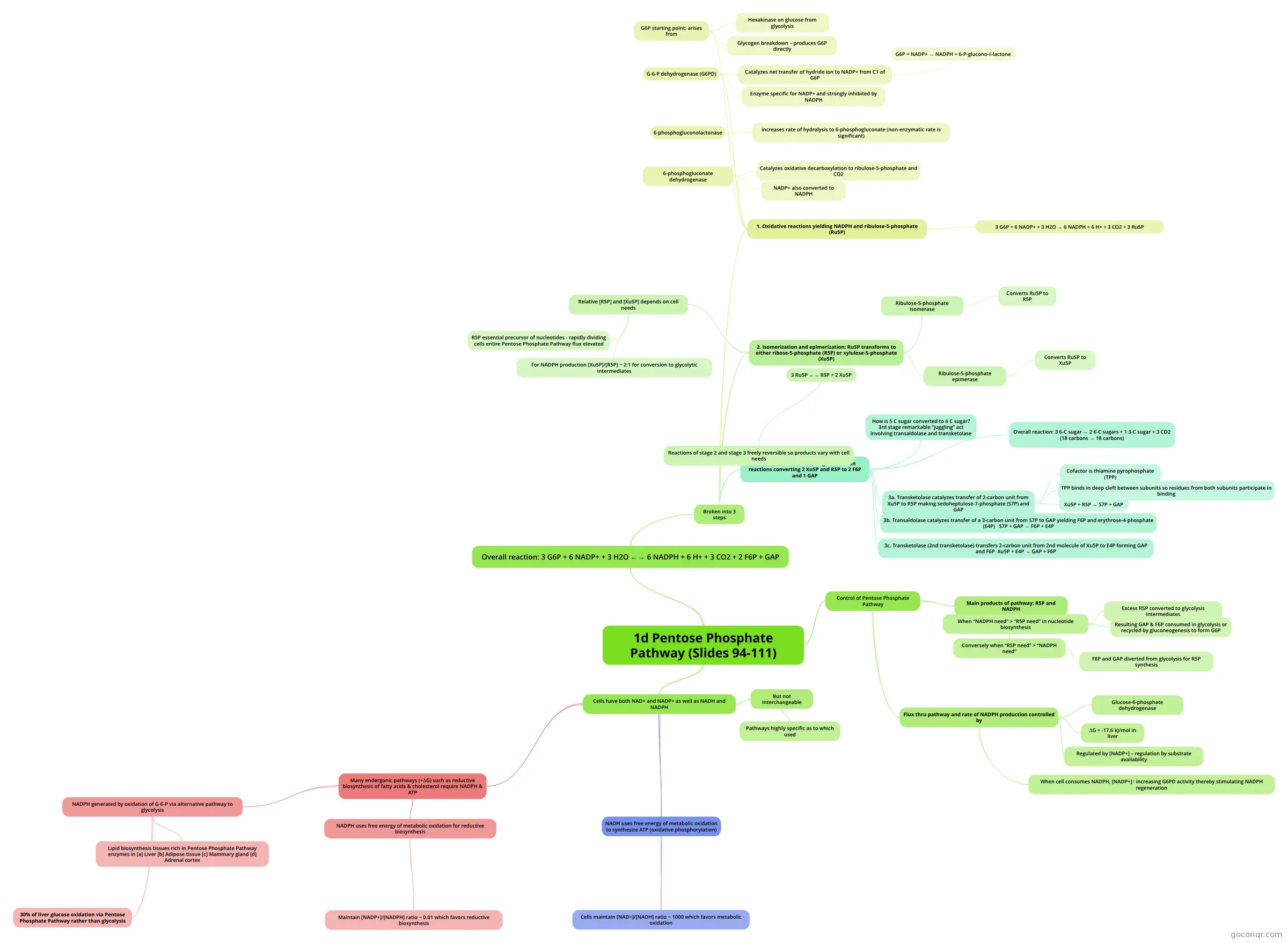
Mind map: Pentose phosphate pathway
Map content
1d Pentose Phosphate Pathway (Slides 94-111)
Cells have both NAD+ and NADP+ as well as NADH and NADPH
- But not interchangeable
- Pathways highly specific as to which used
- Many endergonic pathways (+ΔG) such as reductive biosynthesis of fatty acids & cholesterol require NADPH & ATP
- NADPH uses free energy of metabolic oxidation for reductive biosynthesis
- Maintain [NADP+]/[NADPH] ratio ~ 0.01 which favors reductive biosynthesis
- NADPH generated by oxidation of G-6-P via alternative pathway to glycolysis
- Lipid biosynthesis tissues rich in Pentose Phosphate Pathway enzymes in [a] Liver [b] Adipose tissue [c] Mammary gland [d] Adrenal cortex
- 30% of liver glucose oxidation via Pentose Phosphate Pathway rather than glycolysis
- NADPH uses free energy of metabolic oxidation for reductive biosynthesis
- NADH uses free energy of metabolic oxidation to synthesize ATP (oxidative phosphorylation)
- Cells maintain [NAD+]/[NADH] ratio ~ 1000 which favors metabolic oxidation
- But not interchangeable
Overall reaction: 3 G6P + 6 NADP+ + 3 H2O ←→ 6 NADPH + 6 H+ + 3 CO2 + 2 F6P + GAP
- Broken into 3 steps
- 1. Oxidative reactions yielding NADPH and ribulose-5-phosphate (Ru5P)
- 3 G6P + 6 NADP+ + 3 H2O → 6 NADPH + 6 H+ + 3 CO2 + 3 Ru5P
- G6P starting point: arises from
- Hexakinase on glucose from glycolysis
- Glycogen breakdown – produces G6P directly
- G-6-P dehydrogenase (G6PD)
- Catalyzes net transfer of hydride ion to NADP+ from C1 of G6P
- G6P + NADP+ → NADPH + 6-P-glucono-δ-lactone
- Enzyme specific for NADP+ and strongly inhibited by NADPH
- Catalyzes net transfer of hydride ion to NADP+ from C1 of G6P
- 6-phosphogluconolactonase
- increases rate of hydrolysis to 6-phosphogluconate (non-enzymatic rate is significant)
- 6-phosphogluconate dehydrogenase
- Catalyzes oxidative decarboxylation to ribulose-5-phosphate and CO2
- NADP+ also converted to NADPH
- 2. Isomerization and epimerization: Ru5P transforms to either ribose-5-phosphate (R5P) or xylulose-5-phosphate (Xu5P)
- Reactions of stage 2 and stage 3 freely reversible so products vary with cell needs
- 3 Ru5P ←→ R5P + 2 Xu5P
- Ribulose-5-phosphate isomerase
- Converts Ru5P to R5P
- Ribulose-5-phosphate epimerase
- Converts Ru5P to Xu5P
- Relative [R5P] and [Xu5P] depends on cell needs
- R5P essential precursor of nucleotides - rapidly dividing cells entire Pentose Phosphate Pathway flux elevated
- For NADPH production [Xu5P]/[R5P] ~ 2:1 for conversion to glycolytic intermediates
- 3. Series of C-C bond cleavage/formation reactions converting 2 Xu5P and R5P to 2 F6P and 1 GAP
- 3b. Transaldolase catalyzes transfer of a 3-carbon unit from S7P to GAP yielding F6P and erythrose-4-phosphate (E4P) S7P + GAP → F6P + E4P
- 3c. Transketolase (2nd transketolase) transfers 2-carbon unit from 2nd molecule of Xu5P to E4P forming GAP and F6P Xu5P + E4P → GAP + F6P
- Overall reaction: 3 6-C sugar → 2 6-C sugars + 1 3-C sugar + 3 CO2 (18 carbons → 18 carbons)
- How is 5 C sugar converted to 6 C sugar? 3rd stage remarkable “juggling” act involving transaldolase and transketolase
- 3a. Transketolase catalyzes transfer of 2-carbon unit from Xu5P to R5P making sedoheptulose-7-phosphate (S7P) and GAP
- Cofactor is thiamine pyrophosphate (TPP)
- TPP binds in deep cleft between subunits so residues from both subunits participate in binding
- Xu5P + R5P → S7P + GAP
- 1. Oxidative reactions yielding NADPH and ribulose-5-phosphate (Ru5P)
- Broken into 3 steps
Control of Pentose Phosphate Pathway
- Main products of pathway: R5P and NADPH
- When “NADPH need” > “R5P need” in nucleotide biosynthesis
- Excess R5P converted to glycolysis intermediates
- Resulting GAP & F6P consumed in glycolysis or recycled by gluconeogenesis to form G6P
- Conversely when “R5P need” > “NADPH need”
- F6P and GAP diverted from glycolysis for R5P synthesis
- When “NADPH need” > “R5P need” in nucleotide biosynthesis
- Flux thru pathway and rate of NADPH production controlled by
- Glucose-6-phosphate dehydrogenase
- ΔG = -17.6 kJ/mol in liver
- Regulated by [NADP+] – regulation by substrate availability
- When cell consumes NADPH, [NADP+]↑ increasing G6PD activity thereby stimulating NADPH regeneration
- Main products of pathway: R5P and NADPH
Information
- Description
- Mind Map on 1d Pentose Phosphate Pathway (Slides 94-111), created by adamlowenstein on 29/04/2014.
- Created by
- adamlowenstein
- Views
- 29
- Rating
More on Pentose Phosphate Pathway