
Mind map
Chapter 6: Learning
Map content
Chapter 6: Learning
Classical Conditioning
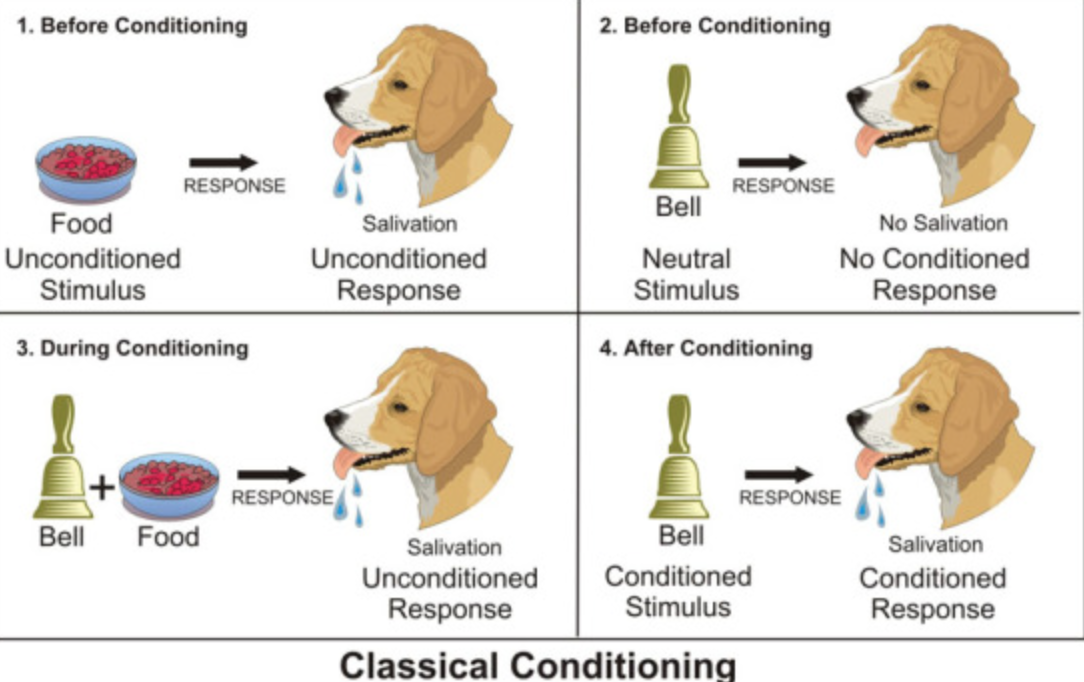
- Classical conditioning is a type of learning in which a stimulus acquires the capacity to evoke a response that was originally evoked by another stimulus.
- Pavlovs subjects were dogs restrained in harnesses in an experimental chamber. Their saliva was collected by means of a surgically present meat powder to a dog and then collect the resulting saliva. As his research continued, he noticed that dogs accustomed to the procedure would start salivating before the meat powder was presented.
- The dogs would salivate in response to a clicking sound made by the device that was used to present the meat powder. They responded by salivating to the sound of the tone alone. The key is that the tone started out as a neutral stimulus.
- The unconditioned stimulus (UCS) is a stimulus that evokes an unconditioned response without previous conditioning. The unconditioned response (UCR) is an unlearned reaction to an unconditioned stimulus that occurs without previous conditioning.
- The conditioned stimulus (CS) is a previously neutral stimulus that has, through conditioning, acquired the capacity to evoke a conditioned response (CR) is a learned reaction to a conditioned stimulus that occurs because of previous conditioning.
- A trial in classical conditioning consists of any presentation of a stimulus or a pair of stimuli.
- Case studies of patients suffering from phobias suggest that many irrational fears can be traced back to experiences that involve classical conditioning.
- Evaluative conditioning refers to changes in the liking of a stimulus that result from pairing that stimulus with other positive or negative stimulus.
- Research have shown that classical conditioning procedures can lead to immunosuppression (a decrease in the production of antibodies)
- Acquisition refers to the initial stage of learning something. Pavlov theorized that the acquisition of a conditioned response depends on stimulus contiguity.
- The right circumstances produce extinction, the gradual weakening and disappearance of a conditioned response tendency.
- Learning theorists use the term spontaneous recovery to describe such a resurrection from the graveyard of conditioned associations. Spontaneous recovery is the reappearance of an extinguished response after a period of nonexposure to the conditioned stimulus.
- The renewal effect is if a response is extinguished in a different environment than it was acquired, the extinguished response will reappear if the animal is returned to the original environment where acquisition took place.
- Stimulus generalization occurs when an organism that has learned a response to a specific stimulus responds in the same way to new stimuli that are similar to the original stimulus.
- Stimulus discrimination occurs when an organism that has learned a response to a specific stimulus doesn't respond in the same way to new stimuli that are similar to the original stimulus.
- Higher-order conditioning is when a conditioned stimulus functions as if it were an unconditioned stimulus.
Operant Conditioning
- According to the law of effect, if a response in the presence of a stimulus leads to satisfying effects, the association between the stimulus and the response is strengthened. Thorndike viewed instrumental learning as a mechanical process in which successful responses are gradually stamped in by their favourite effects.
- Skinner demonstrated that organisms tend to repeat those responses that are followed by favourable consequences. This fundamental principle is embodied in skinners concept of reinforcement. Reinforcement occurs when an event following a response increases an organisms tendency to make that response.
- An operant chamber, or Skinner box, is a small enclosure in which an animal can make a specific response that is recorded while the consequences of the response are systematically controlled.
- Because operant responses tend to be voluntary, they are said to be emitted rather than elicited. To emit means to send forth.
- Reinforcement contingencies are the circumstances or rules that determine whether responses lead to the presentation of reinforcers.
- The cumulative recorder creates a graphic record of responding and reinforcement in a skinner box as a function of time.
- Operant responses are usually established through a gradual process called shaping, which consists of the reinforcement of closer and closer approximations of a desired response. Shaping is necessary when an organism does not, on its own, emit the desired response.
- In operant conditioning, extinction refers to the gradual weakening and disappearance of a response tendency because the response is no longer followed by a reinforcer. Extinction begins in operant conditioning whenever previously available reinforcement is stopped.
- A key issue in operant conditioning is how much resistance to extinction an organism will display when reinforcement is halted. Resistance to extinction occurs when an organism continues to make a response after delivery of the reinforcer has been terminated.
- Operant responding is ultimately controlled by its consequences, as organisms learn response-outcome associations. However, stimuli that precede a response can also exert considerable influence over operant behaviour.
- Discriminative stimuli are cues that influence operant behaviour by indicating the probable consequences (reinforcement or non reinforcement) of a response.
- Reactions to discriminative stimulus are governed by the process of stimulus generalization and stimulus discrimination.
- Generalization is responding to a new stimulus as if it were the original.
- Acquisition: the initial stage of learning. CS and UCS are paired, gradually resulting in CR (classical conditioning). Respiring gradually increases because of reinforcement possibly through shaping (operant conditioning).
- Extinction: the gradual weakening and disappearance of a conditioned response tendency. CS is presented alone until it no longer elicits CR (classical). Responding gradually slows and stops after reinforcement is terminated (operant).
- Stimulus generalization: an organisms responding to stimuli other than the original stimulus used in conditioning. CR is elicited by new stimulus that resembles original CS (classical conditioning). Responding increases in the presence of new stimulus that resembles discriminative stimulus (operant conditioning).
- Stimulus discrimination: an organisms response to stimuli that are similar to the original stimulus used in conditioning. CR is not elicited by new stimulus that resembles original CS (classical conditioning). Responding doesn't increase in the lack of presence of new stimulus that resembles the original discriminative stimulus.
- Primary reinforcers are events that are inherently reinforcing because they satisfy biological needs.
- Secondary or conditioned reinforcers are events that acquire reinforcing qualities by being associated with primary reinforcers.
- A schedule of reinforcement determines which occurrences of a specific response result in the presentation of a reinforcer. Continuous reinforcement occurs when every instance of a designated response is reinforced.
- Intermittent, or partial, reinforcement occurs when a designated response is reinforced only some of the time.
- With a fixed-ratio (FR) schedule, the reinforcer is given after a fixed number of non reinforced responses.
- With a variable-ratio (VR) schedule, the reinforcer is given after a variable number of non reinforced responses.
- With a fixed- interval (FI) schedule, the reinforcer is given for the first response that occurs after a fixed time interval has elapsed.
- With a variable-interval (VI) schedule, the reinforcer is given for the first response after a variable time interval has elapsed.
- Positive reinforcement occurs when a response is strengthened because it is followed by the presentation of a rewarding stimulus.
- Negative reinforcement occurs when a response is strengthened because it is followed by the removal of an aversive stimulus.
- Escape learning is when an organism acquires a response that decreases or ends some aversive stimulation.
- In avoidance learning, an organism acquires a response that presents some aversive stimulation from occuring.
- Punishment occurs when an event following a response weakens the tendency to make that response.
- How to make punishment more effective while reducing its side effects: 1- Apply punishment swiftly. 2- Use punishment just severe enough to be effective. 3- Make punishment consistent. 4- Explain the punishment. 5- Use non corporal punishments, such as withdrawal of privileges.
The study of conditioning
- Instinctive drift occurs when an animals innate response tendencies interfere with conditioning process.
- Preparedness involves a species-specific predisposition to be conditioned in certain ways and not others.
- Latent-learning is learning that is not apparent from behaviour when it first occurs.
Observational Learning
- Observational learning occurs when an organisms responding is influenced by the observation of others, who are called models.
- Attention: to learn through observation, you must pay attention to another persons behaviour and its consequences.
- Retention: you may not have occasion to use an observed response for weeks, months, or even years. Hence you must store in your memory a mental representation of what you have witnessed.
- Reproduction: enacting a modelled response depends on your ability to reproduce the response by converting your stored mental images into overt behaviour. This may not be easy for some responses.
- Motivation: finally you are unlikely to reproduce an observed response unless you are motivated to do so. Your motivation depends on whether you encounter a situation in which you believe that the response is likely to pay off for you.
- Mirror neurons are neurons that are activated by performing an action or by seeing another monkey or person to perform the same action.
Images and files in the map
Information
- Description
- Mind Map on Chapter 6: Learning, created by Katie Konechny on 13/03/2017.
- Created by
- Katie Konechny · Mar 2017
- Updated
- Apr 6, 2018
- Views
- 1
- Rating