
Mind map
Rescorla Wagner cont

Map content
Rescorla Wagner cont
How does the associative strength of the light change across simple conditioning trials?
- On the first pairing of one stimulus (e.g., a light) with another (e.g., a shock) there is no reason for the light to provoke a memory of a shock. There is a large discrepancy between what is known about the light (nothing) and what happens (shock is delivered) and the increase in the strength of the associative link between the light and shock is large. As training continues, the correspondence between what is expected on the basis of what has been learnt on previous trials (i.e., a light-->shock association) and what happens (shock is delivered) becomes closer and increases in the strength of the light-->shock association become smaller and smaller.
- The increase in the associative strength (ΔV) of a stimulus (e.g., a light) that occurs as a result of a trial is determined by the difference between the maximum associative strength that the US (e.g. a shock) can support (λ; what happens) and the total associative strength of all stimuli of all stimuli presented on that trial (ΣV; what the animal expects to happen). This difference is multiplied by the product of the fixed learning rate parameters for the light and shock (α.β).
- On the first pairing of one stimulus (e.g., a light) with another (e.g., a shock) there is no reason for the light to provoke a memory of a shock. There is a large discrepancy between what is known about the light (nothing) and what happens (shock is delivered) and the increase in the strength of the associative link between the light and shock is large. As training continues, the correspondence between what is expected on the basis of what has been learnt on previous trials (i.e., a light-->shock association) and what happens (shock is delivered) becomes closer and increases in the strength of the light-->shock association become smaller and smaller.
Predictions
- The strength of the conditioned response is proportional to associative strength. It is concerned with qualitative predictions about relative performance of animals that are treated differently. It cannot give us quantitative predictions about the absolute values of conditioned responding. However, using this kind of theory allows us to predict a conditioned response will be stronger after one treatment than after another. This prediction can then be tested with an experiment.
- The maximum conditioned response is limited by the value of the US. Learning rate is determined by CS (and US) intensity,
- The strength of the conditioned response is proportional to associative strength. It is concerned with qualitative predictions about relative performance of animals that are treated differently. It cannot give us quantitative predictions about the absolute values of conditioned responding. However, using this kind of theory allows us to predict a conditioned response will be stronger after one treatment than after another. This prediction can then be tested with an experiment.
So far we have concerned ourselves with learning that enables the memory of one stimulus to excite that of another through an associative link that has been formed between them (i.e., with excitatory associations). There is other evidence suggesting that the memory of one stimulus can come to inhibit that of another through a process of learning. We will explore the nature of inhibitory learning and how the Rescorla-Wagner model explains it. We will also explore the successes and shortcomings of the Rescorla-Wagner model as an account of associative learning in animals.
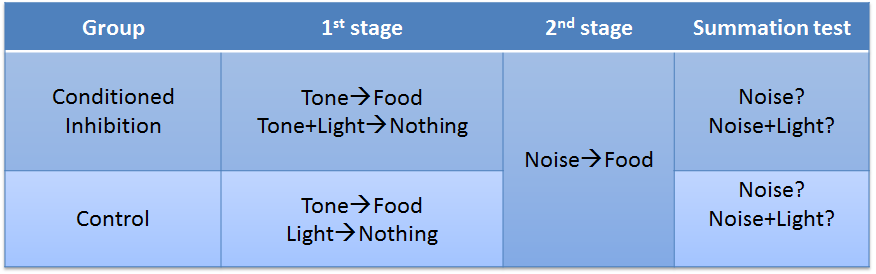
Conditioned inhibition
- Typical outcome of such training: Animals come to show conditioned responding when the tone is presented alone, but not when the tone is accompanied by the light. When the light is presented alone it does not (normally) appear to have any tendency to provoke a response. That is, what is learned about the light is “behaviourally silent”.
- It appears that animals learn something that counteracts what the tone signals. For example, just as the tone signals the presentation of food, so the light signals that food will not occur. Give that the learning about the light is behaviourally silent, how might we reveal the information that has been acquired?
- The summation test
- Result: Group Condition Inhibition will show greater suppression of responding during the Noise+Light compound. Group Conditioned Inhibition are not simply learning that the Tone+Light compound is followed by no food; the Light’s properties transfer to another stimulus. They are not simply learning that the Tone+Light compound is followed by food, the lights properties transfer to another stimulus.
- The retardation test
- Result: Group Condition Inhibition will show slower acquisition of conditiond responding during the test phase. The reason the Group Conditioned Inhibition fail to respond to the Tone+Light compound isn’t simply that the Light is capturing a lot of attention. If this was the case then they would be faster to acquire conditioning in the retardation test.
- The summation test
How does the Rescorla-Wagner model explain conditioned inhibition
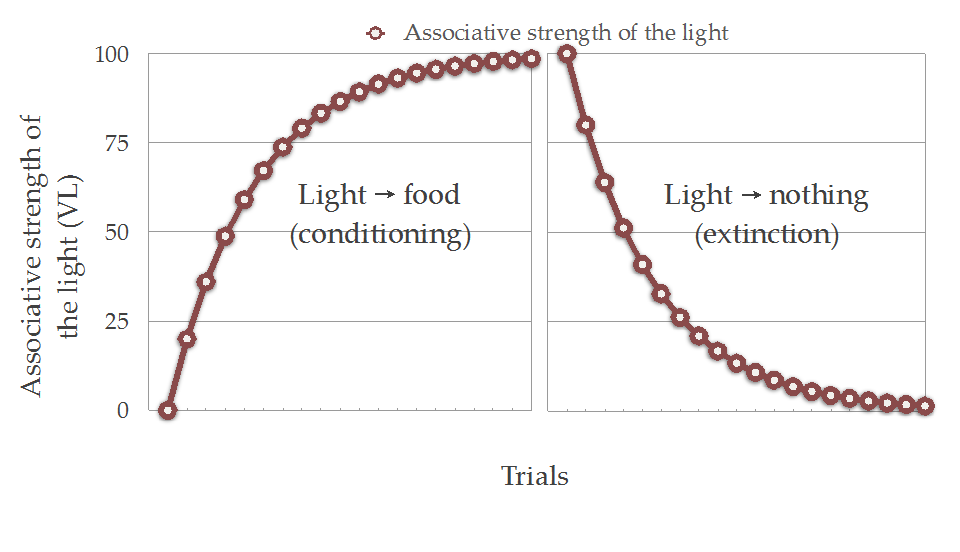
- In the same way that condition trials with the light result in increases to VL to an asymptote according to a negatively accelerated function, extinction trials result in VL decreasing to 0 according to a negatively accelerated function.
- What is the fate of the light during condition inhibition training? Tone-->Food and Tone+Light-->Nothing. The change in the associative strength of the light is negative.
- What is the fate of the tone during condition inhibition training? The Tone loses associative strength, but because it starts out with associative strength it doesn’t lead to inhibition. On the next Tone-->Food trial, Tone gains associative strength again (but nothing happens to the associative strength of the light, because its not presented).
- Explanation for summation! The light’s negative associative strength (e.g. -100) combines with the positive associative strength of the noise (e.g. 100) to produce a net value of, in this case, 0.
- Explanation for retardation!When the light is paired with food its takes longer for the light to move from having a negative value (-100) to a positive value (when conditioned responding becomes evident) than it does when the light has no associative strength (in the control group).
- In the same way that condition trials with the light result in increases to VL to an asymptote according to a negatively accelerated function, extinction trials result in VL decreasing to 0 according to a negatively accelerated function.
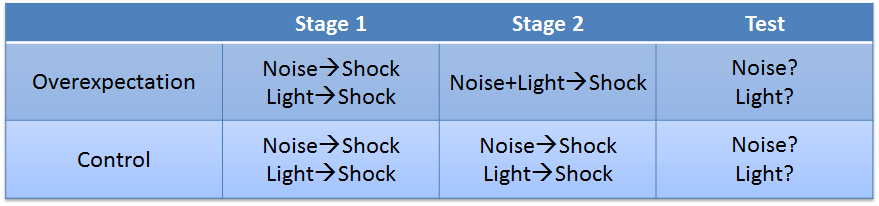
Overepectation, Kremer, 1978.
- General intuition: It should be possible to arrange that the associative strength supportable by the US presented on a trial (i.e., λ) has a lower value than that predicted by the stimuli presented on that trial (i.e., ΣV). Under these conditions (i.e., λ < ΣV), the associative strengths of the stimuli will decrease even though the US is delivered.
- Added cue - If an associatively neutral cue is added to the compound when overexepctation occurs, then, because the compound loses associative strength, the added cue’s strength will go below zero; it will become inhibitory.
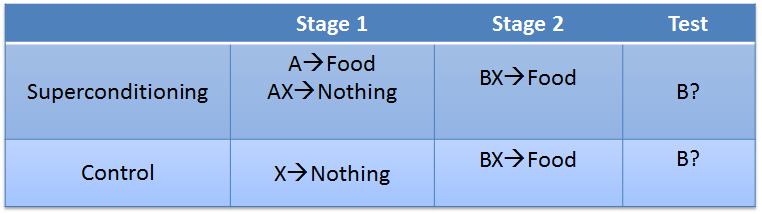
Superconditioning
- Pearce & Redhead, 1995. General intuition: If increases in associative strength are most marked when the US is surprising (i.e., when λ-ΣV has a large positive value), then one should be able to produce particularly marked (or super) changes in associative strength by arranging that the US is explicitly not predicted and yet occurs.
- Pearce & Redhead, 1995. General intuition: If increases in associative strength are most marked when the US is surprising (i.e., when λ-ΣV has a large positive value), then one should be able to produce particularly marked (or super) changes in associative strength by arranging that the US is explicitly not predicted and yet occurs.
Stengths
- It is precise; making ordinal predictions about the effects of manipulations at a trial-by-trial level. It has considerable explanatory power (e.g., blocking). It makes novel and counterintuitive predictions, some of which have been confirmed (e.g., superconditioning and overexpectation).
But is it always right?
- What is learnt during conditioned inhibition training? According to RW, just as excitatory conditioning results in growth of positive association strength, so inhibitory conditioning results in a stimulus with negative associative strength
- Is amount of conditioned inhibition correct? Extinction of conditioned inhibition (Zimmer-Hart & Rescorla, 1974). According to the Rescorla-Wagner model in the same way that a stimulus with positive strength loses associative strength during extinction so a stimulus with negative strength should lose this strength in extinction. So if a light has negative associative (-100) strength and is presented in extinction (light-->nothing) then… ΔVL = 0.2(0-(-100)) = 20. So, as a consequence of presenting a conditioned inhibiter alone its inhibitory associative strength should diminish (from -100 back up to 0). This is not the case: there is no evidence that this method extinguishes inhibition (Zimmer-Hart & Rescorla, 1974).
- Problems for RW
- Hearst and Franklin (1977) trained pigeons with a light that predicted the absence of food. Pigeons exhibited avoidance behaviour in the presence of the light. This behavioural response is not anticipated if inhibition is simply negative associative strength.
- Overshadowing is not predicted to occur, but is observed, following a single conditioning trial (James & Wagner, 1980; Mackintosh & Reese, 1979). The model’s account of conditioned inhibition is flawed (e.g., Zimmer-Hart & Rescorla, 1974) and Konorski’s (1967) account seems better placed to account for what is learned during conditioned inhibition training. As we shall see in subsequent lectures, the suggestion that the α value of a stimulus does not vary as a function of experience is undermined by the observation that simple exposure to a stimulus retards subsequent learning involving that stimulus (i.e., latent inhibition)
- Problems for RW
- Is amount of conditioned inhibition correct? Extinction of conditioned inhibition (Zimmer-Hart & Rescorla, 1974). According to the Rescorla-Wagner model in the same way that a stimulus with positive strength loses associative strength during extinction so a stimulus with negative strength should lose this strength in extinction. So if a light has negative associative (-100) strength and is presented in extinction (light-->nothing) then… ΔVL = 0.2(0-(-100)) = 20. So, as a consequence of presenting a conditioned inhibiter alone its inhibitory associative strength should diminish (from -100 back up to 0). This is not the case: there is no evidence that this method extinguishes inhibition (Zimmer-Hart & Rescorla, 1974).
- What is learnt during conditioned inhibition training? According to RW, just as excitatory conditioning results in growth of positive association strength, so inhibitory conditioning results in a stimulus with negative associative strength
Images and files in the map
Information
- Description
- Y3 Uni Learning and Animal cognition - David Mind Map on Rescorla Wagner cont, created by Issy de Silva on 27/03/2017.
- Created by
- Issy de Silva
- Views
- 0
- Rating