
Mind map
Sound
Map content
Sound
How is sound produced?
- Sound produces vibration / vice versa
- String instruments
- When the guitar string is plucked, it vibrates and produces sound.
- Tuning fork
- When you hit the tuning fork, you can see a vibration on the tuning fork. A sound is produced and is heard when placed near the ear.
- String instruments
- When a object vibrates it makes a sound. Different Objects make different sounds
- Sound produces vibration / vice versa
Travelling of sound
- Energy passed to surrounding molecules
- Pushing and pulling layers of molecules surrounding it
- Layers of air form compression and rarefaction.
- Compression
- Air molecules are closer together
- Rarefaction
- Air molecules are further from each other
- Compression
- Layers of air form compression and rarefaction.
- Pushing and pulling layers of molecules surrounding it
- Vacuum
- NO matter
- Sound cannot be heard
- No particles for the sound to be carried
- Sound cannot be heard
- NO matter
- Requires matter to surround the sound
- Solid
- 6000 m/s
- Highest because molecules are closer
- Transmission of sound is faster
- Material is more dense
- Transmission of sound is faster
- Highest because molecules are closer
- 6000 m/s
- Liquid
- 1500 m/s
- Gas
- 330 m/s
- Solid
- Energy passed to surrounding molecules
How we hear sound
- The ear is a sensitive device which functions with hearing
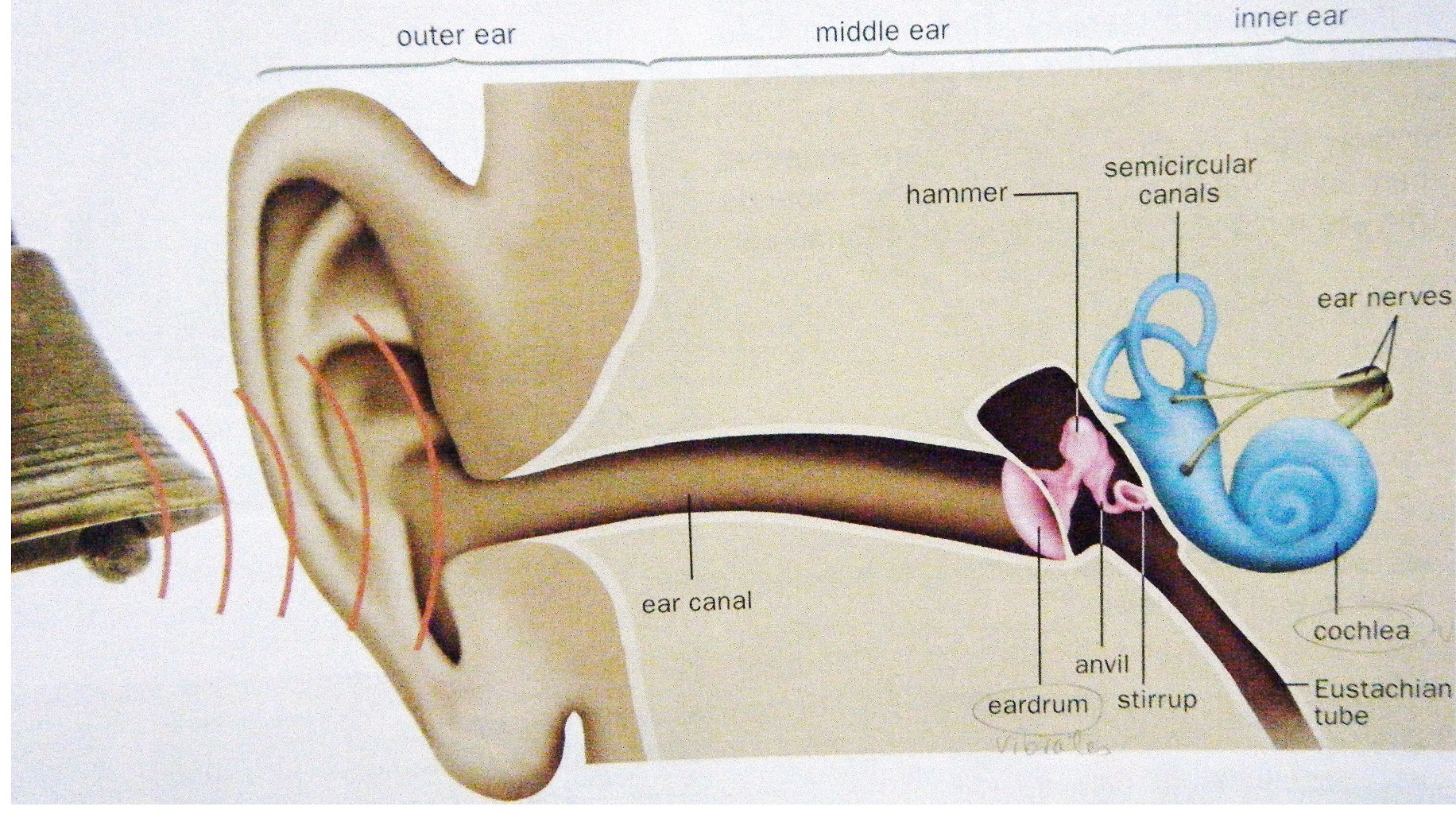
- 3 Parts: Outer Ear Inner Ear Middle Ear
- Outer Ear / Pinna collects sound from the surroundings and passes through auditory canal to the ear drum
- Eardrum: Thin membrane that vibrates when catches compression and rarefaction of sound.
- Middle Ear : 3 bones Hammer, Anvil and Stirrup
- Vibrations of eardrum are amplified many times by ear bones and turned into electric signals by cochlea which are passed through auditory nerve to brain. The brain interprets them as sound.
- Middle Ear : 3 bones Hammer, Anvil and Stirrup
- Eardrum: Thin membrane that vibrates when catches compression and rarefaction of sound.
- Outer Ear / Pinna collects sound from the surroundings and passes through auditory canal to the ear drum
- 3 Parts: Outer Ear Inner Ear Middle Ear
- The ear is a sensitive device which functions with hearing
Uses
- Healing wounds
- Levitation
- Echolocation / Flash sonar
- Curing cancer
Pitch
- Frequency
- Hertz (Hz)
- Human Hearing range : 20 Hz- 20000 Hz
- Hertz (Hz)
- Higher/Lower sounds
- Frequency
Loudness
- larger vibration, louder sounds
Sound and Society
- Sonar
- Ultrasound
- Sound with frequencies above human range
- above 26,000 Hz
- Reflected waves can be used to
- Create images of foestuses in pregnant moms
- Detect Cancers
- Observe tumours
- Sound with frequencies above human range
Images and files in the map

Information
- Description
- This is a summary of Singapore's Syllabus in 2014 on Chapter 16: Transfer of Sound and Energy through vibrations
- Created by
- Mansee Jain
- Views
- 0
- Tags
- History
-
- Created by Jasper Chia · Feb 3, 2014
- Copied by Vaibhav Bhojwani · Feb 5, 2017
- Copied by Mansee Jain · Apr 10, 2017
- Rating