
Mind map
Motivation, Values, Lifestyles & Attitudes
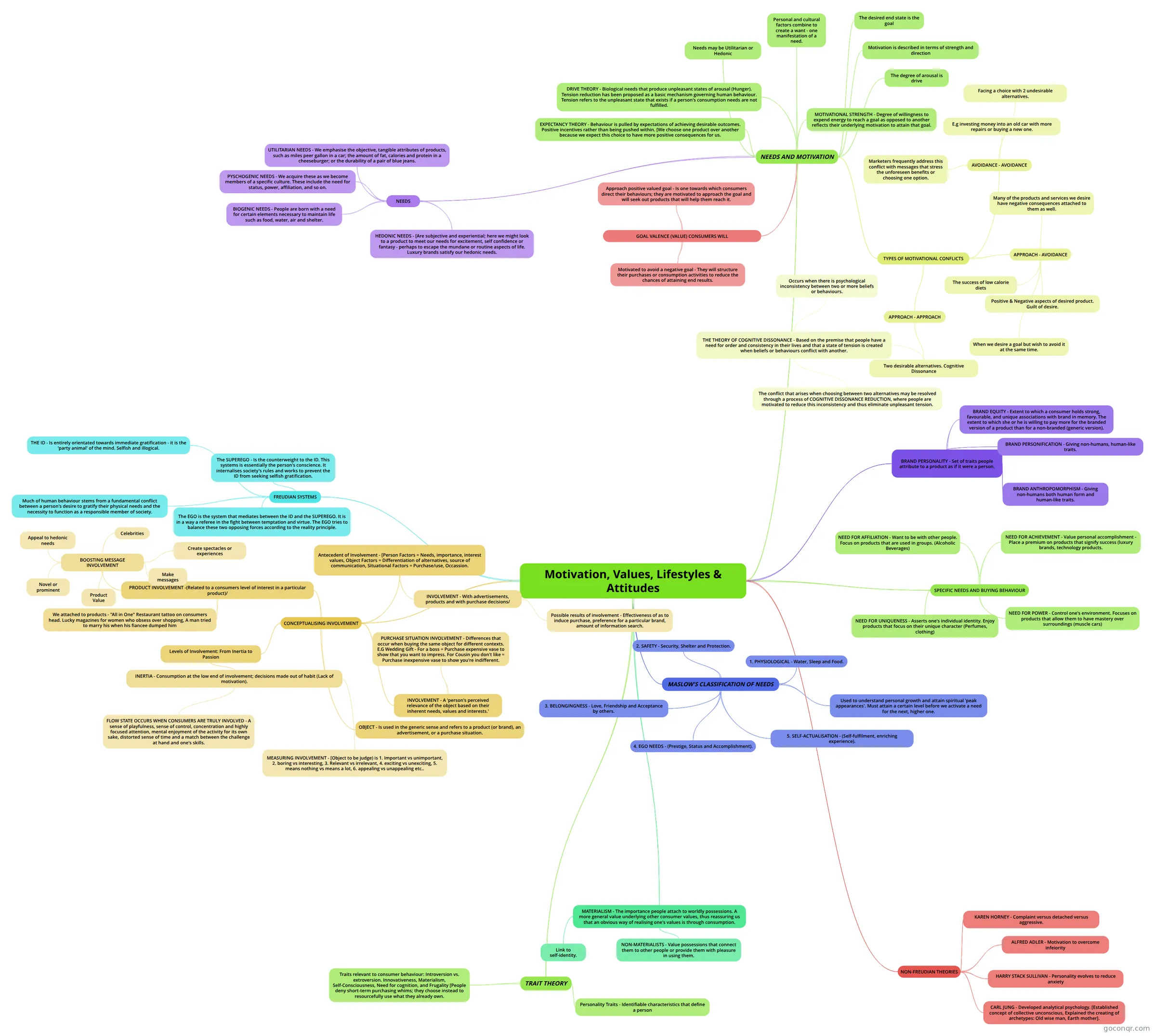
Mind map: Motivation, values, lifestyles and attitudes
Map content
Motivation, Values, Lifestyles & Attitudes
FREUDIAN SYSTEMS
- Much of human behaviour stems from a fundamental conflict between a person's desire to gratify their physical needs and the necessity to function as a responsible member of society.
- THE ID - Is entirely orientated towards immediate gratification - it is the 'party animal' of the mind. Selfish and illogical.
- The SUPEREGO - Is the counterweight to the ID. This systems is essentially the person's conscience. It internalises society's rules and works to prevent the ID from seeking selfish gratification.
- The EGO is the system that mediates between the ID and the SUPEREGO. It is in a way a referee in the fight between temptation and virtue. The EGO tries to balance these two opposing forces according to the reality principle.
NON-FREUDIAN THEORIES
- KAREN HORNEY - Complaint versus detached versus aggressive.
- ALFRED ADLER - Motivation to overcome infeiority
- HARRY STACK SULLIVAN - Personality evolves to reduce anxiety
- CARL JUNG - Developed analytical psychology. [Established concept of collective unconscious, Explained the creating of archetypes: Old wise man, Earth mother].
TRAIT THEORY
- Personality Traits - Identifiable characteristics that define a person
- Traits relevant to consumer behaviour: Introversion vs. extroversion. Innovativeness, Materialism, Self-Consciousness, Need for cognition, and Frugality [People deny short-term purchasing whims; they choose instead to resourcefully use what they already own.
MATERIALISM - The importance people attach to worldly possessions. A more general value underlying other consumer values, thus reassuring us that an obvious way of realising one's values is through consumption.
- Link to self-identity.
- NON-MATERIALISTS - Value possessions that connect them to other people or provide them with pleasure in using them.
BRAND PERSONALITY - Set of traits people attribute to a product as if it were a person.
- BRAND EQUITY - Extent to which a consumer holds strong, favourable, and unique associations with brand in memory. The extent to which she or he is willing to pay more for the branded version of a product than for a non-branded (generic version).
- BRAND PERSONIFICATION - Giving non-humans, human-like traits.
- BRAND ANTHROPOMORPHISM - Giving non-humans both human form and human-like traits.
NEEDS AND MOTIVATION
- Needs may be Utilitarian or Hedonic
- The desired end state is the goal
- The degree of arousal is drive
- Personal and cultural factors combine to create a want - one manifestation of a need.
- Motivation is described in terms of strength and direction
- MOTIVATIONAL STRENGTH - Degree of willingness to expend energy to reach a goal as opposed to another reflects their underlying motivation to attain that goal.
- DRIVE THEORY - Biological needs that produce unpleasant states of arousal (Hunger). Tension reduction has been proposed as a basic mechanism governing human behaviour. Tension refers to the unpleasant state that exists if a person's consumption needs are not fulfilled.
- EXPECTANCY THEORY - Behaviour is pulled by expectations of achieving desirable outcomes. Positive incentives rather than being pushed within. [We choose one product over another because we expect this choice to have more positive consequences for us.
- NEEDS
- BIOGENIC NEEDS - People are born with a need for certain elements necessary to maintain life such as food, water, air and shelter.
- PYSCHOGENIC NEEDS - We acquire these as we become members of a specific culture. These include the need for status, power, affiliation, and so on.
- UTILITARIAN NEEDS - We emphasise the objective, tangible attributes of products, such as miles peer gallon in a car; the amount of fat, calories and protein in a cheeseburger; or the durability of a pair of blue jeans.
- HEDONIC NEEDS - [Are subjective and experiential; here we might look to a product to meet our needs for excitement, self confidence or fantasy - perhaps to escape the mundane or routine aspects of life. Luxury brands satisfy our hedonic needs.
- GOAL VALENCE (VALUE) CONSUMERS WILL
- Approach positive valued goal - Is one towards which consumers direct their behaviours; they are motivated to approach the goal and will seek out products that will help them reach it.
- Motivated to avoid a negative goal - They will structure their purchases or consumption activities to reduce the chances of attaining end results.
- TYPES OF MOTIVATIONAL CONFLICTS
- APPROACH - APPROACH
- Two desirable alternatives. Cognitive Dissonance
- THE THEORY OF COGNITIVE DISSONANCE - Based on the premise that people have a need for order and consistency in their lives and that a state of tension is created when beliefs or behaviours conflict with another.
- The conflict that arises when choosing between two alternatives may be resolved through a process of COGNITIVE DISSONANCE REDUCTION, where people are motivated to reduce this inconsistency and thus eliminate unpleasant tension.
- Occurs when there is psychological inconsistency between two or more beliefs or behaviours.
- THE THEORY OF COGNITIVE DISSONANCE - Based on the premise that people have a need for order and consistency in their lives and that a state of tension is created when beliefs or behaviours conflict with another.
- Two desirable alternatives. Cognitive Dissonance
- APPROACH - AVOIDANCE
- Positive & Negative aspects of desired product. Guilt of desire.
- When we desire a goal but wish to avoid it at the same time.
- Many of the products and services we desire have negative consequences attached to them as well.
- The success of low calorie diets
- AVOIDANCE - AVOIDANCE
- Facing a choice with 2 undesirable alternatives.
- E.g investing money into an old car with more repairs or buying a new one.
- Marketers frequently address this conflict with messages that stress the unforeseen benefits or choosing one option.
- APPROACH - APPROACH
SPECIFIC NEEDS AND BUYING BEHAVIOUR
- NEED FOR ACHIEVEMENT - Value personal accomplishment - Place a premium on products that signify success (luxury brands, technology products.
- NEED FOR AFFILIATION - Want to be with other people. Focus on products that are used in groups. (Alcoholic Beverages)
- NEED FOR POWER - Control one's environment. Focuses on products that allow them to have mastery over surroundings (muscle cars)
- NEED FOR UNIQUENESS - Asserts one's individual identity. Enjoy products that focus on their unique character (Perfumes, clothing)
MASLOW'S CLASSIFICATION OF NEEDS
- 5. SELF-ACTUALISATION - (Self-fulfilment, enriching experience).
- 4. EGO NEEDS - (Prestige, Status and Accomplishment).
- 3. BELONGINGNESS - Love, Friendship and Acceptance by others.
- 2. SAFETY - Security, Shelter and Protection.
- 1. PHYSIOLOGICAL - Water, Sleep and Food.
- Used to understand personal growth and attain spiritual 'peak appearances'. Must attain a certain level before we activate a need for the next, higher one.
CONCEPTUALISING INVOLVEMENT
- INVOLVEMENT - A 'person's perceived relevance of the object based on their inherent needs, values and interests.'
- PURCHASE SITUATION INVOLVEMENT - Differences that occur when buying the same object for different contexts. E.G Wedding Gift - For a boss = Purchase expensive vase to show that you want to impress. For Cousin you don't like = Purchase inexpensive vase to show you're indifferent.
- OBJECT - Is used in the generic sense and refers to a product (or brand), an advertisement, or a purchase situation.
- Levels of Involvement: From Inertia to Passion
- INERTIA - Consumption at the low end of involvement; decisions made out of habit (Lack of motivation).
- FLOW STATE OCCURS WHEN CONSUMERS ARE TRULY INVOLVED - A sense of playfulness, sense of control, concentration and highly focused attention, mental enjoyment of the activity for its own sake, distorted sense of time and a match between the challenge at hand and one's skills.
- MEASURING INVOLVEMENT - [Object to be judge) is 1. Important vs unimportant, 2. boring vs interesting, 3. Relevant vs irrelevant, 4. exciting vs unexciting, 5. means nothing vs means a lot, 6. appealing vs unappealing etc..
- INERTIA - Consumption at the low end of involvement; decisions made out of habit (Lack of motivation).
- PRODUCT INVOLVEMENT -(Related to a consumers level of interest in a particular product)/
- We attached to products - "All in One" Restaurant tattoo on consumers head. Lucky magazines for women who obsess over shopping, A man tried to marry his when his fiancee dumped him
- BOOSTING MESSAGE INVOLVEMENT
- Appeal to hedonic needs
- Novel or prominent
- Celebrities
- Create spectacles or experiences
- Product Value
- Make messages
- Antecedent of Involvement - [Person Factors = Needs, importance, interest values, Object Factors = Differentiation of alternatives, source of communication, Situational Factors = Purchase/use, Occassion.
- INVOLVEMENT - With advertisements, products and with purchase decisions/
- Possible results of involvement - Effectiveness of as to induce purchase, preference for a particular brand, amount of information search.
- INVOLVEMENT - With advertisements, products and with purchase decisions/
- INVOLVEMENT - A 'person's perceived relevance of the object based on their inherent needs, values and interests.'
Information
- Description
- Mind Map on Motivation, Values, Lifestyles & Attitudes, created by Crogers on 13/05/2014.
- Created by
- Crogers
- Views
- 19
- Rating
More on Consumer motivation, personality and self-concept