
Mind map
Recruitment + Selection (Bratton & Gold, 2012)
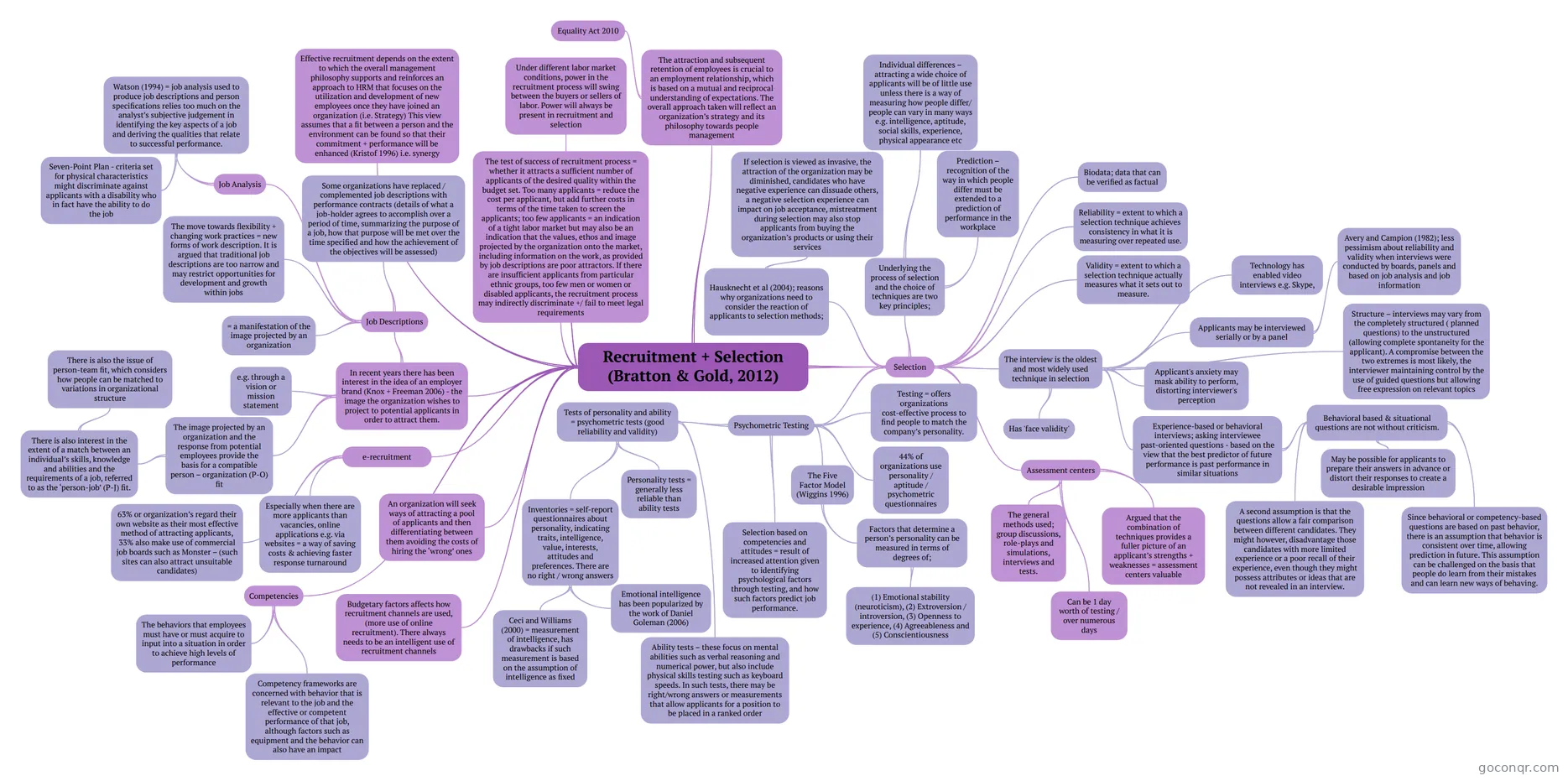
Mind map: Recruitment and Selection
Map content
Recruitment + Selection (Bratton & Gold, 2012)
Competencies
- The behaviors that employees must have or must acquire to input into a situation in order to achieve high levels of performance
- Competency frameworks are concerned with behavior that is relevant to the job and the effective or competent performance of that job, although factors such as equipment and the behavior can also have an impact
The test of success of recruitment process = whether it attracts a sufficient number of applicants of the desired quality within the budget set. Too many applicants = reduce the cost per applicant, but add further costs in terms of the time taken to screen the applicants; too few applicants = an indication of a tight labor market but may also be an indication that the values, ethos and image projected by the organization onto the market, including information on the work, as provided by job descriptions are poor attractors. If there are insufficient applicants from particular ethnic groups, too few men or women or disabled applicants, the recruitment process may indirectly discriminate +/ fail to meet legal requirements
In recent years there has been interest in the idea of an employer brand (Knox + Freeman 2006) - the image the organization wishes to project to potential applicants in order to attract them.
- Job Descriptions
- = a manifestation of the image projected by an organization
- Job Analysis
- Watson (1994) = job analysis used to produce job descriptions and person specifications relies too much on the analyst’s subjective judgement in identifying the key aspects of a job and deriving the qualities that relate to successful performance.
- Seven-Point Plan - criteria set for physical characteristics might discriminate against applicants with a disability who in fact have the ability to do the job
- Watson (1994) = job analysis used to produce job descriptions and person specifications relies too much on the analyst’s subjective judgement in identifying the key aspects of a job and deriving the qualities that relate to successful performance.
- The move towards flexibility + changing work practices = new forms of work description. It is argued that traditional job descriptions are too narrow and may restrict opportunities for development and growth within jobs
- Some organizations have replaced / complemented job descriptions with performance contracts (details of what a job-holder agrees to accomplish over a period of time, summarizing the purpose of a job, how that purpose will be met over the time specified and how the achievement of the objectives will be assessed)
- The image projected by an organization and the response from potential employees provide the basis for a compatible person – organization (P-O) fit
- There is also interest in the extent of a match between an individual’s skills, knowledge and abilities and the requirements of a job, referred to as the ‘person-job’ (P-J) fit.
- There is also the issue of person-team fit, which considers how people can be matched to variations in organizational structure
- There is also interest in the extent of a match between an individual’s skills, knowledge and abilities and the requirements of a job, referred to as the ‘person-job’ (P-J) fit.
- e.g. through a vision or mission statement
- Job Descriptions
Budgetary factors affects how recruitment channels are used, (more use of online recruitment). There always needs to be an intelligent use of recruitment channels
Under different labor market conditions, power in the recruitment process will swing between the buyers or sellers of labor. Power will always be present in recruitment and selection
Effective recruitment depends on the extent to which the overall management philosophy supports and reinforces an approach to HRM that focuses on the utilization and development of new employees once they have joined an organization (i.e. Strategy) This view assumes that a fit between a person and the environment can be found so that their commitment + performance will be enhanced (Kristof 1996) i.e. synergy
An organization will seek ways of attracting a pool of applicants and then differentiating between them avoiding the costs of hiring the ‘wrong’ ones
Selection
- Underlying the process of selection and the choice of techniques are two key principles;
- Individual differences – attracting a wide choice of applicants will be of little use unless there is a way of measuring how people differ/ people can vary in many ways e.g. intelligence, aptitude, social skills, experience, physical appearance etc
- Prediction – recognition of the way in which people differ must be extended to a prediction of performance in the workplace
- Hausknecht et al (2004); reasons why organizations need to consider the reaction of applicants to selection methods;
- If selection is viewed as invasive, the attraction of the organization may be diminished, candidates who have negative experience can dissuade others, a negative selection experience can impact on job acceptance, mistreatment during selection may also stop applicants from buying the organization’s products or using their services
- Biodata; data that can be verified as factual
- Validity = extent to which a selection technique actually measures what it sets out to measure.
- Reliability = extent to which a selection technique achieves consistency in what it is measuring over repeated use.
- Psychometric Testing
- Selection based on competencies and attitudes = result of increased attention given to identifying psychological factors through testing, and how such factors predict job performance.
- Testing = offers organizations cost-effective process to find people to match the company’s personality.
- Tests of personality and ability = psychometric tests (good reliability and validity)
- Ability tests – these focus on mental abilities such as verbal reasoning and numerical power, but also include physical skills testing such as keyboard speeds. In such tests, there may be right/wrong answers or measurements that allow applicants for a position to be placed in a ranked order
- Inventories = self-report questionnaires about personality, indicating traits, intelligence, value, interests, attitudes and preferences. There are no right / wrong answers
- Ceci and Williams (2000) = measurement of intelligence, has drawbacks if such measurement is based on the assumption of intelligence as fixed
- Emotional intelligence has been popularized by the work of Daniel Goleman (2006)
- Personality tests = generally less reliable than ability tests
- 44% of organizations use personality / aptitude / psychometric questionnaires
- The Five Factor Model (Wiggins 1996)
- Factors that determine a person’s personality can be measured in terms of degrees of;
- (1) Emotional stability (neuroticism), (2) Extroversion / introversion, (3) Openness to experience, (4) Agreeableness and (5) Conscientiousness
- Factors that determine a person’s personality can be measured in terms of degrees of;
- The interview is the oldest and most widely used technique in selection
- Technology has enabled video interviews e.g. Skype,
- Structure – interviews may vary from the completely structured ( planned questions) to the unstructured (allowing complete spontaneity for the applicant). A compromise between the two extremes is most likely, the interviewer maintaining control by the use of guided questions but allowing free expression on relevant topics
- Applicants may be interviewed serially or by a panel
- Avery and Campion (1982); less pessimism about reliability and validity when interviews were conducted by boards, panels and based on job analysis and job information
- Experience-based or behavioral interviews; asking interviewee past-oriented questions - based on the view that the best predictor of future performance is past performance in similar situations
- Behavioral based & situational questions are not without criticism.
- A second assumption is that the questions allow a fair comparison between different candidates. They might however, disadvantage those candidates with more limited experience or a poor recall of their experience, even though they might possess attributes or ideas that are not revealed in an interview.
- Since behavioral or competency-based questions are based on past behavior, there is an assumption that behavior is consistent over time, allowing prediction in future. This assumption can be challenged on the basis that people do learn from their mistakes and can learn new ways of behaving.
- May be possible for applicants to prepare their answers in advance or distort their responses to create a desirable impression
- Behavioral based & situational questions are not without criticism.
- Has 'face validity'
- Applicant's anxiety may mask ability to perform, distorting interviewer's perception
- Assessment centers
- Can be 1 day worth of testing / over numerous days
- Argued that the combination of techniques provides a fuller picture of an applicant’s strengths + weaknesses = assessment centers valuable
- The general methods used; group discussions, role-plays and simulations, interviews and tests.
- Underlying the process of selection and the choice of techniques are two key principles;
e-recruitment
- 63% or organization’s regard their own website as their most effective method of attracting applicants, 33% also make use of commercial job boards such as Monster – (such sites can also attract unsuitable candidates)
- Especially when there are more applicants than vacancies, online applications e.g. via websites = a way of saving costs & achieving faster response turnaround
The attraction and subsequent retention of employees is crucial to an employment relationship, which is based on a mutual and reciprocal understanding of expectations. The overall approach taken will reflect an organization’s strategy and its philosophy towards people management
- Equality Act 2010
Information
- Description
- Mind Map on Recruitment + Selection (Bratton & Gold, 2012), created by Camilla Kjaer on 02/05/2017.
- Created by
- Camilla Kjaer
- Views
- 0
- Rating