
Mind map
Particle Physics
Map content
Particle Physics
Atomic Structure
- Atom
- Made up of protons, electrons and neutrons
- Alpha Particle
- Helium nuclei
- 2 protons and 2 neutrons
- +vely charged
- Rutherford's Alpha scatterring
- beam of alpha p's fired at a thin piece of gold foil
- most travelled in a straight line whilst others deflected off nucleus
- nucleus discovered
- most travelled in a straight line whilst others deflected off nucleus
- beam of alpha p's fired at a thin piece of gold foil
- Helium nuclei
- Nuclide notation
- Nucleon number
- number of protons and neutrons
- Proton number
- Nucleon number
- Isotopes and ions
- Neutral atom
- same number of protons and electrons
- isotopes
- same number of protons and different number of neutrons
- neutron
- doesn't affect chemical property
- affects stability
- neutron
- same number of protons and different number of neutrons
- ion
- atom with a charge
- Neutral atom
- specific charge
- ratio of charge per unit mass
- charge/mass
- ratio of charge per unit mass
- stable/unstable nuclei
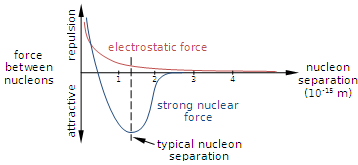
- Forces in nucleus
- EM force
- causes protons to repel each other
- Gravitational force
- all nucleons attract to each other due to mass
- EM>>> gravitational force
- SNF
- Overcomes EM force
- short range
- Overcomes EM force
- EM force
- Forces in nucleus
- Atom
Nuclear Decay
- bigger nucleus=more unstable
- emit particles to become more stable
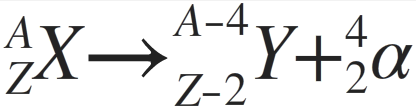
- alpha decay
- Usually happens when there are more than 82 protons
- the nucleus will emit an alpha particle
- Beta-Minus decay
- happens in isotopes that are nucleon rich
- more neutrons than protons
- neutron becomes proton and nucleus emits electron and anti-neutrino
- beta particle
- fast moving electron
- happens in isotopes that are nucleon rich
- bigger nucleus=more unstable
Hypothesis of Neutrinos
- energy of electron and nucleus after decay was < than before
- this didn't follow rule of CONSERVATION OF ENERGY
- Another particle that was neutral and almost zero mass
- this didn't follow rule of CONSERVATION OF ENERGY
- energy of electron and nucleus after decay was < than before
Photons
- Electromagnetic spectrum
- a continuous spectrum of all possible frequencies of EM
- all EM waves travel at the speed of light
- Electromagnetic Waves
- Radiation emitted by charged particles losing energy
- Consists of an oscillating electric wave and a magnetic wave
- Each burst is a packet of EM waves and is referred to as a photon
- E=hf
- E-hc/wavelength
- Electromagnetic spectrum
Antiparticles
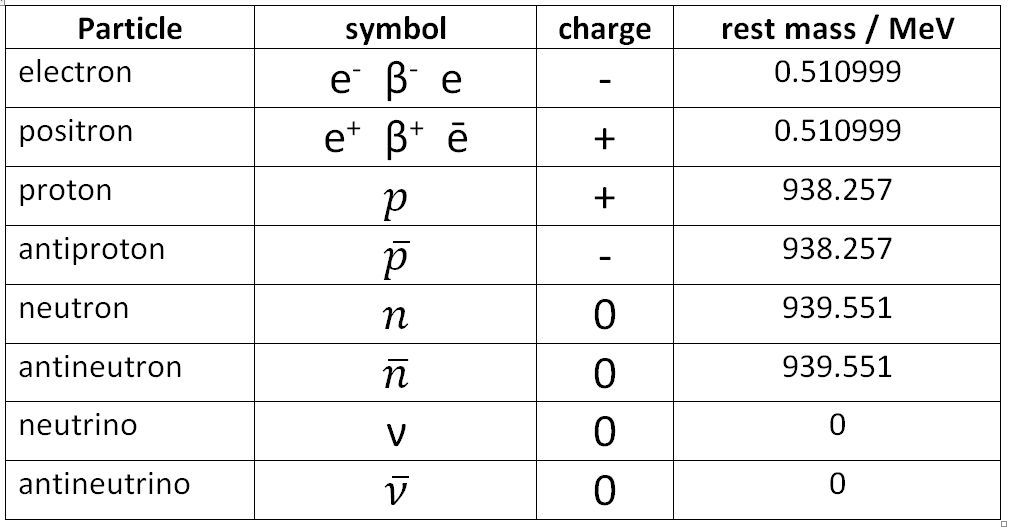
- All particles have a corresponding particle that
- has the same mass
- has the opposite charge
- annihilates its particles when they collide
- can be created along with its particle from a photon with sufficient energy
- can be seen
- in some radioactive isotopes
- in high energy collisions between particles
- in cosmic rays
- All particles have a corresponding particle that
Pair production and annihilation
- Annihilation
- when particle meets antiparticle
- masses converted into energy
- all mass + KE is converted to 2 photons of equal frequency
- Pair production
- energy converted into mass
- minimum energy needed is the total rest energy of the particle produced
- fire 2 protons with large KE at each other
- gamma ray photon -> electron positron
- PET scanner
- scintillator contains scintillator crystals that produce flash of light
- PET scanner
- Annihilation
Hadrons
- Baryons
- nucleons
- all unstable except free protons
- all decay into a proton
- protons/neutrons have a baryon number
- Mesons
- interact with baryons via strong force
- all unstable
- pion
- any charge
- proton>rest mass>electron
- kaon
- any charge
- electron>RM>PION
- Can feel SNF
- made up of quarks
- Baryons
Leptons
- fundamental particles
- interact via weak interaction, gravitational + EM
- muon
- unstable lepton
- heavy electron
- eventually decay into electron
- electron
- stable lepton
- corresponding neutrino
- 0 charge+ mass
- only take part in weak interactions
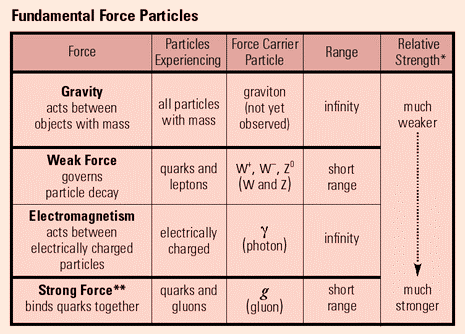
Particle Interactions
- Particle exchange
- virtual particles
- Particle exchange
Images and files in the map

Information
- Description
- Mind Map on Particle Physics, created by natasha sidhu on 07/05/2017.
- Created by
- natasha sidhu
- Views
- 9
- Rating