
Mind map
4. Change Management & Communications
Map content
4. Change Management & Communications
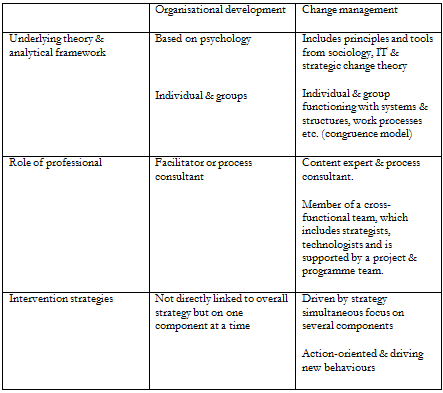
Change Management vs Organisational Development
- OD focuses on continuous improvement through business as usual
- 4 characteristics common in OD:
- 1. OD is a planned intervention, designed to improve organisational effectiveness
- 2. OD relies on a lot of psychology & concepts & research from behavioural science
- 3. OD is a long-term & continuous effort throughout the life of an organisation
- 4. OD is mostly centred on HR variables (motivation/job satisfaction) & often concerned with 1 project at a time
- 3. OD is a long-term & continuous effort throughout the life of an organisation
- 2. OD relies on a lot of psychology & concepts & research from behavioural science
- 1. OD is a planned intervention, designed to improve organisational effectiveness
- 4 characteristics common in OD:
- CM is involved with more radical and far-reaching changes and their effect on the organisation
- Types of change:
- Transformational change
- Fundamental change that involves structures, activities, personnel & often the type of produces or services delivered
- Realignment change
- Adapting or reconstructing existing structures & processes rather than changing them
- Typical implementation plan for change:
- 1. Analyse the current position & the changes required
- 2. Identify the future state required & the barriers to change that may occur
- 3. Analyse the critical change that need to be made
- 4. Identify & design the approach to change
- 5. Plan the transition path & the phasing of changes
- 6. Manage & lead the transition
- 7. Evaluate the process & communicate the outcomes
- 6. Manage & lead the transition
- 5. Plan the transition path & the phasing of changes
- 4. Identify & design the approach to change
- 3. Analyse the critical change that need to be made
- 2. Identify the future state required & the barriers to change that may occur
- 1. Analyse the current position & the changes required
- Transformational change
- OD focuses on continuous improvement through business as usual
Change Kaleidoscope
- Developed to enable managers to design a context-sensitive approach to change within their organisation
- 1. Time-how long have they got?
- 2. Scope-degree of change required
- 3. Preservation-certain things we do not want to change, such as staff commitment, high performance in a particular team, or a good reputation
- 4. Diversity-staff/team experience of change, attitude
- 5. Capability-three levels
- Individual
- Ability of individual to cope with the transition they will go through
- Managerial
- The ability of managers to help their staff through the transition process
- Organisational
- The existence of organisational resources with the knowledge & ability to manage change of the type required
- 6. Capacity-resources available for investment (budget, time, people)
- 7. Readiness-extent to which staff are aware of need to change & are ready to embrace it
- 8. Power-the amount of power that change agents have & autonomy they have
- 7. Readiness-extent to which staff are aware of need to change & are ready to embrace it
- Individual
- 5. Capability-three levels
- 4. Diversity-staff/team experience of change, attitude
- 3. Preservation-certain things we do not want to change, such as staff commitment, high performance in a particular team, or a good reputation
- 2. Scope-degree of change required
- 1. Time-how long have they got?
- Developed to enable managers to design a context-sensitive approach to change within their organisation
TROPICS test
- Predicts whether the changes required within the organisation fall into:
- 1. Soft changes-people attitude & culture paradigms
- 2. Hard changes-system process & structural issues
- 1. Soft changes-people attitude & culture paradigms
- Tool assesses:
- Perceptions
- Interest
- Control
- Source
- Control
- Interest
- Perceptions
- Predicts whether the changes required within the organisation fall into:
Change Life Cycle
- Unfreeze
- Existing mind-sets in the org are challenged, establishing need & motivation for change
- Change
- Freeze
- The new order is bedding in & being reinforced in the org, becoming the new status quo
- Stage of anxiety & confusion, where people are going through changes but do not have clear picture of future
- Freeze
- Change requires prior learning to be rejected & replaced-COGNITIVE REDEFINITION
- Unfreeze
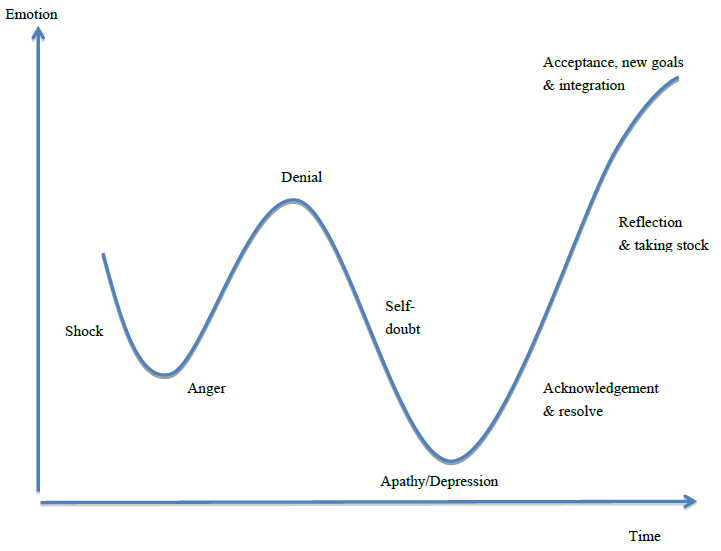
Transition Curve
- Tool designed to help to predict the way people react to change, enabling correct technique to be applied
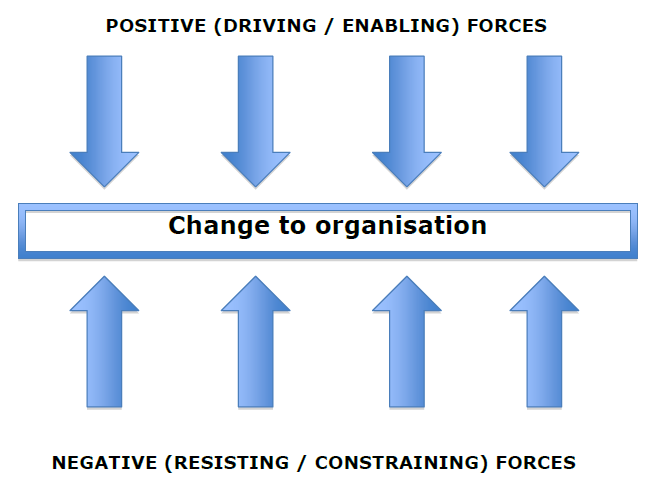
Force Field Analysis
- Tool in anticipating likely resistance to change, based on idea that situation at any given time is not static but subject to driving forces that will push/hold back the change
- Highlights concerns & provides the change leader with an idea as to which solutions to put in place
Change Agents
- Employing a change agent to manage the change process can be a useful catalyst for successful implementation of change
- Main role is to engage with all stakeholders & to sell the change & benefits to all parties
- Change agents must:
- be seen to be open & responsive to others
- be judged by org as a whole to represent all parties
- have the authority to act quickly to solve problems as they occur
- have the ability to be detached from the detail of the various change initiatives, concentrating on end results of change process as a whole
- Advantages of Internal Change Agents:
- Save time as they already know & understand the org
- Know about politics & relationships that exist
- Have access to rumour mill & can anticipate problems
- Accepted by others as looking after the interests of the org as a whole
- Quickly establish rapport & trust
- Not an additional cost
- Quickly establish rapport & trust
- Accepted by others as looking after the interests of the org as a whole
- Have access to rumour mill & can anticipate problems
- Know about politics & relationships that exist
- Save time as they already know & understand the org
- Disadvantages of Internal Change Agents:
- Subjective view due to previous role in organisation
- Over-cautious when making decisions that might ultimately affect their career
- Potentially lacking in the skills of change management
- Learning on the job inefficient
- Might get drawn back into their 'old' past
- May defer decisions to more senior leaders
- Difficulty moving back to original role after the change process
- May defer decisions to more senior leaders
- Might get drawn back into their 'old' past
- Learning on the job inefficient
- Potentially lacking in the skills of change management
- Over-cautious when making decisions that might ultimately affect their career
- Subjective view due to previous role in organisation
- Advantages of External Change Agents
- Specialist knowledge & skills
- Objective view point
- Specific help on a temporary basis
- Access to expert opinion
- Have done it before & can participate problems & issues
- Highly competent project management skills
- Can make the difficult choices
- Can transfer knowledge to the organisation for future change
- Can make the difficult choices
- Highly competent project management skills
- Have done it before & can participate problems & issues
- Access to expert opinion
- Specific help on a temporary basis
- Objective view point
- Specialist knowledge & skills
- Disadvantages of External Change Agents
- Need time to get to know the organisation
- Members of the org may be wary of outsiders
- Perceived as not having loyalty to the organisation
- Feeling that if negative things happen they can just leave
- Cost
- May not have time available to manage unforeseen consequences if moving on to next job
- Cost
- Feeling that if negative things happen they can just leave
- Perceived as not having loyalty to the organisation
- Members of the org may be wary of outsiders
- Need time to get to know the organisation
Images and files in the map
Information
- Description
- CIPFA Strategic Leadership Mind Map on 4. Change Management & Communications, created by colinmillar on 18/05/2014.
- Created by
- colinmillar
- Views
- 30
- Rating