
Mind map
Bowlby's attachment theory
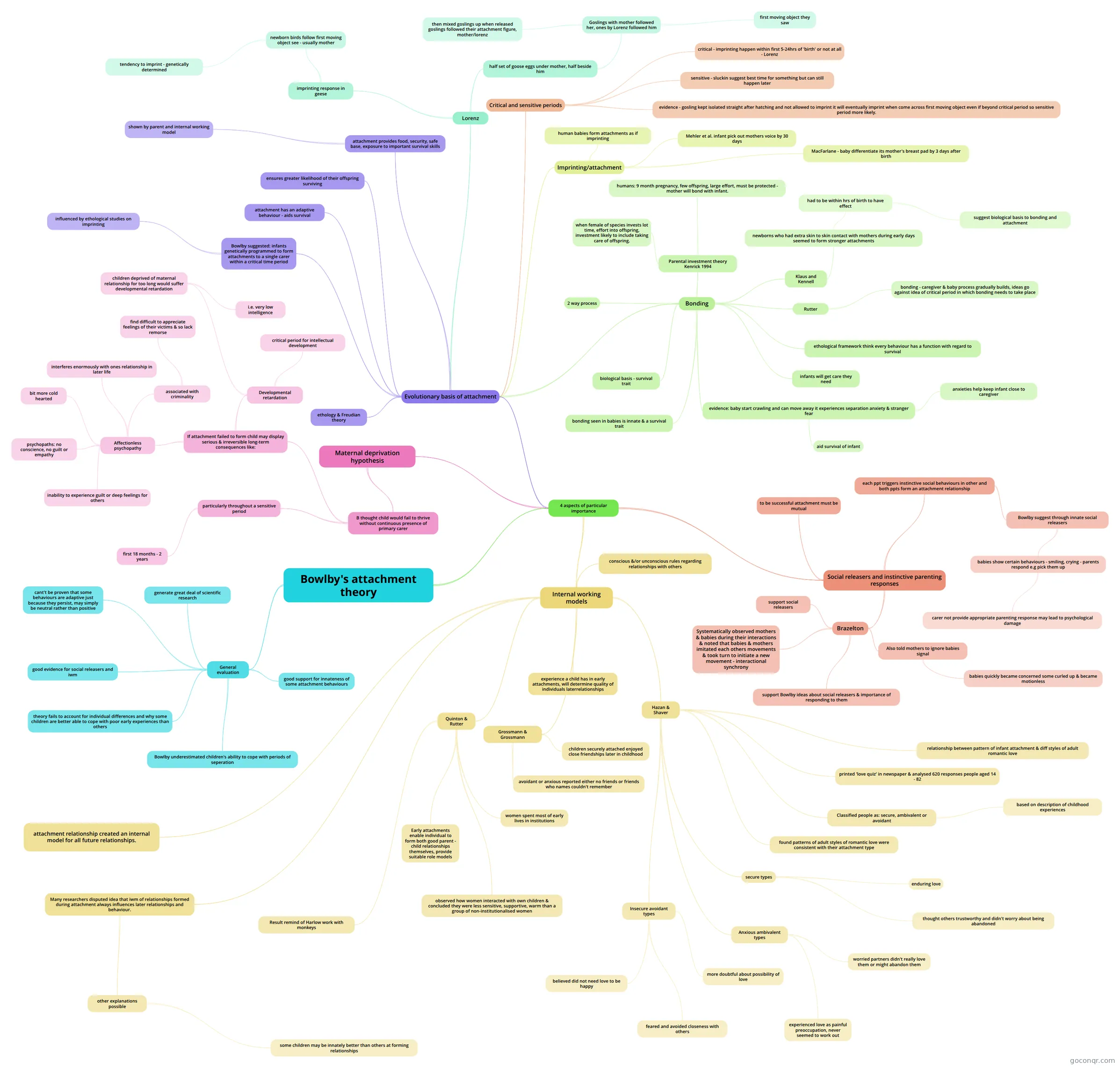
Mind map: Bowlby's attachment theory
Map content
Bowlby's attachment theory
4 aspects of particular importance
- Maternal deprivation hypothesis
- B thought child would fail to thrive without continuous presence of primary carer
- particularly throughout a sensitive period
- first 18 months - 2 years
- If attachment failed to form child may display serious & irreversible long-term consequences like:
- Affectionless psychopathy
- bit more cold hearted
- psychopaths: no conscience, no guilt or empathy
- inability to experience guilt or deep feelings for others
- interferes enormously with ones relationship in later life
- associated with criminality
- find difficult to appreciate feelings of their victims & so lack remorse
- Developmental retardation
- critical period for intellectual development
- children deprived of maternal relationship for too long would suffer developmental retardation
- i.e. very low intelligence
- Affectionless psychopathy
- particularly throughout a sensitive period
- B thought child would fail to thrive without continuous presence of primary carer
- Evolutionary basis of attachment
- ethology & Freudian theory
- Bowlby suggested: infants genetically programmed to form attachments to a single carer within a critical time period
- influenced by ethological studies on imprinting
- attachment has an adaptive behaviour - aids survival
- attachment provides food, security, safe base, exposure to important survival skills
- shown by parent and internal working model
- ensures greater likelihood of their offspring surviving
- Lorenz
- imprinting response in geese
- newborn birds follow first moving object see - usually mother
- tendency to imprint - genetically determined
- newborn birds follow first moving object see - usually mother
- half set of goose eggs under mother, half beside him
- Goslings with mother followed her, ones by Lorenz followed him
- first moving object they saw
- then mixed goslings up when released goslings followed their attachment figure, mother/lorenz
- Goslings with mother followed her, ones by Lorenz followed him
- imprinting response in geese
- Critical and sensitive periods
- critical - imprinting happen within first 5-24hrs of 'birth' or not at all - Lorenz
- sensitive - sluckin suggest best time for something but can still happen later
- evidence - gosling kept isolated straight after hatching and not allowed to imprint it will eventually imprint when come across first moving object even if beyond critical period so sensitive period more likely.
- Imprinting/attachment
- human babies form attachments as if imprinting
- MacFarlane - baby differentiate its mother's breast pad by 3 days after birth
- Mehler et al. infant pick out mothers voice by 30 days
- Bonding
- 2 way process
- Parental investment theory Kenrick 1994
- when female of species invests lot time, effort into offspring, investment likely to include taking care of offspring.
- humans: 9 month pregnancy, few offspring, large effort, must be protected - mother will bond with infant.
- Klaus and Kennell
- newborns who had extra skin to skin contact with mothers during early days seemed to form stronger attachments
- had to be within hrs of birth to have effect
- suggest biological basis to bonding and attachment
- had to be within hrs of birth to have effect
- newborns who had extra skin to skin contact with mothers during early days seemed to form stronger attachments
- Rutter
- bonding - caregiver & baby process gradually builds, ideas go against idea of critical period in which bonding needs to take place
- biological basis - survival trait
- ethological framework think every behaviour has a function with regard to survival
- bonding seen in babies is innate & a survival trait
- infants will get care they need
- evidence: baby start crawling and can move away it experiences separation anxiety & stranger fear
- anxieties help keep infant close to caregiver
- aid survival of infant
- Social releasers and instinctive parenting responses
- to be successful attachment must be mutual
- each ppt triggers instinctive social behaviours in other and both ppts form an attachment relationship
- Bowlby suggest through innate social releasers
- babies show certain behaviours - smiling, crying - parents respond e.g pick them up
- carer not provide appropriate parenting response may lead to psychological damage
- babies show certain behaviours - smiling, crying - parents respond e.g pick them up
- Bowlby suggest through innate social releasers
- Brazelton
- support social releasers
- Systematically observed mothers & babies during their interactions & noted that babies & mothers imitated each others movements & took turn to initiate a new movement - interactional synchrony
- Also told mothers to ignore babies signal
- babies quickly became concerned some curled up & became motionless
- support Bowlby ideas about social releasers & importance of responding to them
- Internal working models
- attachment relationship created an internal model for all future relationships.
- conscious &/or unconscious rules regarding relationships with others
- experience a child has in early attachments, will determine quality of individuals laterrelationships
- Grossmann & Grossmann
- children securely attached enjoyed close friendships later in childhood
- avoidant or anxious reported either no friends or friends who names couldn't remember
- Hazan & Shaver
- relationship between pattern of infant attachment & diff styles of adult romantic love
- printed 'love quiz' in newspaper & analysed 620 responses people aged 14 - 82
- Classified people as: secure, ambivalent or avoidant
- based on description of childhood experiences
- found patterns of adult styles of romantic love were consistent with their attachment type
- secure types
- enduring love
- thought others trustworthy and didn't worry about being abandoned
- Anxious ambivalent types
- experienced love as painful preoccupation, never seemed to work out
- worried partners didn't really love them or might abandon them
- Insecure avoidant types
- more doubtful about possibility of love
- feared and avoided closeness with others
- believed did not need love to be happy
- Quinton & Rutter
- women spent most of early lives in institutions
- observed how women interacted with own children & concluded they were less sensitive, supportive, warm than a group of non-institutionalised women
- Result remind of Harlow work with monkeys
- Early attachments enable individual to form both good parent - child relationships themselves, provide suitable role models
- Many researchers disputed idea that iwm of relationships formed during attachment always influences later relationships and behaviour.
- other explanations possible
- some children may be innately better than others at forming relationships
- other explanations possible
- Maternal deprivation hypothesis
General evaluation
- generate great deal of scientific research
- good support for innateness of some attachment behaviours
- cant't be proven that some behaviours are adaptive just because they persist, may simply be neutral rather than positive
- good evidence for social releasers and iwm
- theory fails to account for individual differences and why some children are better able to cope with poor early experiences than others
- Bowlby underestimated children's ability to cope with periods of seperation
Information
- Description
- Mind Map on Bowlby's attachment theory, created by Bethan Davies on 21/05/2014.
- Created by
- Bethan Davies
- Views
- 32
- Rating
More on Bowlby's monotropic theory